The Orchestra Kid
Fable
Ages 6–8 · 10 min
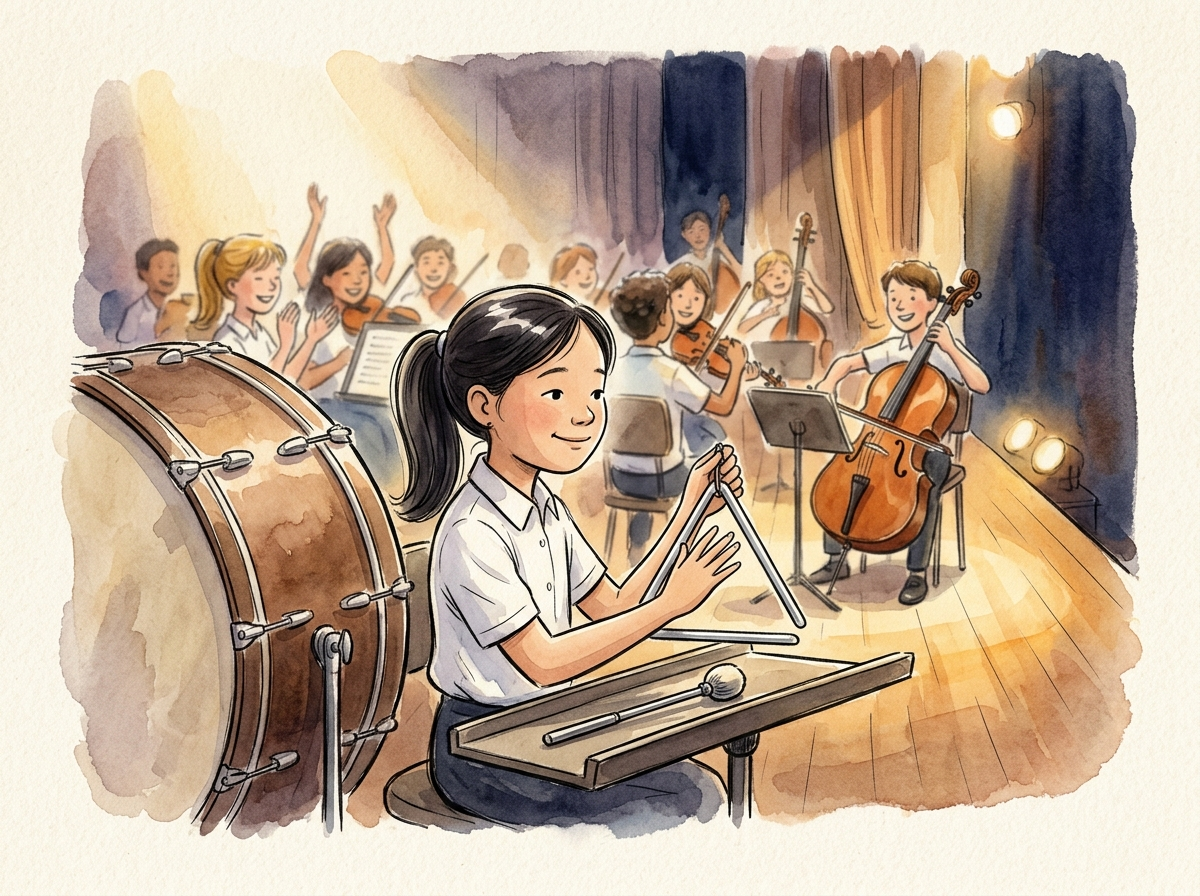
In the school orchestra's big Spring Concert, Harriet Chen's entire part is to play just two single notes on the triangle.
Harriet Chen played the triangle.
Not the drums, which got to boom and crash through every single song. Not the flute, which got to dance and twirl its notes up high like birds. Not the cello, which got to hum deep and warm like a sleeping bear.
Harriet Chen played the triangle.
Not the drums, which got to boom and crash through every single song. Not the flute, which got to dance and twirl its notes up high like birds. Not the cello, which got to hum deep and warm like a sleeping bear.
The triangle.
It was a small, shiny piece of metal that hung from a string. And Harriet got to hit it exactly two times in the entire Spring Concert.
Ting.
And then, four whole pages of music later:
Ting.
That was it. That was the whole thing.
"Two notes?" said her best friend Marco, who played the trumpet. Marco had one hundred and forty-seven notes. He had counted. "What do you even practice?"
Harriet shrugged. "My two notes."
And she meant it.
The first week, Harriet brought her triangle home and hung it from the little hook on her music stand in her bedroom. She picked up the metal stick — it was called a beater, which she thought was a wonderful name — and she hit the triangle.
Tink.
No. That wasn't right. It sounded thin and pinchy, like a fork accidentally falling on the floor.
She tried again.
TANG.
Too hard. That sounded like she was angry at the triangle, and she wasn't. She liked the triangle.
She tried softer.
ting.
Too quiet. Like a secret nobody would hear.
She closed her eyes and thought about what her note was supposed to do. In the music, her first ting came right after the violins played a long, beautiful, sweeping part — all those bows sliding across strings at the same time — and then everything went silent. One whole beat of silence. And then: Harriet.
Her note was supposed to be like a single star appearing in an empty sky.
She lifted the beater. She breathed in. She let the breath out slowly, and at the very bottom of the breath, she struck.
Ting.
Oh.
That was closer. That was much closer.
She did it again. And again. And again and again and again.
Her dad poked his head into her room after forty-five minutes. "You doing okay in here, Harriet?"
"Practicing," she said.
He listened for a moment. She struck the triangle.
Ting.
"Sounds great," he said, and he said it the way he said most things, which was kindly, but she could tell he wasn't sure what he was listening for.
That was okay. Harriet was sure.
The second month, things got more complicated.
At rehearsal, Mr. Kapoor, the music teacher, kept stopping the orchestra to fix things. The flutes were too fast. The trumpets were too loud. Marco made a face. The cellos kept losing their place.
Nobody ever stopped to fix Harriet, because Harriet only had two notes and hadn't played them wrong yet. But she also hadn't played them perfectly yet, and she knew the difference.
At home, she practiced her timing. She set a metronome on her desk — tick, tick, tick, tick — and she counted the beats leading up to her moment. She had to come in on beat three of measure forty-two. Not early. Not late. Right exactly perfectly on beat three.
She practiced waiting. Waiting, it turned out, was the hardest part. Forty-one and a half measures of waiting, with nothing to do but count and listen and be ready. Her fingers got twitchy. Her brain got wandery. One time she started thinking about whether penguins had knees and almost missed her note entirely.
So she practiced being patient. She practiced paying attention. She practiced sitting still with the beater in her hand and her ears wide open, following the music like a hawk watching the ground from high, high up — calm and steady, and then, at exactly the right moment:
Ting.
Yes.
The second note was different from the first. It came near the very end, after a loud, joyful, crashing part with every instrument playing at once, and then — just like before — sudden silence. But this time the silence was bigger. Fuller. Like the whole room was holding its breath. And Harriet's note was the last sound in the entire concert.
That note had to feel like a goodbye.
She practiced it until her mom gently said, "Harriet, honey, it's nine-thirty."
"One more," Harriet said.
Ting.
She frowned. "One more."
Ting.
She tilted her head. "...One more."
The third month — the week before the concert — Marco leaned over during rehearsal and whispered, "Are you seriously still practicing at home?"
"Every day," Harriet said.
"But it's two notes."
"It's two important notes."
Marco scrunched up his face like he didn't understand, but he didn't say anything mean about it because Marco was a good friend, even when he was confused.
The night before the concert, Harriet laid her concert outfit on her chair — black pants, white shirt, just like everyone else. She polished her triangle with a soft cloth until it gleamed. She ran her thumb along the beater.
She wasn't nervous, exactly. She was something else. She was ready.
The Spring Concert was in the school gym, which had been decorated with paper streamers and wobbly music note cutouts made by the kindergartners. The chairs were filled with parents and grandparents and little brothers who wouldn't sit still. The lights were bright, and then they were dimmed, and Mr. Kapoor walked out, and everybody clapped.
The orchestra sat in their chairs. Harriet was at the back, behind the bass drum, behind the xylophones, in the very last row. She could barely see the audience, and the audience could barely see her.
That was fine.
Mr. Kapoor raised his baton.
The music began.
The cellos hummed. The flutes climbed. Marco and the trumpets came in with a bold, bright blast that made the little brothers in the audience sit up straight. The violins sang and swayed. It sounded good — not perfect, because a boy in the second row lost his place for a second, and one of the flutes squeaked — but it sounded real and alive, and the parents were smiling.
Harriet counted.
Measure thirty-six. Thirty-seven. Thirty-eight.
Her heart beat steady.
Thirty-nine. Forty.
The violins rose up into their big, sweeping, beautiful part, all those bows moving together like one enormous wing.
Forty-one.
The music soared and then — silence. One perfect, enormous beat of nothing.
Harriet breathed in. She let the breath fall. And right at the bottom, right on beat three of measure forty-two, she struck.
Ting.
It floated out over the gym like a single clear drop of water falling into a still pond. It hung in the air for just a moment, shining, and then the rest of the orchestra came rushing back in, and the music swelled, and the moment was gone.
But it had been there. Everyone had heard it. Harriet saw a woman in the third row close her eyes, just for a second, the way people do when something unexpected catches them right in the chest.
Harriet set the beater down softly on her knee.
Now she waited again. The music bounced and galloped and laughed. The trumpets showed off. The xylophones sparkled. Everything got louder and faster and bigger and happier until every single instrument was playing all at once in one massive, joyful, magnificent noise —
And then.
Silence.
The biggest silence of all. The whole gym went still. Even the little brothers.
Harriet lifted the beater.
She didn't rush.
Ting.
The note rose like a soap bubble — slow and round and perfect and light. It drifted up past the paper streamers and the wobbly music notes and the bright hot lights. It filled the silence completely, all by itself, this one tiny shining sound.
And then it was gone.
For one second, nobody moved.
Then the audience burst into applause.
Mr. Kapoor turned around and beamed at the whole orchestra. Marco jumped out of his seat. The flutes were hugging. Everybody was clapping and standing, and the little brothers were banging on the chairs.
In the very last row, behind the bass drum, Harriet set down her beater. She laid her hand flat against the triangle to stop it from vibrating, and she felt the last tiny buzz of it whispering against her fingers.
She smiled.
Two notes.
She had made them both count.