The One Who Stopped
Fable
Ages 6–8 · 8 min
On the road to Jericho to sell his oil and wine, a Samaritan named Tobias finds an injured man that two other people have already walked past.
The sun was already high and hot when Tobias loaded his donkey for the long walk to Jericho.
"Be careful on that road," his mother said, pressing a cloth bundle of bread and cheese into his hands. "It winds through the hills, and there are places where no one can see you."
The sun was already high and hot when Tobias loaded his donkey for the long walk to Jericho.
"Be careful on that road," his mother said, pressing a cloth bundle of bread and cheese into his hands. "It winds through the hills, and there are places where no one can see you."
"I know, Mama," Tobias said, tucking the food into his saddlebag next to the jars of oil and wine he was bringing to sell at the market.
Tobias was a Samaritan. He knew what that meant. It meant that when he walked into certain towns, people looked away. It meant that some children weren't allowed to play with him. It meant that in the eyes of many people on this very road, he was the wrong kind of person — not because of anything he had done, but simply because of where he came from.
He tried not to think about it too much. He had his donkey, Clover, who didn't care what kind of person he was. He had the warm bread in his bag. He had the road ahead.
The road to Jericho was a winding, narrow thing that cut between tall rocky cliffs. Tobias walked beside Clover, humming a song his grandmother used to sing. The shadows of the rocks stretched across the path like long fingers.
Then he saw something.
Up ahead, crumpled at the edge of the road like a pile of old cloth, was a man.
Tobias slowed. Clover's ears twitched forward.
As they got closer, Tobias could see that the man was hurt. His robe was torn. His sandals were gone. He had cuts on his face and arms, and he was lying very, very still — except for the small, shallow rise and fall of his chest.
Robbers. It had to be. They hid in these hills and waited for travelers walking alone. They had taken everything this man had and left him in the dust.
Tobias felt his stomach tighten. He looked up the road and then down it. Empty. But he noticed something in the dirt — footprints. Two sets, coming from the direction of Jerusalem, passing right by the man and continuing on.
Two people had already come this way.
Two people had already seen this man lying here.
Two people had kept walking.
Now, Tobias didn't know who those two people were. But I'll tell you.
The first was a priest — an important man who worked at the great temple. He wore fine robes and carried a scroll under his arm. When he had come around the bend and seen the beaten man lying there, he had stopped for just a moment. His eyes went wide.
Oh dear, he had thought. If I touch him and something has happened to him, I won't be allowed into the temple. I have important work to do. Surely someone else will come along. Someone whose job it is to help.
And the priest had crossed to the far side of the road, walked a wide circle around the man, and hurried on his way. He walked a little faster than before.
The second was a Levite — a man who helped at the temple and knew all the rules and laws by heart. He was the kind of man who could tell you exactly what was right and what was wrong.
When the Levite had seen the man on the ground, he had actually walked closer. He had leaned down and looked. He had seen the blood. He had heard the man's ragged breathing.
This is terrible, he had thought. But what if the robbers are still nearby? What if this is a trap? I can't risk it. Besides, I'm expected in Jericho by sundown. Someone else will stop. Someone braver.
And the Levite had straightened up, brushed off his knees, and walked on.
So now it was Tobias.
Tobias, the Samaritan. The one people whispered about. The one shopkeepers watched with suspicious eyes. The one other children had called names he tried very hard to forget.
He stood on the road and looked at the man lying in the dirt.
Tobias knew — he knew — that this man was probably someone who would cross the street to avoid him on any normal day. This was a man from Judea, he could tell by what was left of his clothing. A man who might call Tobias "outsider" or worse.
A small voice inside him said: Keep walking. He wouldn't stop for you.
But there was another voice too, a quieter one, down deep. It said something much simpler.
He's hurt.
Tobias stepped off the road and knelt beside the man.
"Hey," he said softly. "Can you hear me?"
The man groaned. One eye opened, just barely. When he saw Tobias's face — when he saw the Samaritan cloth around his shoulders — something flickered across his expression. Confusion, maybe. Or fear.
"It's all right," Tobias said. "I'm going to help you."
He went to Clover's saddlebag and pulled out the jar of oil and the jar of wine — the ones he was supposed to sell at market. The oil was worth two days' wages. The wine, even more.
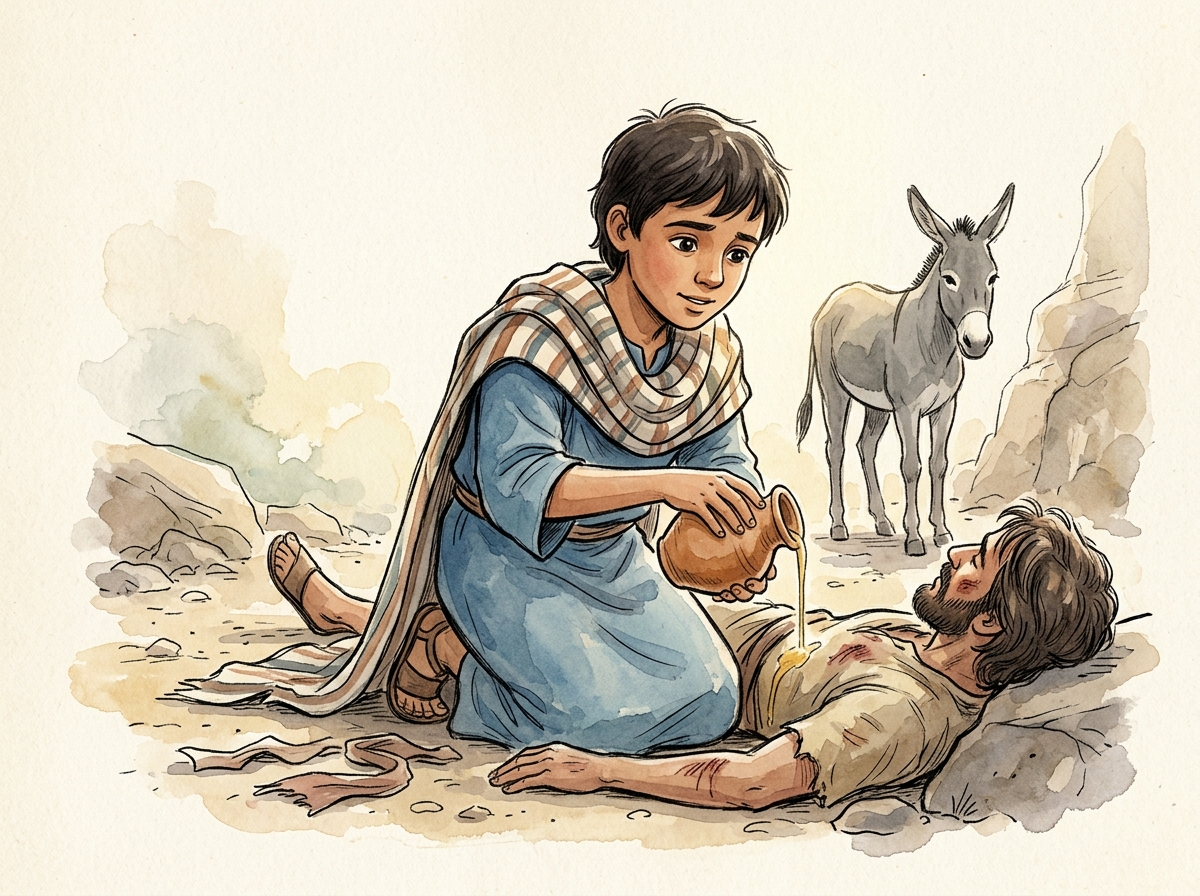
Tobias didn't hesitate. He poured the oil gently over the man's wounds. It would keep them clean and help them heal. Then he poured a little wine to wash away the dirt. The man winced and sucked in air through his teeth.
"I'm sorry," Tobias said. "I know it stings."
He tore strips from his own cloak — his good cloak, the one his mother had woven — and wrapped them carefully around the man's cuts. He worked slowly, the way he had seen his mother tend to his little brother's scraped knees. Gently. Patiently.
When the bandages were tied, Tobias put his arms under the man and lifted. The man was heavy, and Tobias was not especially big, but he managed. He set the man on Clover's back and held him steady so he wouldn't fall.
"Come on, girl," he said to Clover. "Nice and easy."
They walked like that for miles. Tobias held the man up with one arm and guided Clover with the other. The sun beat down. His shoulders ached. His water was running low. But he kept going.
When they finally reached the inn at the bottom of the hills, Tobias was drenched in sweat and his legs were shaking. He called to the innkeeper, a round woman with flour on her apron.
"This man was attacked on the road," Tobias said. "He needs a bed and food and someone to look after him."
The innkeeper looked at Tobias. She looked at his Samaritan clothing. For a moment, her expression was hard to read. Then she looked at the man draped over the donkey, barely conscious, and she nodded.
They carried him inside together and laid him on a bed. Tobias brought water and helped the man drink, tilting the cup carefully against his cracked lips.
The next morning, Tobias reached into his saddlebag and pulled out two silver coins — all the money he had for his trip. He set them on the innkeeper's counter.
"Please take care of him," Tobias said. "If it costs more than this, I'll pay you back when I come through again."
The innkeeper picked up the coins and looked at Tobias for a long moment. "You don't even know him," she said.
"No," Tobias agreed. He scratched Clover behind the ears. "I don't."
He lifted his now-empty saddlebag onto his donkey. No oil to sell. No wine. No money. No good cloak. He would arrive at the Jericho market with nothing.
But as Tobias stepped back onto the road and the morning light stretched golden across the hills, he found that he was humming again — that same old song his grandmother used to sing.
And somehow, his saddlebag didn't feel empty at all.