The Night Library
Fable
Ages 6–8 · 9 min
Alone in the library after Mrs. Chen locks the door, Margot hears an argument between a princess and a knight coming from the book shelves.
Margot had a secret.
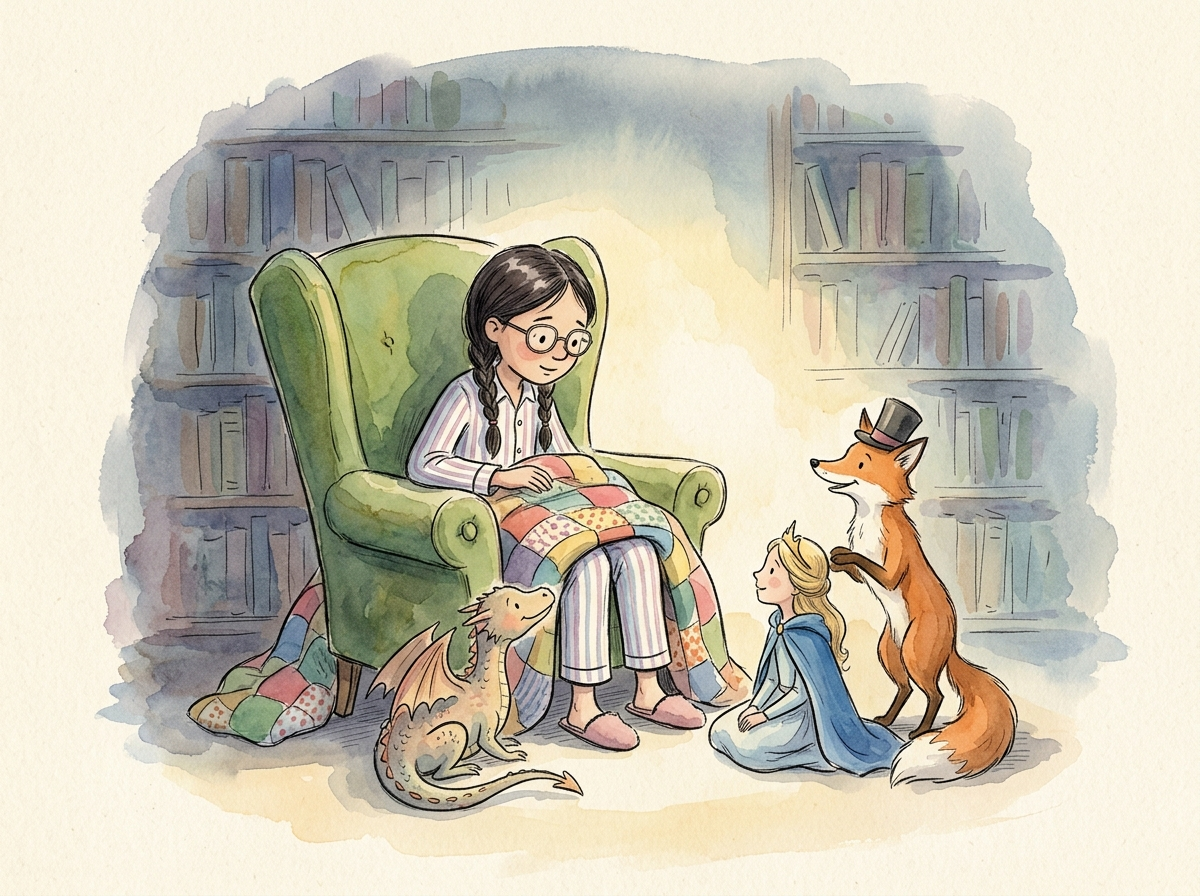
Every Tuesday and Thursday, when her mom worked the late shift at the hospital, Margot stayed at the Pinewood Public Library until closing time. Mrs. Chen, the librarian, would let Margot sit in the big green armchair in the corner with a blanket and a stack of books while she finished her shelving and paperwork.
Margot had a secret.
Every Tuesday and Thursday, when her mom worked the late shift at the hospital, Margot stayed at the Pinewood Public Library until closing time. Mrs. Chen, the librarian, would let Margot sit in the big green armchair in the corner with a blanket and a stack of books while she finished her shelving and paperwork.
But that wasn't the secret.
The secret was what happened after Mrs. Chen locked the front door.
It started on a rainy Tuesday in October. Mrs. Chen had stepped out to move her car closer to the door, and Margot was alone in the library for exactly three minutes and forty-one seconds.
That's when she heard the arguing.
"I am NOT a damsel in distress!" said a sharp voice from somewhere near the fairy tale section. "I solved the riddle of the bridge! I outsmarted the troll! And what does the author write? 'The prince arrived just in time to save her.' JUST IN TIME? I had already SAVED MYSELF!"
Margot clutched her blanket. She peeked around the armchair.
A girl about her age — but dressed in a long blue cloak with mud on her boots — was standing in the middle of the aisle, hands on her hips, fuming. Beside her, a knight in wobbly cardboard-looking armor was sitting cross-legged on the floor, eating what appeared to be a sandwich.
"She's got a point," said the knight, with his mouth full.
Margot screamed. But only a tiny scream. More of a squeak, really.
The cloaked girl spun around. "Oh! A reader. You're still here?"
"I — I'm Margot. I'm waiting for Mrs. Chen."
The girl narrowed her eyes, then broke into a grin. "I'm Princess Elara. From The Enchanted Bridge of Gloomwood. Third shelf, second row. And this useless lump is Sir Bramble."
"I am a decorated knight," Sir Bramble said, brushing crumbs off his armor. "It's not my fault the author only gave me four lines."
"Four lines and a sandwich," Elara corrected.
Margot's mouth hung open. "You're... from the books?"
"Every night after closing," Elara said, as if this were the most ordinary thing in the world. "We stretch our legs. Complain a bit. You know how it is."
Margot did not, in fact, know how it was.
But before she could say so, more characters started appearing. They climbed out of the shelves like people stepping off buses — yawning, stretching, blinking in the dim library light.
A dragon the size of a golden retriever trotted down the aisle, smoke curling from its nostrils. "Has anyone seen my other wing? Page forty-seven — the illustration is completely wrong. I look lopsided."
"At least you GET illustrations," grumbled a talking fox in a top hat. "I'm from a chapter book. No pictures at all. People think I look like a regular fox. I'm wearing a TOP HAT."
A small robot rolled past Margot's feet, beeping sadly. "My story says I cannot feel emotions. But I feel VERY emotional about that."
Margot giggled. She couldn't help it.
The characters all turned to look at her.
"She laughed," whispered the fox. "An actual reader laughed at something I said."
"Don't let it go to your head," said Elara.
Over the next hour, Margot met dozens of book characters, and every single one of them had something to say about their stories.
There was Captain Maggie Stormcloud, a pirate who was tired of only going on adventures to find treasure. "Just once," she said, leaning against the biography section, "I'd like to go on an adventure to find a really good recipe for banana bread. Is that too much to ask?"
There was a boy named Oliver from a mystery book who already knew who the villain was on page one. "It's the butler," he whispered to Margot. "It's ALWAYS the butler. I have to act surprised for two hundred pages. Do you know how exhausting that is?"
There was a grandmother character from a picture book who was upset that she only existed to bake cookies and say "dear." "I used to be a competitive swimmer," she said, flexing her arm. "But does the author mention that? No. Just cookies."
Margot listened to all of them. She sat in her big green armchair, blanket on her lap, and she listened the way she listened to everything — carefully, quietly, with her whole self. She asked questions. She nodded. She laughed when things were funny and frowned when things weren't fair.
And something amazing happened.
The characters noticed.
"You actually hear us," said the little robot, rolling up to Margot's feet. Its eyes — two small blue lights — blinked rapidly.
"Of course I hear you," Margot said.
"No," said Elara, sitting down on the floor next to her. "You hear us. That's different. Most people read our stories and think that's all we are — the words on the page. But we're more than that."
Margot thought about this. She thought about how sometimes, when she read a book, she could feel that a character wanted to say more — that there were thoughts hiding behind the words, just out of reach.
"I always wondered what you were thinking," Margot said softly. "In the parts between the sentences."
The library went very quiet.
Then the dragon said, "I think I might cry. And I'm a dragon."
"Your lopsided wing is trembling," observed the fox.
"THAT'S THE ILLUSTRATOR'S FAULT."
Margot laughed again, and this time, all the characters laughed with her.
From that night on, Tuesdays and Thursdays became the best nights of Margot's week. She'd sit in the green armchair after Mrs. Chen locked up, and the characters would come out, and they would talk.
Captain Maggie Stormcloud told Margot about the ocean — not the adventure parts, but the quiet parts. How the water looked at dawn. How the ship creaked like it was singing.
The grandmother taught Margot a card game that wasn't in her book at all, and she was ferociously competitive about it.
Oliver the mystery boy told Margot he actually wanted to be a poet. He recited a poem he'd been writing in the margins of page sixty-three when nobody was reading.
And Elara — Elara told Margot what it felt like to save yourself and have nobody notice.
"It's like shouting into a jar," Elara said, "and then someone puts the lid on."
Margot was quiet for a moment. Then she said, "I notice."
Elara smiled. Not her princess smile — the one drawn on her face in the illustrations. A real smile. One that crinkled her eyes and made her look like exactly what she was: a brave girl who just wanted to be seen.
Then one Thursday night, Margot brought a notebook.
She sat in her green armchair and asked every character the same question: "What do you wish your reader knew about you?"
And she wrote down every answer.
The fox wished people knew he was afraid of thunderstorms, even though he acted brave. The robot wished people knew it dreamed about the ocean, even though robots weren't supposed to dream. Captain Maggie wished people knew she sang to the stars when no one was listening. Sir Bramble wished people knew he made excellent sandwiches, and that was its own kind of heroism.
Margot filled seventeen pages.
When she got home that night, she put the notebook on her desk and looked at it for a long time.
Then she picked up a pencil.
She began to write a story. It was about a princess who saved herself. And a knight who made very good sandwiches. And a dragon who was beautiful even when its wings didn't match. And a grandmother who could swim faster than anyone. And a robot who dreamed about the sea.
It wasn't a perfect story. The spelling was a little wobbly, and she wasn't sure about the ending yet.
But every character in it was heard.
And somewhere, in the Pinewood Public Library, between the shelves and the silence, a girl in a blue cloak smiled a real smile.
Because finally, someone was listening.