The Museum at Night
Fable
Ages 6–8 · 10 min
A forgotten backpack leads Maya back into the museum after hours, where the Triceratops skeleton has a complaint about being stuck in the same pose since 1987.
Every Tuesday, Grandpa took Maya to the Willow Creek Museum of Natural History. Every Tuesday, they walked through the same big doors, past the same front desk, and into the same great hall where the dinosaurs stood.
And every Tuesday, Maya whispered the same thing.
Every Tuesday, Grandpa took Maya to the Willow Creek Museum of Natural History. Every Tuesday, they walked through the same big doors, past the same front desk, and into the same great hall where the dinosaurs stood.
And every Tuesday, Maya whispered the same thing.
"Do you think they move when nobody's looking?"
And every Tuesday, Grandpa whispered back, "Only one way to find out."
Well, one particular Tuesday, they found out.
It happened because Maya left her backpack under the Triceratops — the green one with the rainbow zipper that she'd had since kindergarten. She didn't notice until they were already in the parking lot, and by the time Grandpa talked to the security guard and they got back inside, the museum was closing.
"Five minutes," the guard said, holding up five fingers like maybe they didn't know what five meant.
The lights were going off, section by section. The Hall of Ocean Life went dark. The Gem Room went dark. But the great hall — the Dinosaur Hall — still had one flickering light on, right above the Triceratops.
Maya ran ahead.
And stopped.
Because the Triceratops had moved.
Not a lot. Just a little. Its massive skull had tilted to the left, and one bony leg had shifted forward about six inches.
Maya stared.
The Triceratops stared back. Which was impressive, because it didn't have eyes. Just sockets. Big, dark, empty sockets that somehow looked very, very annoyed.
"Do you mind?" said the Triceratops.
Maya's mouth dropped open.
"Your bag," the Triceratops continued, "has been leaning against my left foot for THREE HOURS. Do you have any idea what that's like? I've been standing in this exact position since 1987. The one thing I ask is that nobody leans things against my feet."
From across the hall came a deep, rattling sound — like someone laughing through a very long throat.
"Oh, here we go," muttered the Triceratops.
"Thirty-seven years!" boomed a voice from above. It was the Tyrannosaurus rex, the big one in the center of the room, the one that was posed with its jaws wide open and its tiny arms reaching forward. "Thirty-seven years in the same pose and you're complaining about a backpack?"
"At least your pose is dramatic, Harold," snapped the Triceratops. "Look at me. LOOK at me. They've got me leaning down like I'm sniffing the floor. I'm a Triceratops. I weighed twelve thousand pounds. I had three horns on my face. And they have me SNIFFING THE FLOOR."
Maya picked up her backpack very slowly.
"Um," she said. "Sorry about the bag."
"Accepted," said the Triceratops. "I'm Beatrice, by the way."
"I'm Harold," called the T. rex. "And I would love to shake your hand, but as you can see—" He wiggled his tiny arms, which barely moved. "They wired these absolutely useless things in a reaching position. I look like I'm trying to grab the last cookie on a very high shelf."
A soft clicking sound came from the back corner, where a long-necked skeleton stood so tall its head nearly touched the ceiling.
"Could everyone please keep it down?" said the Brachiosaurus. "Some of us are trying to maintain our dignity."
"Oh, please, Gwendolyn," said Harold. "You've had your neck craned toward the emergency exit since forever. You look like you're trying to leave your own exhibit."
"I AM trying to leave my own exhibit!" said Gwendolyn. "Have you seen what they put next to me? An informational plaque that says I had a brain the size of a walnut. A WALNUT. Right where every child can read it. Every single day, children walk up, read that plaque, and say, 'Wow, that's so dumb.' I have thoughts. Complex, walnut-sized thoughts, and I deserve RESPECT."
Maya giggled. She couldn't help it.
"You think this is funny?" said Beatrice.
"A little," said Maya.
"She's not wrong," said Harold. "It is a little funny."
"It is NOT funny that I have been sniffing this floor for thirty-seven years, Harold."
"Okay, but what pose would you want?" Maya asked.
The hall went quiet.
Beatrice's bones creaked as she seemed to think about it. Really think.
"Charging," she said finally. "Head up. Horns forward. Like I'm running across a field and nothing in the world could stop me. That's what I was, you know. Before I was bones in a room. I was unstoppable."
Maya looked up at Harold. "What about you?"
Harold was quiet for a moment. His big jaw shifted, just slightly.
"I think," he said, "I'd like my arms down. Relaxed. I know they're small. Everyone makes jokes. But they were mine, and I used them just fine, and I'd rather not spend eternity reaching for something I can't have."
Maya nodded. She looked at Gwendolyn.
"I'd like to face the window," Gwendolyn said quietly. "The big one, on the east wall. In the mornings, the sun comes through, and for about twenty minutes, the light hits the floor and it looks like…" She paused. "Well. It looks like outside."
Nobody said anything for a moment.
Then Grandpa's voice came from the doorway. "Maya? You find your bag?"
Maya turned. Grandpa was standing at the entrance to the great hall, squinting into the dim light. She looked back at the dinosaurs. They were perfectly still. Frozen. Just bones in the shapes that someone had chosen for them a long time ago.
But Maya could have sworn that Beatrice's skull tilted — just barely — in a kind of nod.
"Yeah," Maya said. "I found it."
She walked to Grandpa, took his hand, and they headed for the doors.
The next Tuesday, Maya brought something. She marched right up to the front desk and asked for the museum director, a tall woman named Dr. Patel who wore earrings shaped like ammonites.
"Excuse me," Maya said, holding up a piece of paper. "I have some suggestions about the dinosaur poses."
Dr. Patel raised an eyebrow. Maya unfolded the paper. She had drawn three pictures in crayon, with labels and arrows and very specific instructions.
"The Triceratops should be charging," Maya said. "Head up. Horns forward. It looks wrong sniffing the floor like that."
"And the T. rex arms should be relaxed. Down at its sides. It looks silly reaching for nothing."
"And the Brachiosaurus should face the east window."
Dr. Patel studied the drawings for a long time. She looked at Maya. She looked at Grandpa, who shrugged.
"You know," Dr. Patel said slowly, "I've thought the same thing for years."
It took four months. Maya visited every Tuesday to check the progress. Workers came with tools and wire and careful, careful hands. Bone by bone, pose by pose, the dinosaurs changed.
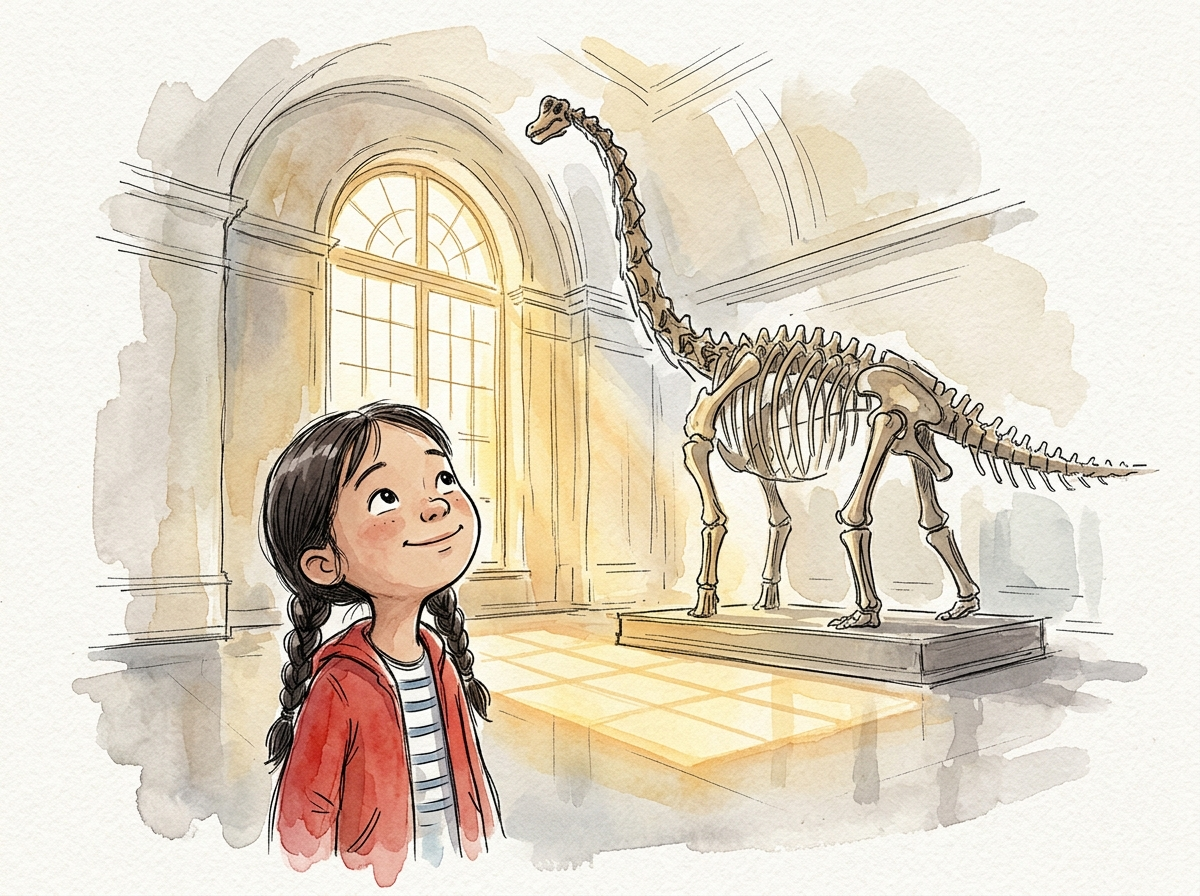
On the day the new exhibit opened, Maya stood in the great hall and looked up.
Beatrice charged across her platform, head high, horns forward, unstoppable.
Harold stood tall, his small arms resting easy at his sides, like they'd always belonged exactly as they were.
And Gwendolyn faced the east window, her long neck stretched toward the morning light that spilled across the floor like a golden field.
Maya smiled.
She didn't hear anything. The bones didn't speak. They didn't move or creak or complain.
But the Dinosaur Hall felt different now — the way a room feels when everyone in it is finally comfortable.
"Much better," Maya whispered.
And from somewhere deep inside the old museum walls, she thought she heard the faintest sound — like three very large, very ancient creatures sighing with relief.