The Mountain's Last Request
Fable
Ages 6–8 · 13 min
An ancient mountain that is crumbling away asks a girl named Indira to save the secret garden of flowers that grow only at its peak.
Indira had always known the mountain was alive.
Not alive the way her little brother Ravi was alive — noisy and sticky-fingered and always needing something. Alive in a quieter way. The way old things are alive. The mountain breathed in centuries instead of seconds, and its heartbeat was the deep rumble of stone settling against stone.
Indira had always known the mountain was alive.
Not alive the way her little brother Ravi was alive — noisy and sticky-fingered and always needing something. Alive in a quieter way. The way old things are alive. The mountain breathed in centuries instead of seconds, and its heartbeat was the deep rumble of stone settling against stone.
Their village sat in the palm of the mountain's southern slope, tucked between two ridges that curved like gentle fingers. Indira's family had lived there for as long as anyone could remember, which — according to her grandmother — was a very long time indeed.
It was Indira who first heard the voice.
She was climbing the eastern trail one Saturday morning, the one that wound up past the waterfall that had slowed to a trickle over the years. She liked to collect interesting rocks — not for any scientific reason, just because they felt important in her hand, like small pieces of a larger sentence she was still learning to read.
She had just picked up a piece of red sandstone, smooth as a worry stone, when the ground beneath her feet sighed.
Not shifted. Not rumbled. Sighed.
And then a voice rose up around her, not from any direction in particular, but from everywhere — from the soil and the stones and the roots of the old pine trees. It was deep and cracked and gentle, like the sound a canyon might make if it tried to whisper.
"Little one," the mountain said. "I have been waiting for someone who would listen."
Indira stood completely still. Her heart hammered. The rock in her hand suddenly felt warm.
"I'm listening," she said, because she was the kind of person who, when something extraordinary happened, decided to be brave about it.
"I am old," the mountain said. "Older than the river. Older than the forest. And I am crumbling."
Indira looked around. She had noticed, actually — though she'd never quite put words to it. The trails that used to be wide were narrow now. The cliff face on the north side had lost great chunks last spring. The waterfall barely ran because the channel that fed it had collapsed somewhere higher up. The mountain was eroding, piece by piece, year by year, wearing away like a bar of soap left in the rain.
"I know," she said softly.
"One day I will be a hill," the mountain said. "And then a ridge. And then just a gentle rise in the earth that no one will think much about. That is the way of things, and I have made my peace with it."
The wind moved through the pines, and Indira waited, because she could tell the mountain wasn't finished.
"But there is one thing I would like done before I go."
"What is it?"
"At my peak, there is a garden."
Indira blinked. "A garden? At the top?"
"I grew it over three hundred years. A pocket of soil in the crater at my summit, sheltered from the worst of the wind. There are flowers there that grow nowhere else in the world. Small ones. Blue and gold, with roots as fine as hair. They have lived with me since before your village existed."
Indira felt a strange tightness in her chest.
"The soil is washing away," the mountain continued. "Another winter, maybe two, and the crater will crack and drain, and the garden will be gone. I have held on as long as I can. But stone is not as strong as people think."
"What do you want me to do?"
"Move them. Carry the flowers somewhere they can keep growing. Somewhere they will be tended."
Indira looked up toward the peak, which disappeared into a thin veil of cloud. She had never climbed all the way to the top. Her parents said the upper trails were too dangerous now — too much loose rock, too many places where the path had fallen away.
"I'll need help," she said.
"Yes," the mountain agreed. "You will."
Telling her family went about as well as you'd expect.
"The mountain talked to you," her father said, slowly, in the voice he used when Ravi claimed a dinosaur was living under his bed.
"I know how it sounds, Papa."
"A talking mountain," her mother repeated, exchanging a look with her father.
"It needs our help. There's a garden at the top — flowers that don't grow anywhere else — and they're going to be destroyed if someone doesn't move them."
Her grandmother, who had been sitting quietly in the corner shelling peas, looked up. "What did the voice sound like?"
Everyone turned to her.
"Like stones in a river," Indira said. "Like something very old trying to be gentle."
Her grandmother nodded, as though this confirmed something she had suspected for a very long time. "My grandmother used to say the mountain speaks to those who carry its rocks in their pockets." She looked at the red sandstone Indira had set on the kitchen table. "I always thought she was being poetic."
"Amma, you can't be serious," Indira's father said.
"There's a simple way to settle it," her grandmother replied. "Climb up and see if there's a garden."
They set out the next morning — all of them, even Ravi, who rode on their father's back when the trail got steep. Their grandmother stayed behind but packed them food and tucked small cotton pouches into Indira's backpack. "For the roots," she said. "Wrap them in damp cloth and they'll survive the journey down."
The lower trails were fine. Familiar. But above the tree line, things changed. The path grew narrow and crumbly, and twice they had to scramble over sections where it had simply vanished — replaced by a slope of loose gravel that shifted and whispered under their feet.
"Careful," the mountain murmured beneath them, and Indira's father froze.
"Did you—" he started.
"I told you," Indira said.
Her mother grabbed her father's arm. "Just keep climbing, Deepak."
It took them four hours to reach the summit. The last stretch was a scramble up a rocky spine where the wind tried to shove them sideways. Ravi clung to their father like a baby monkey, eyes wide, absolutely delighted by the whole thing.
And then they crested the final ridge, and they saw it.
The crater was small — no bigger than their living room. It was sheltered on three sides by walls of ancient rock, and in the center, in a basin of dark, rich soil, was the garden.
Indira's mother made a sound — a small, involuntary "oh" — and pressed her hand to her mouth.
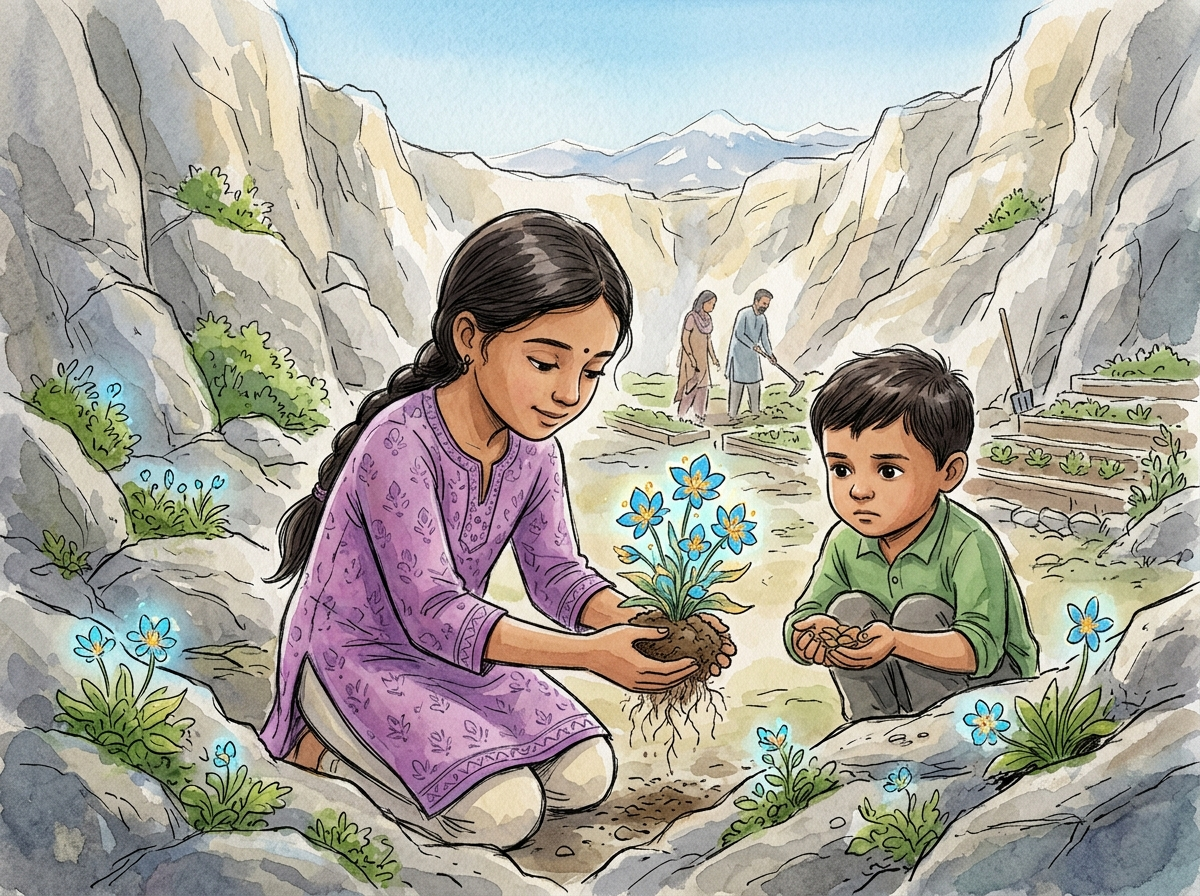
The flowers were everywhere. Tiny ones, smaller than Indira's thumbnail, carpeting the soil in waves of deep blue and bright gold. They grew in spiraling patterns, like little galaxies, and they seemed to catch the light in a way that made them glow. Between them, delicate green stems held seed pods that rattled softly in the breeze like the world's tiniest wind chimes.
"They're beautiful," Indira whispered.
"They are the last of their kind," the mountain said, and this time everyone heard it. Ravi gasped. Indira's father sat down heavily on a rock.
"We'll take them," Indira's mother said, her voice firm and practical, the way it got when she had decided something. She was already kneeling, examining the soil, testing its texture between her fingers. "We'll need to match this soil. It's volcanic, mineral-rich. Indira, hand me those pouches."
They worked for hours. Carefully, so carefully, they lifted clumps of flowers with their roots intact, wrapping them in damp cotton, nestling them into the backpacks between layers of soft clothing. Indira's father dug with steady hands. Her mother organized everything with the precision of someone who had kept a kitchen garden alive through three droughts. Even Ravi helped, carrying tiny seed pods in his cupped hands as though they were baby birds, walking with exaggerated caution that would have been funny if it hadn't been so earnest.
Indira worked closest to the center of the garden, and as she lifted the last cluster of gold flowers, she felt the mountain exhale beneath her. The stone was warm under her knees.
"Thank you," the mountain said. The voice was quieter now. Tired.
"Will you be okay?" Indira asked, and immediately felt silly, because the mountain had already told her the answer.
"I will be something new," the mountain said. "That is not the same as not being okay."
Indira held the flowers against her chest. Their roots dangled, delicate as thread, reaching for soil that wasn't there yet.
They planted the garden behind their house, in a plot Indira's mother prepared with volcanic soil they hauled from the mountain's base. Her grandmother built a low stone wall around it using — at her insistence — rocks from the mountain itself. "So it can still feel them growing," she said.
That first week, Indira checked the flowers every morning before school and every evening after. She checked if the soil was moist enough, if the light was right, if any stems were wilting. Most weren't. A few were. She moved those to shadier spots and whispered encouragement that she would deny if anyone asked about.
By spring, the garden had doubled.
The blue and gold flowers spilled over the stone wall and crept along the path to the front door. Neighbors stopped to stare. Ravi appointed himself the official garden waterer, a job he performed with a battered tin cup and tremendous seriousness.
Sometimes Indira climbed to the ridge above the village and looked up at the mountain. It was different now. Lower on one side where a whole section had slid away. Softer in outline. The crater at the top had cracked open, just as the mountain had predicted, and rain poured through it unchecked.
But in the village below, the flowers bloomed.
Other families asked for seeds. Indira showed them how to prepare the soil, how to plant the roots just deep enough, how to shelter the tiny stems from harsh wind. Within a year, the flowers grew in gardens all across the village — blue and gold, spiraling like little galaxies, catching the light.
And on quiet mornings, when Indira knelt in the dirt with her hands buried in warm soil, she could swear she felt something deep below — not a voice exactly, but a hum. A slow, contented vibration, like an old heart still beating, grateful and steady, in the bones of the earth.