The Map That Lied
Fable
Ages 6–8 · 9 min
An old map from a library book promises Soren a whispering forest, but it leads him to a familiar stone wall where no trees have ever grown.
Soren found the map on a Tuesday, which was already a strange day because his sandwich had been cut into triangles instead of rectangles, and his left shoe had come untied four times before lunch.
The map was tucked inside a library book about volcanoes. It was drawn on paper that felt soft and old, like it had been folded and unfolded a hundred times by a hundred different hands. There were little ink drawings of mountains and rivers and dotted paths, and right in the middle — marked with a bright red circle — was a forest.
Soren found the map on a Tuesday, which was already a strange day because his sandwich had been cut into triangles instead of rectangles, and his left shoe had come untied four times before lunch.
The map was tucked inside a library book about volcanoes. It was drawn on paper that felt soft and old, like it had been folded and unfolded a hundred times by a hundred different hands. There were little ink drawings of mountains and rivers and dotted paths, and right in the middle — marked with a bright red circle — was a forest.
Not just any forest. The map said, in tiny curling letters: The Whispering Forest of Extraordinarily Tall Trees.
And according to the map, this forest was exactly three blocks from Soren's house, right where Maple Street met the old stone wall behind the hardware store.
Soren knew that spot. He walked past it every single day. There was no forest there. There wasn't even a bush.
But a map was a map.
So after school, Soren followed it.
He turned left at the big oak tree — just like the map showed. He walked along the cracked sidewalk past Mrs. Huang's house with the wind chimes — just like the map showed. He counted fourteen steps past the fire hydrant — just like the map showed.
And then he arrived at Maple Street, right where it met the old stone wall behind the hardware store.
No forest.
No extraordinarily tall trees.
No whispering of any kind.
Just the wall, gray and plain, with moss creeping along the bottom and one very bored-looking pigeon sitting on top.
"Well," Soren said to the pigeon, "that's disappointing."
The pigeon blinked.
Soren looked at the map again. He turned it upside down. He turned it sideways. He held it up to the light. And that's when he noticed something he hadn't seen before — a tiny arrow near the red circle, pointing down, with the words: Look closer.
So Soren looked closer.
He walked right up to the old stone wall and pressed his nose almost against it. The stones were rough and gray and very ordinary. But down near the bottom, hidden behind a curtain of moss, there was something that was not ordinary at all.
A door.
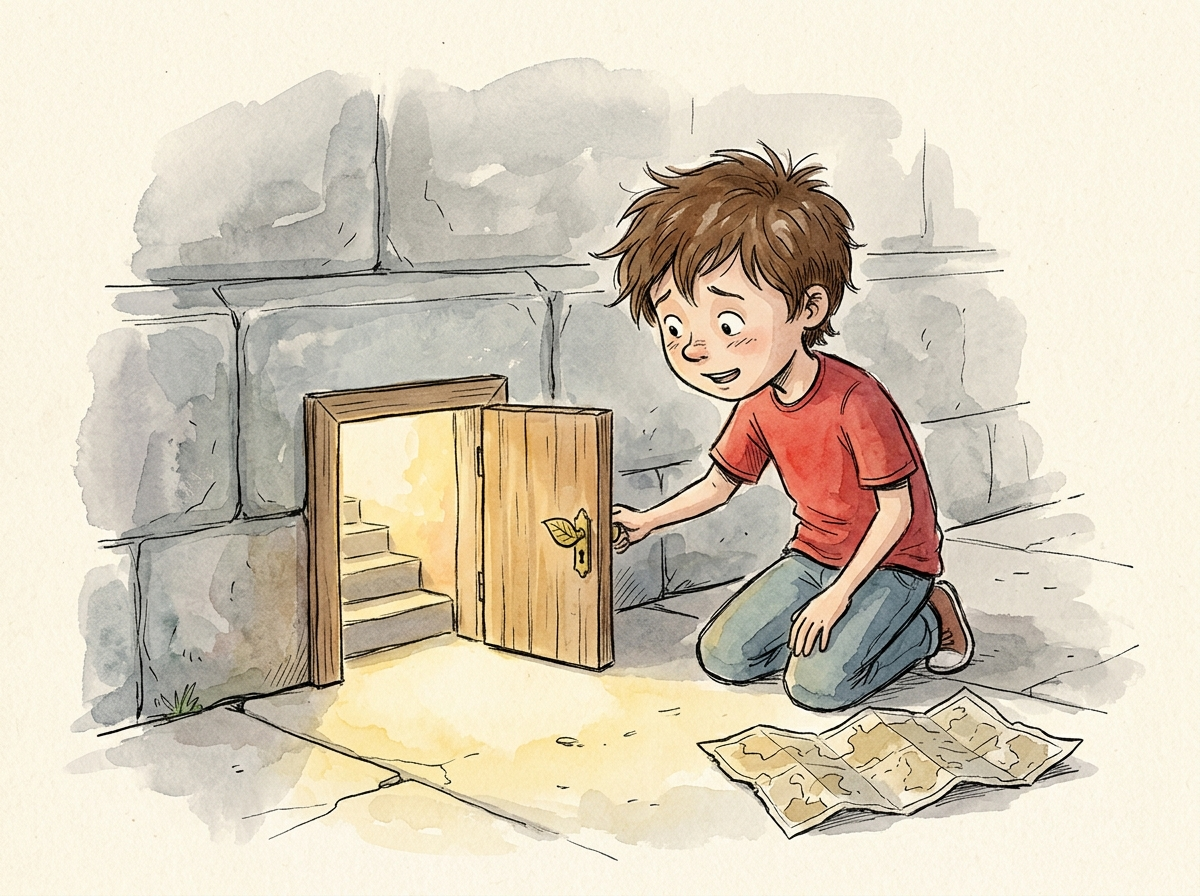
It was small — not much bigger than a cereal box — and made of dark wood with a tiny brass handle shaped like a curling leaf.
Soren's heart began to beat in a way that felt like running even though he was standing still.
He reached down and pulled the little handle.
The door swung open.
Behind it was not a forest. Behind it was a set of stone steps, going down into soft golden light.
Now, Soren was not the kind of kid who rushed into things. He was the kind of kid who read the instructions before building the Lego set. He was the kind of kid who looked both ways twice. He was the kind of kid who once spent twenty minutes deciding between chocolate and vanilla — and then chose strawberry.
But the golden light was very warm. And it smelled like pine needles and rain.
He went down.
The steps were just the right size for his feet, which was comforting. There were seven of them, and at the bottom, Soren stepped into a round room with walls made of earth and roots. Lanterns hung from the twisted ceiling, glowing amber. And in the middle of the room sat a fox.
Not a regular fox. This fox was wearing spectacles and sitting at a desk covered in papers and maps — dozens of maps, maybe hundreds, all different sizes, all spread out and overlapping and pinned to the walls.
"Ah," said the fox, peering over the spectacles. "You found the door."
"The map said there'd be a forest," Soren said, because it seemed important to mention.
"Did it?" The fox picked up Soren's map and examined it. "Hmm. Yes. Well. The forest was here. Seventy years ago. Extraordinary trees, every one of them. They whispered the most wonderful things. Mostly jokes, actually. Trees have a terrific sense of humor."
"So the map is wrong," Soren said.
The fox tilted its head. "The map is old. There's a difference. When this map was drawn, everything on it was true. The forest was real. The river on the east side — you see it there? — that dried up forty years ago. And the mountain to the north got shorter after a big storm. Things change." The fox set the map down gently. "Maps show you where things were. It's your feet that show you where things are."
Soren looked at all the maps on the walls. "Are they all old too?"
"Every single one," the fox said cheerfully. "And every single one led someone to this door. Because that's what a good map does — even an old one. It gets you moving. It gets you looking. And when you look closely enough..." The fox gestured around the cozy, glowing room. "You find what's actually there."
Soren thought about this. "What if what's actually there isn't as good as what the map promised?"
The fox took off its spectacles and cleaned them on a tiny cloth. "Was the map promising you a forest?"
"Yes."
"And instead you found a secret door, a staircase made of stone, a room full of maps, and a talking fox."
Soren opened his mouth. Then he closed it. Then he opened it again.
"That is... actually better than a forest," he admitted.
"Usually is," said the fox. "The best things I've ever found were things I wasn't looking for. Would you like some tea? I have peppermint."
They drank peppermint tea from cups so small Soren had to hold his with just two fingers. The fox showed him maps of places that didn't exist anymore — a castle that had become a parking lot, a lake that had become a meadow, a meadow that had become a neighborhood where kids rode bikes and dogs barked happily at squirrels.
"Everything becomes something else," the fox said. "That's not sad. That's just what everything does."
Before Soren left, the fox handed him a blank piece of paper and a pencil.
"What's this for?" Soren asked.
"You walked here today. You know things about this neighborhood that no map has ever recorded. Where the best puddles form after rain. Which fence has the loose board. Where the cat with the crooked tail sleeps in the sun every afternoon."
Soren looked at the blank paper. "You want me to make a map?"
"I want you to make your map. It'll be old one day too, of course. Everything changes. But someone might follow it and find something wonderful — something you never expected to put there."
Soren climbed back up the seven stone steps, ducked through the little door, and stood on Maple Street in the late afternoon light. The pigeon was still there, still bored.
He looked at the blank paper. He looked at the street.
Then he started drawing.
He drew his house, and the big oak tree, and the cracked sidewalk. He drew Mrs. Huang's wind chimes. He drew the fire hydrant and counted the steps again to make sure he got the number right — fourteen exactly. He drew the old stone wall and, very carefully, he drew the tiny door hidden behind the moss.
He drew the whole walk home, marking every interesting thing — the storm drain where you could hear water rushing underground, the fence post where someone had carved a tiny star, the spot on the corner where dandelions pushed through the concrete every spring like small bright stubborn suns.
By the time Soren got home, the map was nearly full.
He folded it carefully, the way you fold something that matters, and slid it inside the library book about volcanoes, right where he'd found the first one.
Then he went inside for dinner.
And when his mom asked him what he did after school, Soren said, "I followed a map."
"Where did it take you?" she asked.
Soren thought about the golden light, and the fox, and the peppermint tea, and the little door behind the moss, and all the maps of places that didn't exist anymore but once did.
"Somewhere I wasn't expecting," he said.
And that, he decided, was the very best kind of somewhere.