The Letter in the Drawer
Fable
Ages 9–11 · 13 min
All the words Bette is too afraid to say are written on letters folded inside her desk drawer, and now there is no more room.
Bette had a lot to say. She always had.
The problem was that the words came out wrong—or they came out too fast—or they came out at exactly the wrong moment, like the time she told her best friend Maya that her science project looked like a soggy cardboard sandwich. She'd meant it as a compliment, actually, because Bette loved sandwiches, but Maya's eyes had gone pink and wet, and after that, things between them were different. Not broken, exactly. Just... careful.
Bette had a lot to say. She always had.
The problem was that the words came out wrong—or they came out too fast—or they came out at exactly the wrong moment, like the time she told her best friend Maya that her science project looked like a soggy cardboard sandwich. She'd meant it as a compliment, actually, because Bette loved sandwiches, but Maya's eyes had gone pink and wet, and after that, things between them were different. Not broken, exactly. Just... careful.
So Bette started keeping her words inside.
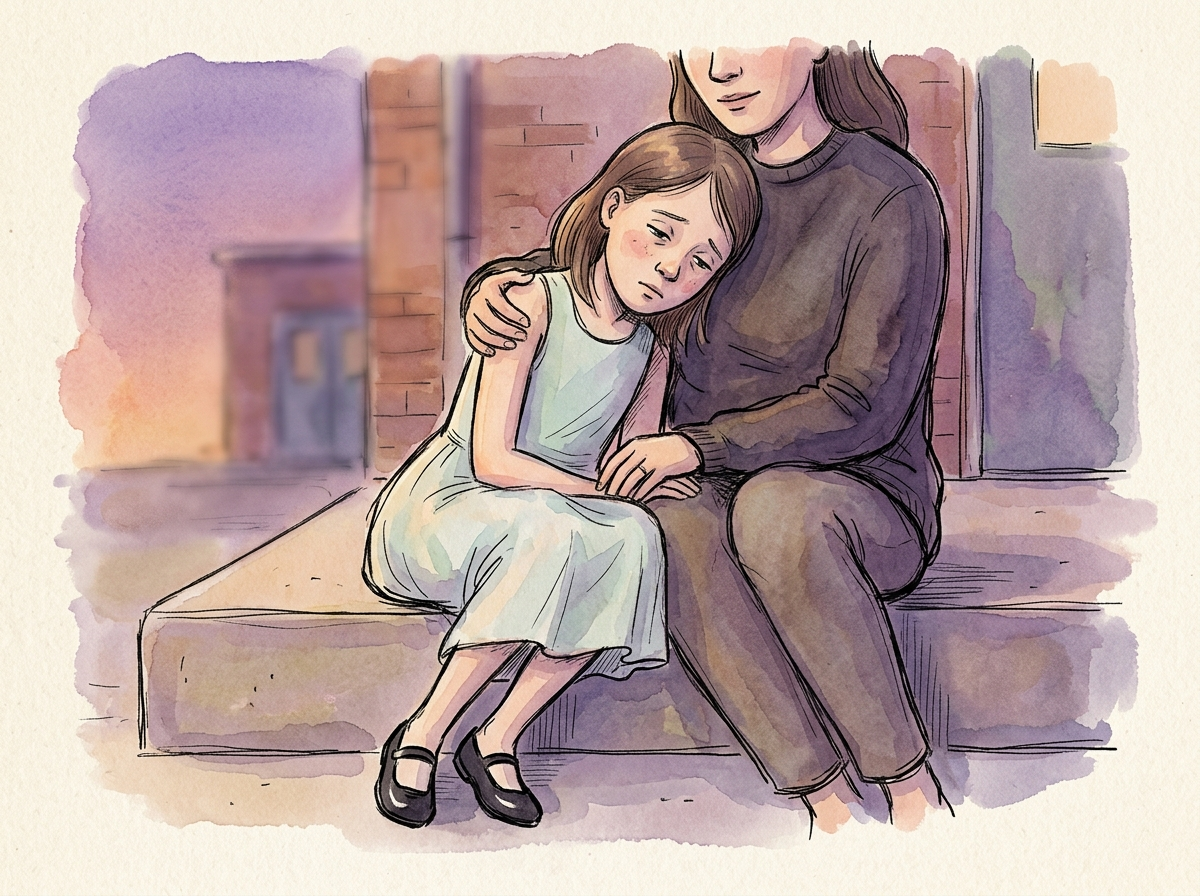
It wasn't hard. You just had to press your lips together and swallow, and the words would slide back down to wherever they came from. She got good at it. Really good. When her older brother, James, took the last popsicle without asking—swallowed. When her mom forgot to pick her up from soccer practice and Bette had to sit on the curb for forty-five minutes pretending she was just "enjoying the fresh air"—swallowed. When her dad moved to an apartment across town and said, "Nothing's going to change, Bette-bug," even though everything already had—swallowed, swallowed, swallowed.
The words piled up inside her like shoes in a closet no one ever organized.
Then one Tuesday in October, her teacher, Mr. Rowan, gave the class a writing assignment. "Write a letter," he said, leaning against his desk like he had all the time in the world. "To anyone. About anything. You will not be turning this in. This is for you."
Bette stared at the blank paper.
"It can be to someone real or imaginary," Mr. Rowan added. "It can be to your dog. It can be to the moon. I don't care. Just write what you actually want to say."
The classroom filled with the sound of pencils scratching and kids whispering and someone asking if they could write to a fictional character—yes—and someone else asking if they could write to Mr. Rowan himself—also yes, though he looked a little nervous about it.
Bette picked up her pencil.
She didn't write to one person. She wrote to everyone.
Dear Dad, she started.
You said nothing would change, but you took the coffee maker and now Mom drinks tea and she HATES tea. I can tell because she makes a face every single sip. You could have at least left the coffee maker.
She kept going.
Dear Mom,
When you forgot to pick me up, I wasn't "fine." I was scared. I thought maybe you forgot about me for real. Not just the pick-up. Me.
Dear James,
It was the orange popsicle. You KNOW orange is my favorite. You know it and you took it anyway and then you said "there's more in the store" like that fixes anything. It doesn't fix anything, James.
The words came faster now. Her pencil was almost shaking.
Dear Maya,
I'm sorry about the sandwich thing. I really am. But also, you haven't sat next to me at lunch in three weeks and I've been pretending I like sitting with the wall, but I don't. The wall is a terrible lunch companion. It has nothing interesting to say.
Dear Mr. Rowan,
This is a dangerous assignment and I think you should know that.
She wrote two full pages, front and back. She wrote to her grandmother, who always said "you're too sensitive" whenever Bette cried. She wrote to her neighbor's cat, who sat on Bette's porch every morning and was honestly the best listener she'd ever met. She wrote to herself, which was the hardest part:
Dear Bette,
You are so full of words that you might actually pop, and that would be very messy and very embarrassing, especially in Mr. Rowan's class, because he just got new carpet squares.
When the timer went off, Bette's hand ached. She looked down at the pages covered in her cramped, slanted handwriting, and she felt lighter. Like someone had opened a window in a room that had been closed too long.
She folded the letter carefully. Once, twice, three times, until it was a thick little square.
At home that afternoon, she opened the top drawer of her desk—the one where she kept old erasers, a broken watch, and a friendship bracelet Maya had made her in fourth grade—and she tucked the letter inside.
She closed the drawer.
And that, she figured, was that.
Except it wasn't.
Because the next morning, Bette woke up and the words were still there. Not the ones she'd written—those were safely in the drawer. But new ones. More of them. She'd lie in bed staring at the ceiling and think about what she'd written to her mom, and new sentences would start forming, and she'd have to get up and scribble them on the back of a homework sheet and fold that up and stuff it in the drawer too.
By Friday, there were five letters in the drawer.
By the following Wednesday, there were eleven.
The drawer was getting full.
Bette started putting letters in other places—between the pages of books, inside jacket pockets, folded into the case of her old glasses. She wrote one on a napkin at dinner and shoved it in her sock.
"What are you writing?" her mom asked, holding her tea and making The Face.
"Nothing," Bette said.
But it wasn't nothing. It was everything. Every word she'd swallowed for months was crawling back up, demanding to be written. And the strangest part was that writing it down didn't make it go away. Each letter was like pulling one thread from a knot, and instead of the knot getting smaller, it just loosened enough for her to see how big it actually was.
She needed the drawer to be enough. She needed to write it and fold it and close it and be done.
But she wasn't done.
On a Saturday afternoon, Bette was sitting on the porch with the neighbor's cat—a fat orange tabby named Peanut—when Maya walked by on the sidewalk.
They hadn't really talked in weeks. Maya slowed down. Bette's stomach clenched.
"Hey," Maya said.
"Hey," Bette said.
Peanut yawned.
Maya stood there, gripping the straps of her backpack. "My mom's making me return a library book. It's, like, eight hundred days overdue."
"That's impressive," Bette said.
Maya almost smiled. Almost.
The silence stretched between them like taffy, and Bette could feel all the words she'd written pressing against her ribs—you haven't sat next to me, the wall is a terrible lunch companion, I'm sorry about the sandwich—and she thought about the drawer. About how the drawer was supposed to be enough.
But Maya was right here. Right here. And the drawer was upstairs, and it was already full, and what was the point of writing all those words if the person who needed to hear them never did?
"I'm sorry I said your project looked like a soggy sandwich," Bette said. It came out fast. Almost too fast. "I meant it as a good thing, because I love sandwiches, but I know that's weird and it didn't sound like a compliment and I should have said sorry a long time ago."
Maya blinked. "You... love sandwiches?"
"So much," Bette said. "An unreasonable amount."
Maya's almost-smile became a real one. "That is weird."
"I know."
"It really did look like a soggy sandwich, though," Maya said. "The glue got everywhere."
"Yeah," Bette said. "The soggiest."
Maya laughed. It was short and surprised, like she hadn't expected it to come out. Then she sat down on the porch step, right next to Bette, and Peanut immediately climbed into her lap like he'd been waiting for this exact moment.
They didn't talk about everything. Not yet. But Maya was there, on the step, and the space between them felt a little less careful.
That night, Bette opened the drawer.
She looked at all the letters—the thick folded squares, the napkins, the scrap paper. She picked up the one she'd written to Maya and unfolded it. She read it, then folded it back up and set it aside. That one had done its job. Not because Maya had read it—she hadn't—but because writing it had helped Bette figure out what she actually needed to say out loud.
She picked up the letter to her mom.
She read it slowly.
I was scared. I thought maybe you forgot about me for real.
Bette's throat tightened. She closed her eyes.
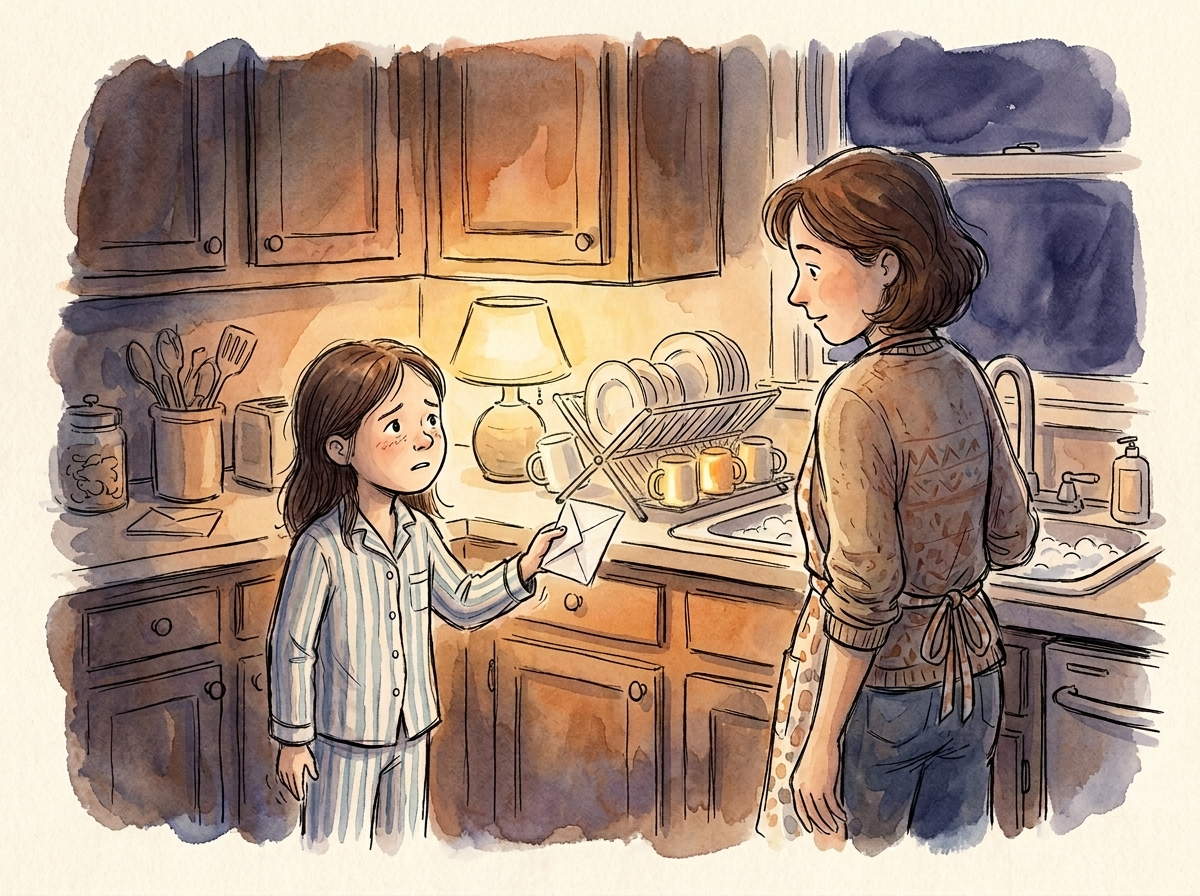
Downstairs, she could hear her mom washing dishes and humming something off-key. Bette picked up the letter—then put it down. Picked it up again. She held it for a long time.
Then she carried it downstairs, her heart hammering so hard she could feel it in her teeth.
Her mom looked up from the sink. "Hey, bug. You okay?"
Bette held out the letter. Her hand was trembling a little, but she kept it steady enough.
"What's this?" her mom asked, drying her hands.
"It's something I wrote. You don't have to read it right now. You can read it whenever. But I wanted you to have it."
Her mom took the letter. She looked at Bette with that expression parents get when they can tell something is important but aren't sure exactly what. "Okay," she said softly. "Thank you, Bette."
Bette nodded and went back upstairs. She sat on her bed and waited and didn't know what she was waiting for, but her chest felt different. Not lighter, exactly. Not heavier either. Just—open. Like the drawer.
She still had a lot of letters. She might not give them all away. The one to Peanut the cat, for example—Peanut could not read and also did not care. And some of the letters were just for her, and that was okay too.
But the drawer wasn't where words went to disappear.
It was where they went to wait.
And some of them—the ones that really mattered—were ready to come out.