The Last T. Rex
Fable
Ages 9–11 · 12 min
In a valley where the great roars have fallen silent, the last T. rex, Titan, walks the nesting grounds alone, listening for a single call to answer her own.
The morning mist hung low over the valley, and Titan walked through it alone, as she always did.
Her footsteps shook the ferns. Her shadow stretched long and dark across the ancient riverbed. She was enormous — taller than the tallest tree still standing in the grove, with teeth like daggers and claws that could split stone. But she moved gently now, carefully, the way someone moves through a room full of sleeping people.
The morning mist hung low over the valley, and Titan walked through it alone, as she always did.
Her footsteps shook the ferns. Her shadow stretched long and dark across the ancient riverbed. She was enormous — taller than the tallest tree still standing in the grove, with teeth like daggers and claws that could split stone. But she moved gently now, carefully, the way someone moves through a room full of sleeping people.
She was listening.
She had been listening for a very long time.
Once, when she was young, the world had been full of sound. The deep, rumbling calls of others like her, echoing across the plains at dusk. Her mother's voice — low and steady, a sound like thunder rolling underground. Her brother's clumsy roar, the one he practiced every morning from the top of the ridge until their mother nudged him quiet.
Now there was birdsong. The hiss of wind through cycads. The bubble and chatter of the river over smooth stones.
But no thunder. Not anymore.
Titan lowered her great head and drank from the river. The water was cold and tasted of minerals and far-off mountains. A small creature — something furry and quick, with bright black eyes — watched her from behind a log. It froze when she looked at it.
"I'm not hungry," Titan thought. Not out loud, of course. T. rexes didn't speak in words. But she thought it so clearly, with such calm, that the little creature seemed to understand. It twitched its whiskers and went back to nibbling a seed.
Titan drank again, then lifted her head and looked east.
She had walked east for many days last season. Across the salt flats where nothing grew, through the forests that smelled of resin and rot, all the way to the black cliffs where the ocean began. She had stood there at the edge of the continent and called out — once, twice, three times — her voice carrying across the water like a bell struck in an empty cathedral.
Nothing answered.
She had walked south the season before that. And north before that. And west, long ago, when she still had hope that it was just distance. That somewhere, over some hill or beyond some river, there were others.
There were not others.
Titan knew this the way she knew the sun would rise — not because anyone had told her, but because the evidence was everywhere and undeniable. The nesting grounds by the sulfur springs were empty and overgrown. The territorial scratch marks on the great boulders had weathered smooth. The bones she sometimes found were old, old, old — half-buried and silent, returning to the earth.
She was the last, and she knew it.
On this particular morning, Titan decided to visit the meadow.
It was her favorite place. A wide, open stretch of green between two wooded hills, where the ground was soft and the dragonflies danced above pools of standing water. Wildflowers grew here in colors she had no names for — though if she had, she might have called them "sunset" and "deep sky" and "the inside of a shell."
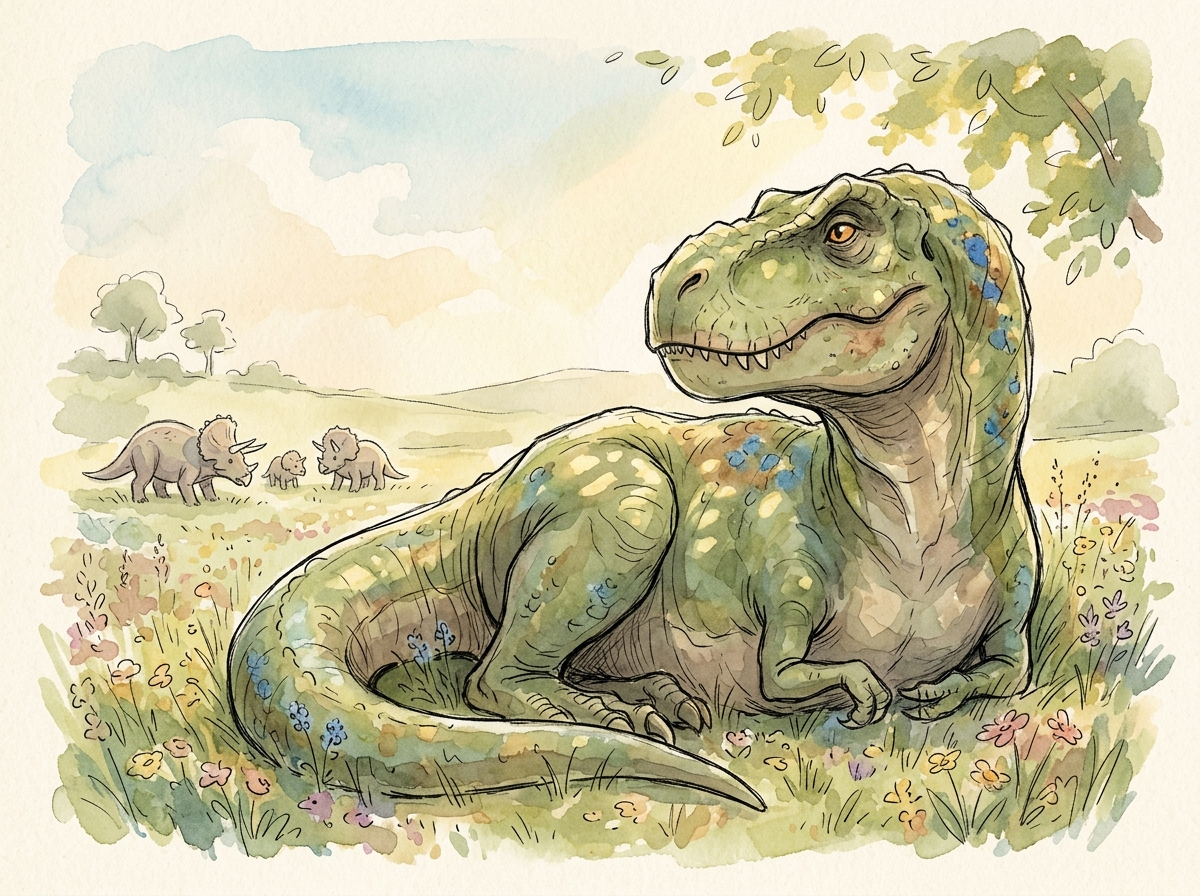
She settled down at the meadow's edge, folding her small arms beneath her and tucking her tail in a long curve around her body. The ground trembled slightly as she lay down, and then was still.
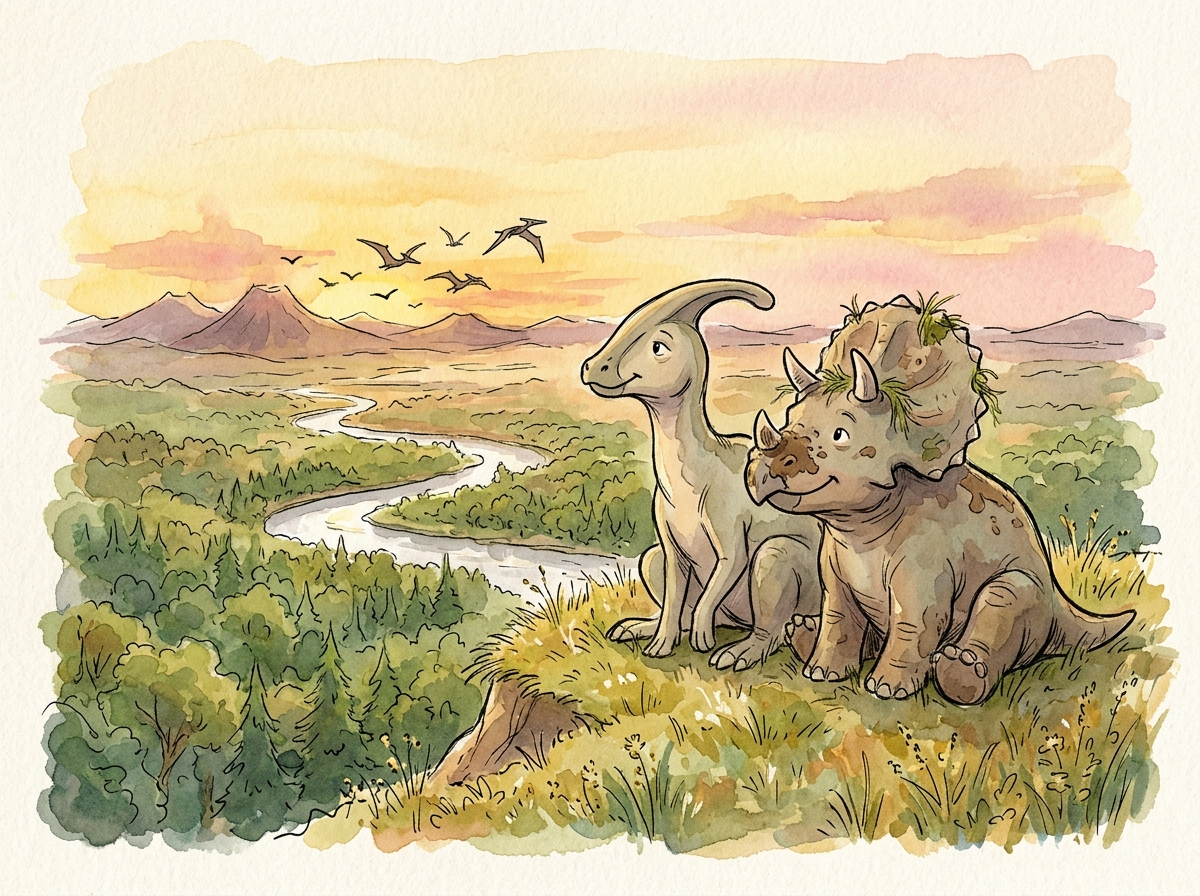
A family of triceratops grazed on the far side of the meadow. There were four of them — two adults and two young ones. The babies kept wandering off to investigate things: a butterfly, a funny-shaped rock, each other's tails. The parents rumbled low warnings whenever they strayed too far, then went back to eating.
Titan watched them for a long time.
She was no threat to them today. She hadn't hunted in weeks. The truth was, she didn't feel much like hunting anymore. She ate when she needed to, small meals — a fish from the river, carrion she came across. Enough to keep going. But the fire that once drove her, that ancient pulse of hunger and chase, had dimmed to something quieter. Something like a candle flame in a wide, dark room.
One of the baby triceratops noticed her. It stopped mid-step, one stubby leg raised, and stared with an expression that was half terror, half fascination.
Titan didn't move.
The baby took a step toward her. Then another. Its parent made a sharp, alarmed sound, and the baby scrambled back to the herd, nearly tripping over its own frill.
Titan exhaled slowly. The grass in front of her flattened, then sprang back up.
In the afternoon, she walked the ridge.
From up here, she could see the whole valley — the river winding silver through the green, the meadow like a bright coin, the forests stretching to the horizon in every direction. Steam rose from the hot springs in the western hills. Birds wheeled in great spirals above the canopy.
It was beautiful. She had always known that, but lately she felt it more sharply, the way you notice the taste of cold water when you're truly thirsty.
She thought about her mother.
Her mother had been the largest T. rex Titan had ever seen — a mountain of muscle and scar tissue and quiet intelligence. She had taught Titan everything: how to read the wind for the scent of prey, how to walk silently despite her size, how to find water in the dry season. But the most important thing her mother taught her wasn't a skill. It was something in the way she carried herself.
Her mother moved through the world as if it mattered. Every step deliberate. Every moment attended to. She would stop sometimes, in the middle of a hunt or a journey, and simply stand — nostrils flaring, eyes half-closed — taking it all in. As if the world were a song, and she wanted to hear every note.
Titan hadn't understood that when she was young. She'd been impatient then, eager to run, to chase, to roar.
She understood it now.
She stood on the ridge and took it all in. The light. The wind. The vast and patient green.
As evening came, Titan made her way to the nesting ground.
She hadn't been here in a long time. It was a sheltered hollow at the base of a cliff, protected from wind and rain by an overhang of ancient stone. The ground was littered with fragments of eggshell — some hers, from clutches that never hatched, and some far older, from generations she had never known.
She nosed through the fragments gently. Each one was a small, curved world. She could see the texture of them, the tiny ridges and pores. Once, life had pressed against the inside of these shells, fighting to break through into the light.
She lay down in the hollow.
The stone at her back was warm from the day's sun. Above her, the first stars were appearing — faint at first, then brighter, like eyes opening one by one.
A small gecko crept along the cliff face near her head. It paused, throat pulsing, and regarded her with golden eyes.
"You'll be here after me," Titan thought. And she didn't think it with sadness, exactly. More like acknowledgment. The way you nod to someone passing you on a trail.
She thought about what would happen when she was gone. The meadow would still be the meadow. The river would still run cold and clean. The triceratops babies would grow up and have babies of their own, who would chase butterflies and investigate funny-shaped rocks. The little furry creatures by the river would keep nibbling their seeds, getting braver and braver now that there was nothing large and toothy to worry about.
The world would go on. It would be different — a world without her kind in it — but it would go on. New things would come. Things she couldn't imagine. Things that would find this valley and think it was theirs, not knowing that a queen had once walked here.
And that was all right.
That was how it worked. She had eaten and been part of the eating. She had walked and left footprints that rain would fill and sun would dry and time would turn to stone. She had called out across oceans and heard nothing back, and that silence was an answer too — not a cruel one, just an honest one.
The night deepened. The stars turned slowly overhead, ancient light traveling impossible distances to land softly on the scales of the last Tyrannosaurus rex.
Titan breathed.
The wind moved through the valley below, bending the tall grass in silver waves. Somewhere, an owl called. Somewhere else, a river found a new path around a fallen log.
She closed her eyes.
In the morning, the meadow would be covered in dew. The dragonflies would rise from the standing water and catch the first light on their wings. The baby triceratops would venture a little farther from its parents, a little braver than yesterday.
And Titan would rise, as she always did, and walk out into the world one more time. She would move through it carefully, deliberately, the way her mother had taught her. She would notice the way the light fell through the canopy. She would drink from the cold river. She would listen — not because she expected an answer anymore, but because the world was worth listening to.
She would carry herself like what she was.
Not the last of something dying.
The last of something that had been magnificent.
And the valley held her, and the stars watched over her, and the earth — patient, ancient, endlessly turning — made room for one more night.