The Last Night in This House
Fable
Ages 6–8 · 8 min
After the moving truck leaves, Eliot unrolls her sleeping bag on the floor to spend one final night alone in her completely empty childhood house.
Eliot unrolled her sleeping bag right in the middle of her bedroom floor, and the sound it made was too loud. Everything was too loud now. Her footsteps. Her breathing. Even the zipper on the sleeping bag sounded like a tiny motorcycle racing through an empty cave.
That's what her room was. An empty cave.
Eliot unrolled her sleeping bag right in the middle of her bedroom floor, and the sound it made was too loud. Everything was too loud now. Her footsteps. Her breathing. Even the zipper on the sleeping bag sounded like a tiny motorcycle racing through an empty cave.
That's what her room was. An empty cave.
No bookshelf with her chapter books leaning against each other like tired friends. No desk with the wobbly leg that she had to prop up with a folded piece of cardboard. No glow-in-the-dark stars on the ceiling — Dad had peeled those off yesterday, one by one, and dropped them into a box labeled Eliot's Room — Stuff.
Just the sleeping bag. Just Eliot. And the walls.
She sat down cross-legged and looked around. There was the tiny dent near the floor where she'd accidentally kicked her roller skate into the wall two summers ago. Mom had sighed. Then Mom had laughed. Then Mom had said, "Well, now the house has a dimple, just like you."
Eliot touched her cheek. Then she touched the dent.
"Sorry about that," she whispered to the wall.
The wall didn't answer, obviously. Walls don't do that. But in the quiet of the empty house, with the moving truck already gone and her family sleeping at Grandma's for the night, Eliot could almost believe this house was listening.
She had told her parents she wanted to stay here one more night. Just one. Dad had tilted his head and said, "By yourself?" and Mom had looked at Dad, and Dad had looked at Mom, and they'd done that thing where they have a whole conversation without saying a single word.
Finally, Dad had said, "Okay. But I'm sleeping in the car in the driveway."
That was fine. That was perfect, actually. Because Eliot didn't want to be totally alone. She just wanted to be alone with the house.
She stood up and walked into the hallway. Her socks slid on the wood floor — shhhhhp — and she remembered how she and her little brother Max used to have sliding races from the bathroom all the way to the kitchen. Max always won because he was smaller and lighter, and also because he cheated by getting a running start.
"The kitchen is the finish line!" she said out loud, and her voice bounced off the bare walls and came back to her sounding braver than she felt.
She slid all the way there. She won, because there was nobody to race.
It didn't feel like winning.
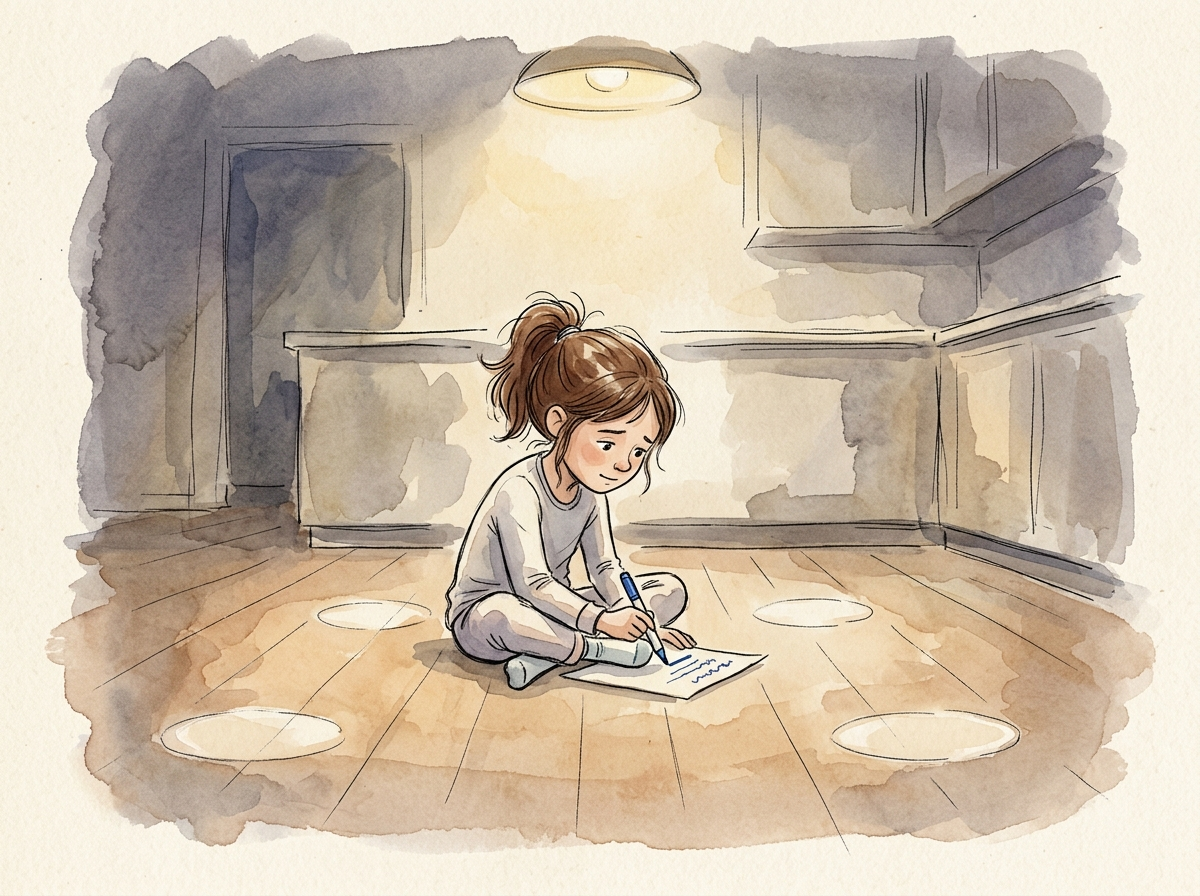
The kitchen was strange without the table. There were four little circles on the floor where the table legs used to sit — four pale moons on the darker wood. Eliot stood in the middle of them. She was standing exactly where Tuesday night dinners used to happen, where Mom would make the noodles that were too spicy and everyone would gulp their water and laugh, and where Max once dropped an entire bowl of applesauce and the dog — the dog who now lived at the new house already — had cleaned it up in eleven seconds flat.
"Thank you for the applesauce memory," Eliot said to the kitchen.
She walked to the living room. No couch. No rug. Just the window where the Christmas tree went every December, and the corner where she'd built a blanket fort so good that Dad had said, "I think this might be better than our actual house." She'd let him come inside the fort, but only if he brought snacks. He brought snacks. He always brought snacks.
Eliot sat down in the Christmas tree spot and pulled her knees to her chest.
This was the house where she had learned to read. Right here in this room, sitting on the old green couch that was now bouncing along a highway somewhere in a truck. She remembered the first time the letters had turned into words that turned into a story, and how it felt like someone had handed her a key that opened every door in the world.
This was the house where she'd had chicken pox and Mom had stayed home for a whole week and they'd watched movies and eaten popsicles until Eliot's tongue turned blue.
This was the house where she'd met her best friend Nadia, because Nadia had moved in next door and come over to ask if Eliot had any bugs. Not toy bugs. Real bugs. Eliot had found a beetle in the backyard, and Nadia had named it Ernesto, and they'd been best friends from that moment on.
A lump grew in Eliot's throat. The big, uncomfortable kind that feels like trying to swallow a tennis ball.
She went back to her room and crawled into the sleeping bag. She pulled it up to her chin and stared at the ceiling. No glow-in-the-dark stars. Just plain white ceiling.
"I don't want to go," she said.
Her voice wobbled. The empty room held the wobble gently, the way the house had always held her.
A tear rolled down her cheek, then another. She let them come. She didn't wipe them away because nobody was watching, and sometimes tears just need to do their thing.
She cried for a little while. For the dent in the wall and the sliding races and the four pale moons on the kitchen floor. For Nadia next door and the beetle named Ernesto and the blanket fort that Dad said was better than a real house.
Then she took a deep, shaky breath.
And then — she did something she hadn't planned to do.
She got up. She went to the kitchen and found the one thing she'd kept out of the boxes: her backpack. Inside it was a notebook and a blue marker. She pulled them out, tore a page from the notebook, and sat on the kitchen floor.
She wrote:
Dear New Kid Who Gets This Room,
Hi. My name is Eliot. This was my room. It is a really good room. Here are some things you should know:
1. The window gets the best sun in the morning. If you put a plant there, it will grow like crazy. I had a bean plant and it went NUTS.
2. There is a dent in the wall near the floor. That was me. Sorry. But also, it gives the house a dimple.
3. If you slide in socks down the hallway, you can make it all the way to the kitchen. The kitchen is the finish line.
4. The backyard has really good bugs. If you find a beetle, maybe name it Ernesto.
5. This house is a good house. Be nice to it.
From, Eliot
She folded the note carefully. Then she went back to her room and tucked it into the little space inside the closet, up on the high shelf — the one you'd only find if you were putting your things away for the first time and exploring every corner the way a new kid would.
She got back into her sleeping bag.
The room was still empty. The lump in her throat was still there, but smaller now. More like a grape than a tennis ball.
She looked up at the blank ceiling where her glow-in-the-dark stars used to be, and she thought about how they were in a box in a truck heading to a new room. A room she hadn't seen yet. A room that might have its own dents and its own sunny windows and its own hallway for sliding.
Maybe that room had a kid before her, too. Maybe that kid had loved it just as much.
Maybe there was a note waiting for her in a closet she hadn't opened yet.
Eliot closed her eyes. The house was quiet around her — the good kind of quiet, the kind that feels like someone big and steady is watching over you and doesn't need to say a word.
"Goodnight, house," she whispered.
And the house held her one last time, all night long, until the morning came and her dad knocked on the door and said, "Ready?"
And Eliot said, "Ready," and meant it — not because she wasn't sad anymore, but because she was brave enough to be sad and still walk out the door, into whatever good thing came next.