The Last Lighthouse
Fable
Ages 9–11 · 12 min
To complete a school project, Seb travels to a lighthouse on a remote island and meets its keeper, Moray, who has just been told a machine will soon take his place.
The island of Harrow Rock was exactly as far from everything as it sounded.
To get there, you had to take a bus to the coast, then a boat across two miles of choppy grey water, then walk up a path so steep your calves burned and your lungs begged for mercy. At the top, standing against the sky like a stubborn old tooth, was the lighthouse.
The island of Harrow Rock was exactly as far from everything as it sounded.
To get there, you had to take a bus to the coast, then a boat across two miles of choppy grey water, then walk up a path so steep your calves burned and your lungs begged for mercy. At the top, standing against the sky like a stubborn old tooth, was the lighthouse.
Seb had not wanted to come.
He'd wanted to stay home, where the Wi-Fi worked and his friends were playing Galactic Siege IV without him. But his mum had volunteered him for the school's "Living History" project, which meant interviewing someone whose job was "of historical significance."
"It'll be an adventure," she'd said.
It was not an adventure. It was a windy rock with seagulls that looked like they wanted to fight him.
Seb pulled his jacket tighter and knocked on the heavy wooden door at the base of the lighthouse. No answer. He knocked again, louder.
"It's open!" called a voice from somewhere impossibly high above.
Seb pushed the door. It groaned like it hadn't been opened since the invention of electricity. Inside, a spiral staircase corkscrewed upward into shadow. The walls were stone, and they smelled of salt and engine oil and something else—something old and warm, like the pages of a book left in the sun.
He climbed.
And climbed.
And climbed some more, until his legs reminded him that he'd skipped every PE lesson he could get away with.
At the top, he found a round room full of glass and light. The lamp itself—enormous, made of crystal and brass—sat in the centre like a jewel. And next to it, in a wooden chair that had been repaired so many times it was more patch than original, sat the keeper.
He was old. Properly old, the kind of old where you couldn't guess the exact number and it would be rude to try. His face was brown and lined like a walnut, and his eyes were the pale blue of sea glass. He wore a thick navy sweater with a hole in one elbow, and he was eating a sandwich.
"You'll be the school one, then," he said.
"Seb." Seb pulled out his phone to record the interview. No signal, obviously. "I'm supposed to ask you questions. About your job. For a project."
"Right." The keeper took another bite of his sandwich. "I'm Moray. Named after the eel, not the other way around. Sit anywhere you like, long as it's not on the lens."
Seb sat on an upturned crate and opened his notebook. He'd prepared questions, the boring kind teachers like.
"So," he said. "How long have you worked here?"
"Forty-seven years."
Seb stared. "Forty-seven years? In this one lighthouse?"
"Well, I did go to the shops a few times."
Seb wasn't sure if that was a joke. Moray's face gave away nothing.
"You know all the other lighthouses are automated now, right?" Seb said. "They run themselves. Computers and sensors and stuff."
"So I've heard."
"So why are you still here?"
Moray set down his sandwich and looked at Seb for a long moment. Then he stood—slowly, the way old people do when their knees have opinions—and walked to the glass.
"Come here," he said.
Seb went. From up here, the view was enormous. Grey-green sea stretched to the horizon in every direction, wrinkled with waves. Below, the rocks jutted out of the water like dark knuckles.
"See that patch there?" Moray pointed to what looked like ordinary water to Seb. "Current's different today. Pulling southeast. When it does that, and the fog comes in from the west—which it will, around four o'clock, I can smell it—the shipping lane shifts. The automated systems adjust the light's timing, sure. But they don't radio the fishing boats out of Crayburn to tell them the bass will be running near the eastern shoal." He pointed somewhere else. "And they don't notice when Jamie Outhwaite's red dinghy hasn't come back in by dark, and they certainly don't call his wife to check if he's just gone to the pub instead of drowning."
He looked at Seb. "Had he?"
"Had he what?"
"Gone to the pub."
"I—I don't know."
"He had. But the time before that, he hadn't. He'd run out of fuel and was drifting toward the rocks. I sent the lifeboat." Moray sat back down. "An automated lighthouse would have kept the light spinning. And Jamie Outhwaite would have been a name on a memorial plaque."
Seb was quiet for a moment. Then he wrote something in his notebook. He wasn't sure what—his hand just moved.
"Can I see how the light works?" he asked, surprising himself.
Moray's eyebrows rose—the first expression Seb had clearly read on his face. "You want to see the light?"
"Yeah. If that's okay."
It was more than okay. Moray moved differently now, quicker, and his voice changed too—not louder, but fuller, like a river that had found its proper width.
He showed Seb the lens first. It was a Fresnel lens, he explained, which Seb wrote down and would later learn to pronounce. It was made of hundreds of glass prisms arranged in concentric rings, and when the light hit it, it didn't just shine—it gathered the light, concentrated it, and flung it outward in a beam you could see for twenty-three nautical miles.
"Twenty-three miles," Seb repeated, staring into the glass. He could see his own face reflected in it, fractured into dozens of tiny versions of himself. "From one light."
"From one light and a lot of very clever glass."
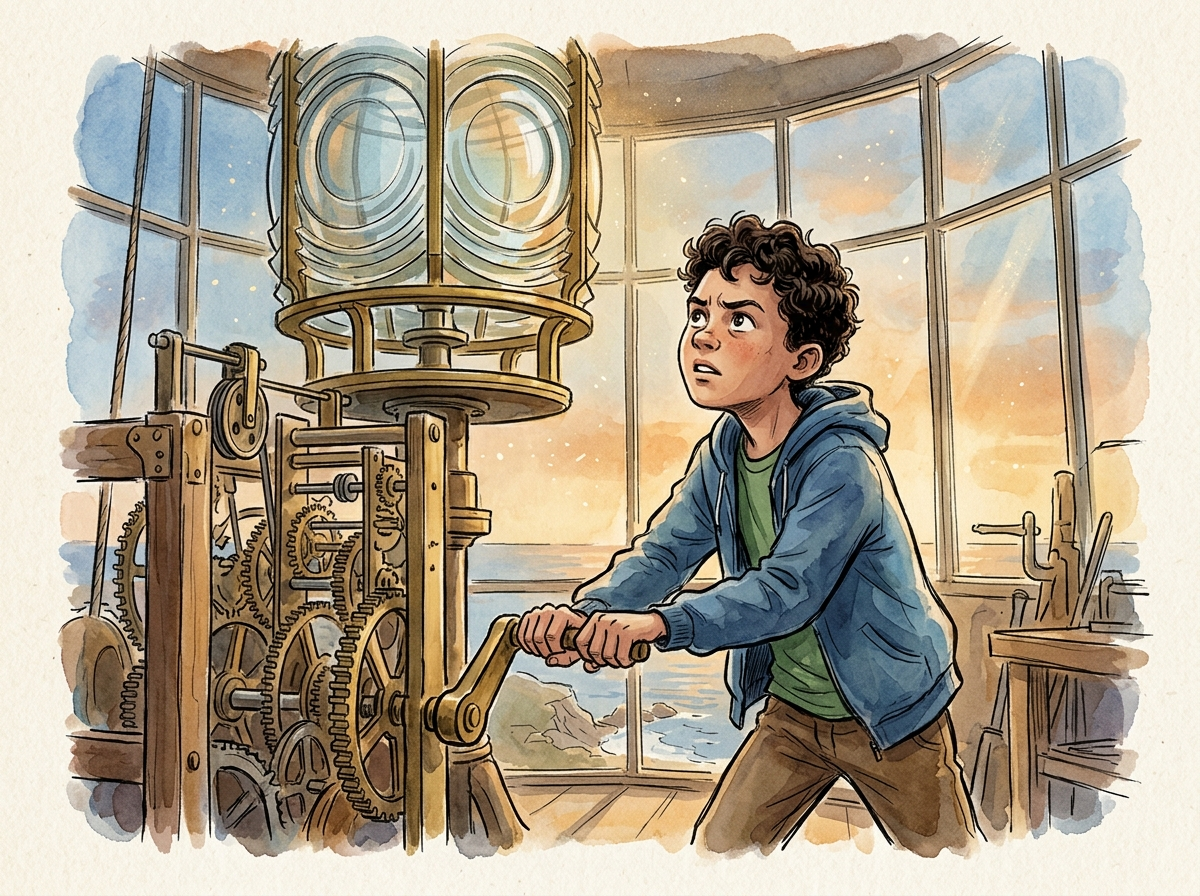
Then Moray showed him the clockwork mechanism that rotated the lens—still original, still hand-wound. He let Seb turn the crank. It was heavy, and Seb had to use both hands, leaning his whole weight into it. The gears caught, and the great lens began to move, slowly, with a deep and satisfying tick... tick... tick...
"Every night?" Seb asked.
"Every single night."
"Even Christmas?"
"Especially Christmas. That's when the amateurs take their boats out. Got no business being on the water, half of them. Need the light most of all."
Seb touched the cool brass housing of the lens. Through the glass walls of the lamp room, the afternoon light was turning golden, and the sea had shifted from grey to something almost silver.
"Doesn't it get lonely?" he asked.
Moray considered this. "There's a difference between being alone and being lonely. I've got the sea. I've got the birds—who are terrible company, by the way, don't trust a gannet. I've got the boats coming and going, the weather changing. I've got the light to tend." He paused. "And every now and then, the school sends someone up."
Seb smiled. Actually smiled, which was rare enough these days that it caught him off guard.
"But I'll be honest with you, Seb." Moray's voice had gone quiet. "They want to automate this one too. Got a letter last month. Said they'll install the new system by spring."
The words sat in the room like something heavy had been set down.
"What'll you do?" Seb asked.
"Don't know. They offered me a flat on the mainland. Very nice. Central heating and everything." He said central heating the way someone might say prison sentence. "But I expect I'll manage. People do."
Seb looked at Moray, then at the lens, then out at the sea where the first wisps of fog were creeping in from the west, exactly on schedule, exactly as Moray had predicted.
"Can I—" Seb started, then stopped. "Would it be okay if I came back? Not for the project. Just... to visit?"
Moray looked at him with those sea-glass eyes.
"I'd like that," he said. "But you'd better come before spring."
Seb took the boat back as the sun was setting. He stood on the deck and watched Harrow Rock shrink behind him, and then—right on time—the light came on.
It swept across the water in a slow, steady arc. Not flashy, not dramatic. Just there. Constant. Reliable. A single bright line cutting through the gathering dark.
He pulled out his notebook and read what he'd written, the thing his hand had put down without him thinking about it:
He doesn't just keep the light. He keeps everything.
When Seb got home, his mum asked how it went.
"Good," he said. Then, after a moment: "Can I borrow your phone? I need to look up the ferry schedule."
He went back the following Saturday. And the Saturday after that.
Moray showed him how to read the weather by watching the clouds stack up on the horizon. He taught him the names of the ships that passed—the big container vessels, the little fishing boats, the coast guard cutter with the crooked antenna. Seb learned to wind the clockwork mechanism without being asked, and he learned that Moray took his tea with no sugar and absolutely no milk, which Moray called "an abomination."
One Saturday, Seb brought a flask of tea made exactly right, and Moray held it in both hands and said nothing for a while, which Seb understood was the loudest kind of thank you.
The letter about spring sat on the desk, unopened now, as if nobody reading it again might make the words inside rearrange themselves.
On his last visit before the automation crew was due, Seb climbed the stairs and found Moray at the window, watching the fog roll in.
"Seb," Moray said, without turning around. He always knew.
"Moray."
They stood together in the lamp room, watching the light sweep out across the dark water. Somewhere out there, boats were finding their way home.
"I talked to my teacher," Seb said. "About the project. She said my report was the best one in the class." He paused. "She also said that automated lighthouses still need quarterly inspections. Someone has to physically check the equipment. She looked it up."
Moray said nothing.
"And I looked it up too. The inspection person doesn't have to live here full-time. But they could. If they wanted. If they applied for the contract."
Moray turned from the window. His sea-glass eyes were bright.
"You looked all that up, did you?"
"It wasn't hard. The Wi-Fi on the mainland is really good."
Moray laughed. It was a rare sound, rough from disuse, like a door opening that hadn't been opened in a long time. And Seb laughed too, standing in the last lighthouse, while the light turned and turned and turned, reaching out across the dark water like a hand held open—steady, patient, and unwilling to let go.