The Last Box
Fable
Ages 6–8 · 9 min
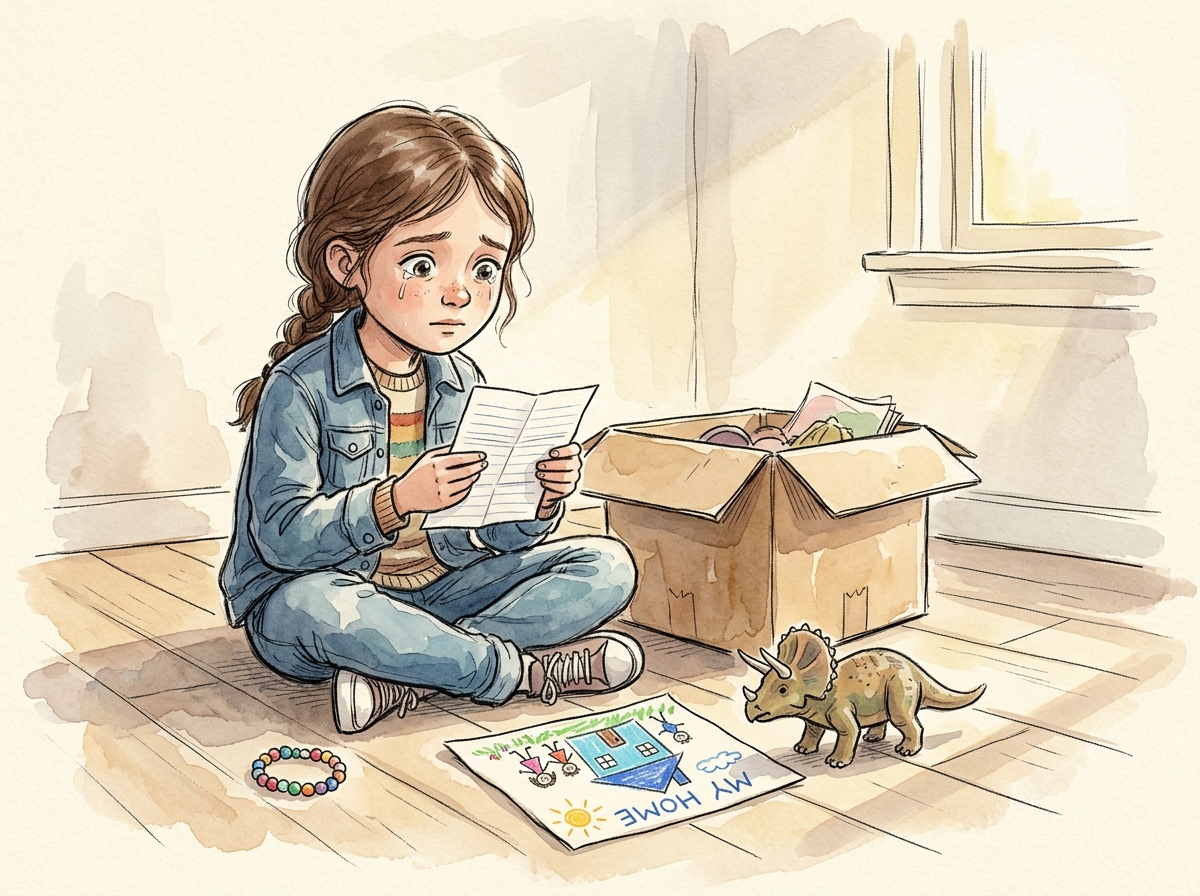
In her empty bedroom just before moving, Hazel finds a single box in the closet that she packed three years ago and never opened.
Hazel sat on the floor of her empty bedroom and counted the things that were gone.
Her bookshelf — gone. Her purple rug with the fringe she used to braid while thinking — gone. The glow-in-the-dark stars on the ceiling that Dad had stuck up there the very first night — gone, peeled off one by one and dropped into a trash bag like they didn't even matter.
Hazel sat on the floor of her empty bedroom and counted the things that were gone.
Her bookshelf — gone. Her purple rug with the fringe she used to braid while thinking — gone. The glow-in-the-dark stars on the ceiling that Dad had stuck up there the very first night — gone, peeled off one by one and dropped into a trash bag like they didn't even matter.
Everything was packed in the moving truck outside. Everything except one box.
It was sitting in the back corner of her closet, half-hidden behind the door. It was small and brown and a little bit dented, and someone had written on it in thick black marker: HAZEL'S STUFF — DO NOT LOSE.
The handwriting was hers, but younger. The letters were big and wobbly, and the S in STUFF went the wrong way.
Hazel knew exactly what was in that box. She had packed it herself three years ago, the day they moved into this house. She had been five. She had carried it up the stairs with both arms and set it in the closet and said, "I'll unpack it later."
She never did.
Now they were moving again, and here it was, waiting for her like a patient little dog.
"Hazel!" Mom called from downstairs. "Ten minutes!"
Hazel pulled the box out. It was lighter than she expected. She sat cross-legged on the bare floor, and the wood was cold through her jeans. She pulled at the tape — it came off easy, since it had lost most of its stickiness a long time ago.
She opened the flaps.
On top was a drawing. She held it up. It was a picture of a house — not this house, but the old old house, the one before this one, the one with the yellow door. She had drawn it in crayon, and the chimney was twice as big as the roof, and there were about forty flowers in the yard, and there was a tiny Hazel in the window with a triangle dress and stick arms, waving.
She set it on the floor beside her.
Next was a plastic dinosaur. A triceratops. It was missing one horn.
Hazel turned it over in her hands. She remembered this dinosaur. His name was Captain Biscuit. She had named him that because she'd been eating a biscuit when she found him at the bottom of a cereal box. Captain Biscuit used to go everywhere with her — the grocery store, the dentist, the bathtub. Somewhere along the way she had just... stopped carrying him.
She set Captain Biscuit next to the drawing.
Underneath him was a piece of string with three wooden beads on it. Red, yellow, blue. Hazel stared at it for a long time. Then she remembered — it was supposed to be a bracelet. Her friend Nomi had made it at the old old house. They had been sitting on Nomi's back porch, and Nomi had tied the beads on and said, "This means we're best friends even when you move away."
Hazel hadn't thought about Nomi in a really long time.
She held the bracelet in her palm. The string was fraying. The beads were dusty. She rubbed the red one with her thumb, and it was smooth and warm, and something in her chest got tight, like she'd swallowed a stone.
She set it down gently.
There was one more thing at the bottom of the box. A folded piece of paper. Hazel opened it, and inside, in that same wobbly five-year-old writing, it said:
DEAR NEW HAZEL, DONT FORGET THE YELLOW DOOR. DONT FORGET CAPTAIN BISKIT. DONT FORGET NOMI. LOVE, OLD HAZEL
Hazel read it three times.
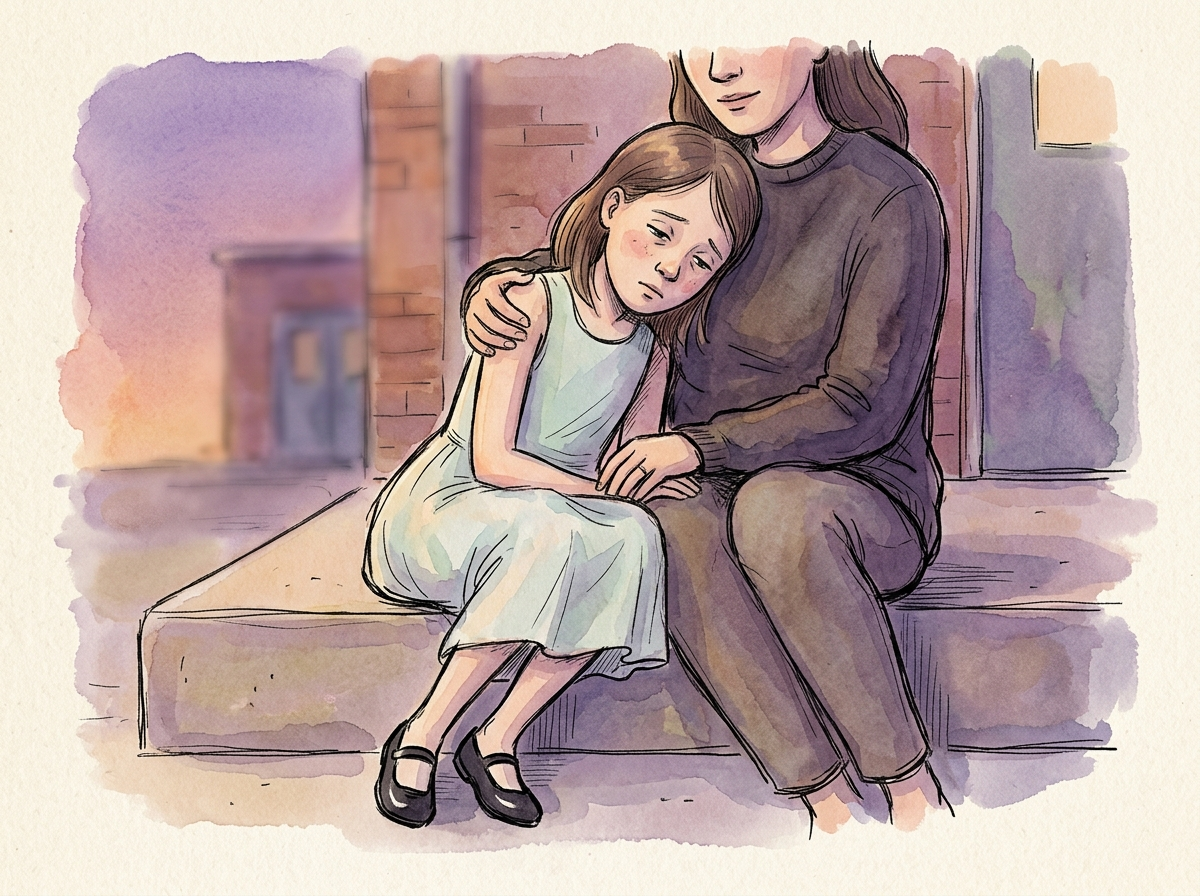
Then she folded it back up and pressed it against her knee, and her eyes got hot and blurry, and she sat very still on the cold floor of her empty room.
She had forgotten. Not on purpose — not in a mean way — but the days just kept going and going, and new things kept coming, and the old things got quieter and quieter until they were all the way silent.
"Hazel! Five minutes, sweetheart!"
Hazel wiped her eyes with her sleeve. She looked at the things spread out on the floor — the drawing, the dinosaur, the bracelet, the letter.
She could put them back in the box. Tape it up. Carry it to the new house. Stick it in a new closet.
Or she could do something different this time.
She picked up Captain Biscuit and looked at his face. He had a goofy little smile painted on. One eye was slightly bigger than the other. He looked like he was keeping a secret.
"Sorry," she whispered. "I should have unpacked you."
She put Captain Biscuit in her jacket pocket.
Then she picked up the bracelet. It was way too small for her wrist now, but she untied the beads and retied them onto a longer piece of packing string from the floor. It wasn't pretty, but it held. She slipped it over her hand and pushed it up past her wrist.
She folded the drawing carefully — very carefully — and put it in her other pocket.
And the letter she held onto. Just held it in her hand.
She looked at the empty box. It was just cardboard now. Just a dented brown box with wobbly writing on the side. But it had kept everything safe for three whole years, even when she wasn't paying attention. Even when she forgot it was there.
"Thank you," she said to the box. And she meant it, even though it was a strange thing to say to cardboard.
She walked downstairs. The house echoed. It sounded huge and hollow, like the inside of a drum. The walls had lighter squares where pictures used to hang.
Mom was by the front door, holding her keys and a coffee cup and looking a little tired. She saw Hazel's face and crouched down.
"You okay, bug?"
Hazel nodded. Then she shook her head. Then she nodded again.
"I found my box," she said. "The one from last time."
Mom's eyebrows went up. "The one you packed when you were five? I wondered where that went."
"It was in the closet the whole time."
Mom looked at the bracelet on Hazel's wrist. She looked at the lump in Hazel's pocket that was shaped like a triceratops. She didn't say anything for a moment, and then she said, very softly, "Sometimes the things we pack away are just waiting for us to be ready."
Hazel looked down at the letter in her hand. DEAR NEW HAZEL. She thought about the new house, the one she hadn't seen yet, the one with the room that would be hers. She thought about how in a few years, there would be a new new Hazel, and this Hazel — the right-now Hazel, the eight-year-old one — would be the old one.
She pulled a marker from Mom's open purse and found a scrap of packing paper on the counter. She leaned against the wall and wrote, in her best handwriting — which was a lot less wobbly now:
DEAR NEXT HAZEL, THIS HOUSE HAD GLOW STARS ON THE CEILING. YOUR TEACHER WAS MS. CHEN AND SHE LAUGHED REALLY LOUD. YOU LIKED THE TREE IN THE BACKYARD WITH THE BRANCH THAT LOOKED LIKE AN ARM WAVING. DON'T FORGET. LOVE, THIS HAZEL
She folded it up and put it with the other letter.
Then she walked out the front door, and she didn't look back — not because she didn't care, but because she was carrying all of it with her.
The dinosaur in her pocket. The beads on her wrist. The letters in her hand. The yellow door in her memory, bright as the day she'd first walked through it.
Mom locked up. The key clicked. The truck rumbled.
And Hazel climbed in, holding on tight to every single thing she wasn't going to forget.