The Invisible Kid Nobody Noticed
Fable
Ages 9–11 · 12 min
A boy named Moth feels so unnoticed at school that he wishes to be invisible, and in the third-floor bathroom mirror, his reflection begins to fade away.
Moth had been invisible long before he could actually turn invisible.
His real name was Matthew, but everyone called him Moth — or at least, the few people who called him anything did. His mom had started it when he was little because he was always drifting toward light sources: lamps, candles, the glow of the TV in a dark room. The nickname stuck, even after the reason was forgotten, even after most people forgot the boy it belonged to.
Moth had been invisible long before he could actually turn invisible.
His real name was Matthew, but everyone called him Moth — or at least, the few people who called him anything did. His mom had started it when he was little because he was always drifting toward light sources: lamps, candles, the glow of the TV in a dark room. The nickname stuck, even after the reason was forgotten, even after most people forgot the boy it belonged to.
At school, Moth sat in the second-to-last row in every class. Not the last row — that would be a choice, a statement. The second-to-last row was where you ended up when no one saved you a seat and you didn't want to be the first to sit down or the last. It was the row of waiting. The row of hoping someone might turn around.
Nobody turned around.
It wasn't that people were mean to Moth. That would have required them to notice him. He was simply… skipped. Like a word your eye passes over when you're reading too fast. Teachers called on the kids with raised hands, then the kids causing trouble, and by the time they scanned the middle of the room, their eyes slid right over him like water over a smooth stone. At lunch, he sat at the end of a long table where a group of kids talked about video games. He laughed when they laughed. They never wondered why there was one extra laugh.
Moth told himself it didn't bother him.
He told himself this approximately four hundred times a day.
The day everything changed was a Tuesday, which felt right, because nobody pays attention to Tuesdays either.
Moth was in the bathroom on the third floor — the one nobody used because it smelled like old pennies and the hand dryer sounded like a dying airplane. He was staring at himself in the mirror, something he did more than he'd ever admit. Not out of vanity. Out of checking. Still here. Still real. Still a person that exists.
"I wish I actually was invisible," he muttered. "At least then there'd be a reason."
His reflection flickered.
Moth blinked. Leaned closer. His reflection flickered again — like a lightbulb about to go out — and then it was gone. The mirror showed the bathroom behind him: the stalls, the tiled wall, the paper towel dispenser. But no Moth.
He looked down. His hands were gone. His shoes were gone. His whole body was just… not there.
"Oh," he said to the empty mirror. "Oh."
The power faded back thirty seconds later, his body returning like someone slowly turning up the brightness on a screen. Moth gripped the edges of the sink and stared at his reflection — the brown hair that never lay flat, the too-big ears, the worried eyes.
"Okay," he whispered. "Okay okay okay."
Within a week, Moth had figured out the basics. The invisibility came when he wanted it — really wanted it — like flexing a muscle he'd always had but never knew about. He could hold it for about twenty minutes before he got a headache. His clothes went invisible too, which was a relief he didn't have words for. Sound still worked normally. If he sneezed, people heard it. So he learned to be quiet, which, honestly, wasn't much of an adjustment.
The first thing Moth did with real invisibility was exactly what you'd expect: he went everywhere he'd never been allowed.
He walked into the teachers' lounge and discovered it was just a sad room with a microwave and a couch that smelled like coffee. He sat in the principal's office during a phone call and learned that Principal Decker was arguing with someone about a gas bill. He stood on the basketball court during practice and watched from the free-throw line as the players thundered past him.
It was thrilling for exactly three days.
Then it was something else.
Because here's what Moth discovered: being actually invisible felt almost exactly like his regular life. He drifted through hallways. Nobody reacted to him. He stood in rooms full of people and none of them knew he was there. The only difference was that now there was a reason they couldn't see him. Before, he'd been standing right there — visible, solid, real — and they'd looked through him anyway.
That was the thought that landed like a brick.
Being invisible because of a superpower was just a fact. Being invisible without one — that was a choice. Other people's choice. And somehow, for years, every single person had made it.
Moth stopped using the power. For a while, it almost made things worse. He'd sit in class, fully visible, and think: I could vanish right now, and the only difference is that you'd have an excuse.
The shift started because of a girl named Delilah Jordan and a jar of paint.
Delilah sat in the actual last row — by choice, as a statement — and she had been suspended twice for graffiti, which she called "public art" and the school called "vandalism." She had short hair dyed the color of a swimming pool and she wore combat boots with daisies painted on them and she was, in Moth's opinion, the most terrifying person alive.
It was a Thursday. Moth was eating lunch in his usual spot — end of the table, edge of the laughter — when a jar of bright yellow paint rolled across the cafeteria floor and bumped against his shoe.
He picked it up. Looked around.
Delilah was standing ten feet away, arms full of paint jars and brushes, clearly in the middle of sneaking them somewhere she shouldn't be. One jar had escaped. She stared at Moth. He stared at her. It was possibly the longest anyone at school had ever looked directly at him.
"You gonna snitch?" she asked.
"No," Moth said, surprising himself with how fast the word came out.
"Then bring it."
So Moth did something he had never once done in his entire life: he followed someone who had actually seen him.
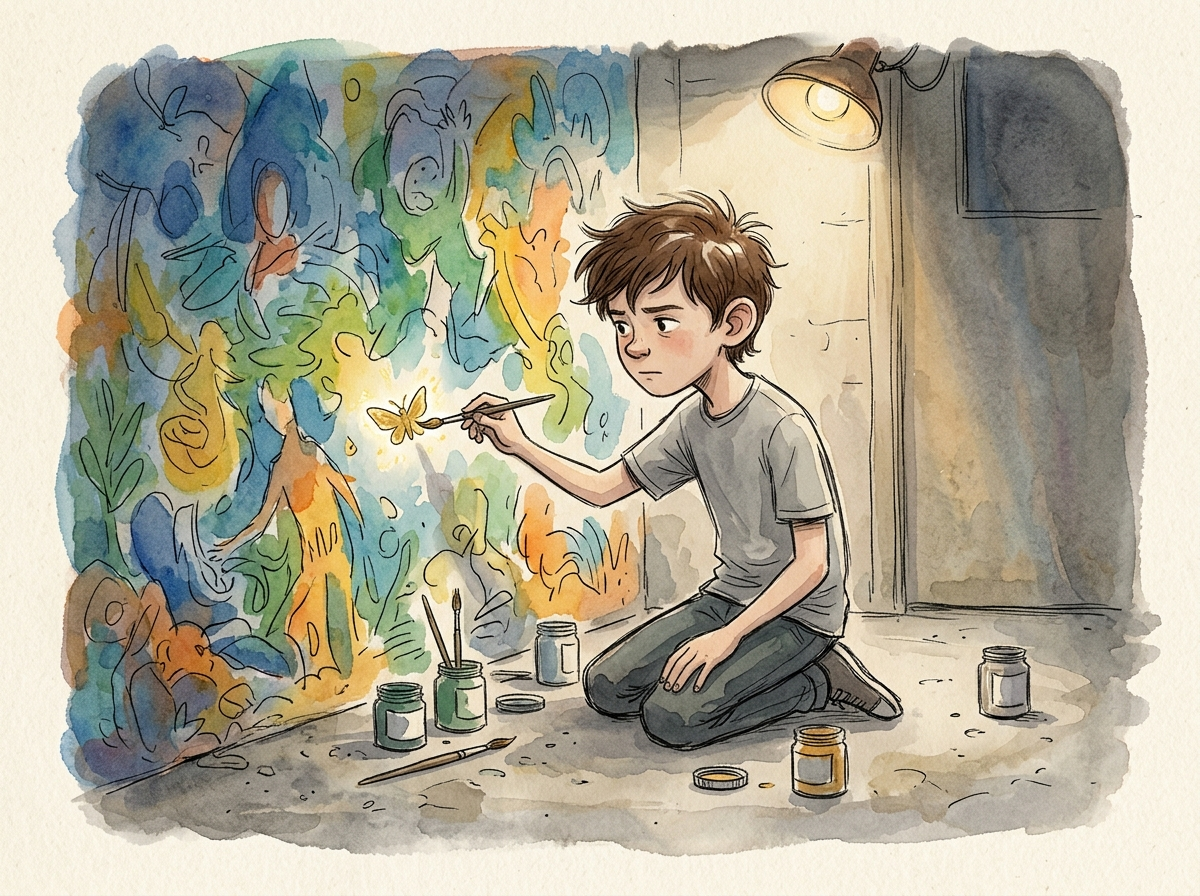
Delilah led him down the back stairwell to the basement hallway — the one with the old lockers that hadn't been used since the school's east wing was condemned. The wall at the end was blank, gray cinder block, and Delilah set her jars down in front of it like an offering.
"I'm painting a mural," she said. "The school said no. I said yes. We're at an impasse." She glanced at him. "You're Moth, right?"
The shock of being known almost knocked him sideways. "You know my name?"
"You sit behind me in English. You laughed at my joke about Lord of the Flies when nobody else got it. I figured you were either smart or weird."
"Can it be both?"
Delilah grinned. "Both is the only option worth being."
She handed him a brush.
They painted for an hour that first day, and the next day, and the day after that. Delilah painted enormous flowers with teeth and birds made of lightning bolts. Moth, who had never painted anything in his life, started with shaky lines and blobs, but by the end of the week, he'd figured out he was good at tiny details — the veins on a leaf, the texture of feathers, the way light caught the edge of a cloud.
Other kids started finding the mural. They'd wander down the basement hallway and stop, staring. A sixth grader named Oscar started showing up with his own paint. Then a girl from the art club. Then three kids Moth had never spoken to, who all seemed to know his name now because Delilah kept yelling it across the hallway.
"MOTH! More yellow!"
"MOTH! Tell Oscar his dragon looks like a poodle!"
"MOTH! You're the only person with steady enough hands for this part, get over here!"
Being yelled for turned out to be the most wonderful thing in the world.
One afternoon, Moth was painting a tiny moth in the corner of the mural — wings spread, drawn toward a painted sun — when he felt the familiar tingle of his power activating on its own. His hand started to flicker. He looked down and watched his fingers begin to fade.
No, he thought. Not firmly, not desperately. Just… clearly. No. I don't want that.
His hand came back. Solid. Holding a brush wet with gold paint.
Oscar looked over. "Dude, that moth is sick. Is that your signature or something?"
"Yeah," Moth said. "I guess it is."
The mural was discovered by Principal Decker on a Monday. There was a lot of yelling. Words like "property damage" and "consequences" and "who is responsible for this."
Moth stepped forward. Not because he was brave. Not because he'd suddenly transformed into some courageous hero. But because he had spent years being unseen, and someone had finally given him something worth being seen for.
"I helped," he said, loud enough that his voice carried. "It was me. And Delilah. And Oscar. And—"
One by one, every kid who had ever touched a brush to that wall stepped forward too.
Principal Decker looked at the group. Looked at the mural. Looked at the group again.
The mural stayed.
They did have to repaint the section where Oscar's dragon-poodle was, because even Oscar admitted that one was pretty rough. But the rest of it — the flowers with teeth, the lightning birds, the tiny gold moth in the corner — became the first thing people saw when they walked down that hallway.
And Moth? Moth could still turn invisible whenever he wanted. He just couldn't remember the last time he'd wanted to.