The Inventor's Daughter
Fable
Ages 6–8 · 9 min
After three months of working in his garage, Delia's inventor dad is finally ready to test the giant machine he built to take over her morning.
Delia's dad was an inventor, which sounds exciting until you realize what it actually means. It means the toaster has been taken apart since February. It means there are wires on the couch, springs on the stairs, and a pair of robot arms hanging from the ceiling fan that nobody is allowed to talk about.
It also means that every morning, Delia made her own breakfast.
Delia's dad was an inventor, which sounds exciting until you realize what it actually means. It means the toaster has been taken apart since February. It means there are wires on the couch, springs on the stairs, and a pair of robot arms hanging from the ceiling fan that nobody is allowed to talk about.
It also means that every morning, Delia made her own breakfast.
She was very good at it. She could pour cereal without spilling a single flake. She could peel a banana in three seconds flat. She could even make toast using the oven, which is harder than it sounds because you have to watch it like a hawk or it turns into a little black brick.
Delia did all of this while her dad worked in the garage, where strange sounds came out at all hours — buzzing, clanking, the occasional small explosion, and once, very clearly, the sound of a goat. He said it was a squeaky hinge. Delia had her doubts.
But three months ago, something changed.
Her dad had come to breakfast with wild hair and wilder eyes and announced, "Delia, I am building a machine that will make mornings EASIER."
Delia had looked at her perfectly poured cereal, her neatly peeled banana, and her golden-brown toast, and said, "Okay, Dad."
He hadn't heard her. He was already running back to the garage.
For three months, the sounds got louder. The explosions got slightly bigger. Delia found a spring in her shoe and a gear in her lunchbox. Her dad started sleeping in the garage, then eating in the garage, then talking to the garage, which Delia found concerning.
But every morning, she got herself ready. She packed her own backpack. She brushed her own hair — two braids, thank you very much. She poured her own cereal. And she walked herself to the bus stop at exactly 7:42.
She had it down to a science.
Then one evening, her dad burst through the kitchen door with grease on his nose and a grin so wide it practically touched his ears.
"Tomorrow," he said. "Tomorrow morning. The test."
"What does it do, exactly?" Delia asked.
"EVERYTHING!" he shouted, and ran back to the garage.
The alarm went off at 6:30 the next morning. But it wasn't Delia's alarm. It was a sound like a brass band falling down a flight of stairs, followed by a cheerful robotic voice that said:
"GOOD MORNING, DELIA. PLEASE REMAIN CALM."
Which is a thing that has never once made anyone calm.
A mechanical arm reached out from a panel in the wall — a panel that had definitely not been there yesterday — and gently pulled Delia's blanket off the bed. A second arm offered her slippers. A third arm, which seemed confused about its purpose, waved hello.
"Dad?" Delia called.
Her dad was standing in the hallway with a clipboard and safety goggles, bouncing on his toes. "Just let it work! Don't interfere! This is science!"
Delia put on her slippers.
The hallway floor had been replaced with a slow-moving conveyor belt that carried her toward the bathroom. The bathroom door swung open automatically. A tiny mechanical hand held out her toothbrush, already loaded with exactly the right amount of toothpaste.
"Okay," Delia admitted. "That part's pretty good."
She brushed her teeth. A warm towel was handed to her by another arm. So far, so good.
Then came the hair.
A large contraption lowered from the ceiling like a metal octopus. It had combs and brushes and ribbons and what appeared to be a small fan attached to it for no clear reason.
"Dad," Delia said carefully. "What is that going to do to my hair?"
"Two braids!" her dad called from the hallway, checking something off on his clipboard. "I programmed it myself! I watched four videos!"
The machine whirred to life.
It did not make two braids.
It made something that could generously be called a hair sculpture. It went up, and sideways, and somehow also a little bit down. There was a ribbon in it, but the ribbon was tied around the wrong part. Delia looked in the mirror and saw what appeared to be a pineapple having a bad day.
"Beautiful!" her dad said, peeking in. "Moving on!"
The conveyor belt carried her to the kitchen, where the REAL machine was waiting.
It was enormous. It took up the entire kitchen. It had tubes and funnels and spinning wheels and a tiny flag on top that said "BREAKFAST-O-MATIC 3000." There were blinking lights in seven colors, including one color Delia was pretty sure she'd never seen before.
Her dad pressed a large green button.
The machine gurgled. It hummed. It made a sound like someone shaking a bag of marbles inside a tuba. Then, with great ceremony, a mechanical arm placed a bowl in front of Delia.
The cereal was in the bowl. But so was the milk. And the banana. And what appeared to be a piece of toast, folded in half, crammed in on top like a hat.
Everything was in the bowl. All at once. In a pile.
"Efficient!" her dad declared.
Delia looked at the cereal-milk-banana-toast pile. A soggy flake slid sadly down the piece of toast.
"Now," her dad said, checking his clipboard, "the backpack station!"
Another mechanical arm swung down from the ceiling holding Delia's backpack. It was packed — technically. But when Delia looked inside, her math book was upside down, her pencils were in her lunch bag, her sandwich was in the pencil case, and there was a gear in there that definitely belonged to the machine.
A buzzer went off. A robotic voice announced: "IT IS NOW TIME TO LEAVE FOR THE BUS. LAUNCHING DEPARTURE SEQUENCE."
"Launching?" Delia said. "Launching?"
The front door flew open. A mechanical arm offered her jacket — inside out. Another arm offered her shoes — both for the left foot. The conveyor belt sped up, and Delia had to hop off before it carried her straight out the door and into the rosebushes.
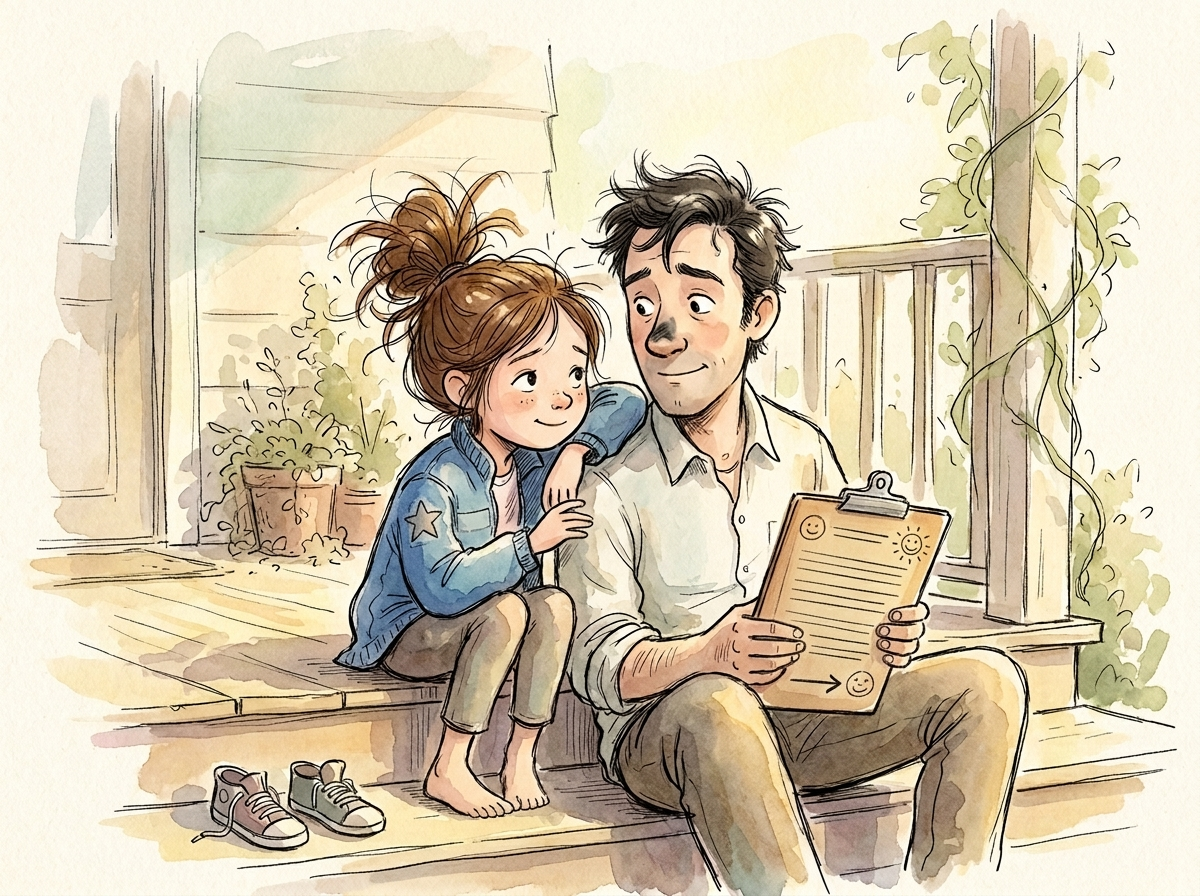
She stood on the front porch, holding two left shoes, wearing an inside-out jacket, with a pineapple on her head and a sandwich in her pencil case.
Her dad appeared in the doorway, clipboard clutched to his chest, eyes shining. Behind him, the Breakfast-O-Matic 3000 made a final, dramatic clunking sound and shot a piece of toast across the kitchen.
"So?" he said. "What do you think? Three months of work! Did it make your morning easier?"
Delia looked at her dad. She looked at his hopeful face, his grease-stained nose, his safety goggles pushed up into his messy hair. She looked at the clipboard covered in notes and diagrams and little drawings of her with smiley faces.
She looked at the little smiley-face drawings for a long time.
He'd drawn her with two braids.
Delia took a deep breath. Then she set down the two left shoes, took the gear out of her backpack, and said, "I think we should fix it together."
Her dad blinked. "Together?"
"You need help," Delia said. "The braiding unit is a disaster. No offense."
"None taken," her dad said, very quietly.
"And the cereal can't go in the same bowl as the toast, Dad. That's just — no."
"I thought it was efficient."
"It was a crime."
Her dad laughed. Then he sat down on the porch step next to her, and Delia leaned against his shoulder. He smelled like machine oil and burnt toast and something that was probably the inside of a battery.
"I wanted to help you," he said. "You do everything yourself every morning, and I thought — if I could just build something —"
"Dad," Delia said. "You don't have to build a machine to help me."
He looked at her.
"You could just wake up and have breakfast with me."
The garage was quiet. The conveyor belt had stopped. Somewhere in the kitchen, the Breakfast-O-Matic 3000 let out one final, exhausted puff of steam.
Her dad put down the clipboard.
"Can you teach me the cereal thing?" he asked. "You never spill a single flake. It's remarkable."
Delia smiled. "It takes practice. Come on."
They went inside together. Delia poured two bowls of cereal without spilling a drop, peeled two bananas, and watched the oven like a hawk while her dad sat at the table and told her about the four braiding videos he'd watched.
They missed the bus.
It was the best morning in a long time.