The Gurdwara Kitchen
Fable
Ages 6–8 · 10 min
In the busy Gurdwara kitchen, Simran is given a mountain of onions to chop, and soon she cannot see the cutting board through her tears.
Every Saturday morning, Simran tied her orange chunni over her head and walked with her dad to the Gurdwara. She loved the way the marble floor felt cool under her bare feet. She loved the music that floated through the halls like something you could almost touch. But most of all, she loved the langar kitchen.
The langar kitchen was the biggest, busiest, most wonderful kitchen in the whole world — at least, Simran thought so. Huge pots bubbled on huge stoves. Volunteers chopped and stirred and laughed and bumped into each other and said "excuse me, ji" about a hundred times an hour. Everyone was welcome to eat, and everyone was welcome to help.
Every Saturday morning, Simran tied her orange chunni over her head and walked with her dad to the Gurdwara. She loved the way the marble floor felt cool under her bare feet. She loved the music that floated through the halls like something you could almost touch. But most of all, she loved the langar kitchen.
The langar kitchen was the biggest, busiest, most wonderful kitchen in the whole world — at least, Simran thought so. Huge pots bubbled on huge stoves. Volunteers chopped and stirred and laughed and bumped into each other and said "excuse me, ji" about a hundred times an hour. Everyone was welcome to eat, and everyone was welcome to help.
Today, Simran marched straight to the kitchen and found Biji, the old aunty who seemed to run everything without ever raising her voice.
"Ah, Simran!" Biji smiled, her eyes crinkling behind her glasses. "Ready to work?"
"Ready!" Simran stood up extra tall.
"Good. Today, you are on onions."
Simran looked over at the onion station. There was a mountain — an actual mountain — of golden-brown onions piled in metal bins. Next to the bins sat a wooden cutting board so big it looked like a table, and a small, dull knife that Biji said was perfect for young helpers.
"All of those?" Simran asked.
"We're feeding three hundred people today," Biji said, patting her shoulder. "The dal needs onions. The sabzi needs onions. Onions, onions, onions."
Simran sat down on the low stool, picked up her first onion, and peeled off the papery skin. She'd watched her mom do this a thousand times. Easy, she thought.
She cut the onion in half.
And then the sting came.
It crept up slow at first — just a tiny tickle in her nose. Then her eyes started to water. Then her eyes started to really water. Then tears were rolling down her cheeks and dripping off her chin, and she couldn't see the cutting board anymore.
"Oh no," she whispered, wiping her face with her sleeve.
She blinked hard and kept cutting. Chop, chop, chop. The pieces were a little uneven, but she pushed them into the steel bowl and grabbed another onion.
More tears.
By the third onion, Simran's nose was running and her eyes were so blurry that the kitchen looked like a watercolor painting. She sniffled loudly.
An aunty walking past with a tray of rotis glanced down. "Oh, beta! Are you okay?"
"I'm fine," Simran said, but her voice came out wobbly because her nose was stuffed up. "It's just the onions."
"Brave girl," the aunty said, and kept walking.
Simran wiped her eyes again and picked up onion number four. The tears kept coming, steady as a leaky faucet. She thought about how she must look — sitting there, crying over a pile of onions like they'd said something mean to her.
She almost laughed. Almost.
But then, somewhere between onion number four and onion number five, something happened. The tears were already falling. Her eyes were already stinging, her cheeks were already wet. And maybe because of that — because the crying part was already happening on the outside — something on the inside started to shift.
She thought about last Tuesday.
Last Tuesday, her best friend Amar had moved away. Not to a different neighborhood. Not to a different school. To a completely different city. His dad got a new job, and just like that, the desk next to Simran was empty.
She'd been fine about it. She'd waved goodbye and said "see you later" and walked home and done her homework and eaten her dinner. She'd been completely, totally, absolutely fine.
The onion blurred in front of her. She chopped slower.
She thought about how Amar always shared his chips at lunch, even the spicy ones. She thought about how they used to race to the swings and he always let her win — except he thought she didn't know that, but she did. She thought about the last day, when he gave her a drawing of the two of them standing in front of the Gurdwara, and she'd said "cool, thanks" and put it in her backpack like it was just a regular piece of paper.
A big tear rolled down and landed right on the cutting board.
That one wasn't from the onions.
Simran put down the knife. She pressed her hands against her eyes, and for a moment she just sat there on her little stool in the middle of all that kitchen noise — the clang of pots, the sizzle of oil, the chatter and laughter — and she cried. Really cried. Not loud. Not dramatic. Just the quiet, hiccuppy kind of crying that comes when you've been holding something heavy and you finally set it down.
She missed Amar. She missed him a lot. And she hadn't told anyone because she thought she was supposed to be fine.
A warm hand rested on her back.
Simran looked up. It was Biji. The old aunty didn't look worried, exactly. She looked like someone who had cut ten thousand onions in her life and understood a few things.
"Strong onions today, huh?" Biji said softly.
Simran nodded, her lip trembling. "Really strong."
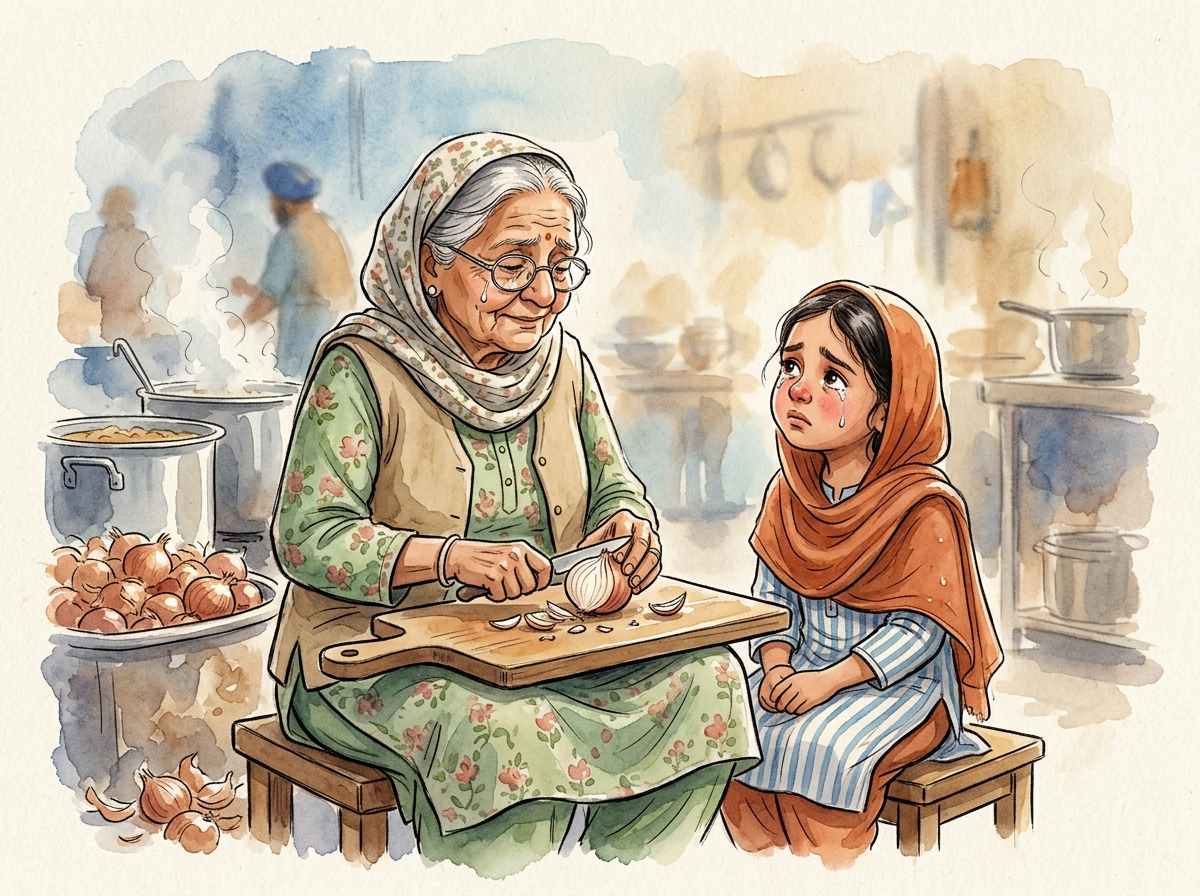
Biji pulled up a stool and sat down next to her. She picked up an onion, peeled it, and started chopping. Her own eyes began to water almost immediately.
"You know," Biji said, tears sliding down her wrinkled cheeks, "I have been cutting onions in this kitchen for thirty-seven years. And every single time, they make me cry." She sniffled. "Some days, the crying is just from the onions. But some days..." She shrugged her soft shoulders. "Some days, the onions just remind your heart that it had something to say."
Simran wiped her nose. "Is that weird?"
"Weird?" Biji looked at her, eyes red and watery. "Beta, look around this kitchen. Everyone here is giving something. Somebody kneads the dough, somebody stirs the dal, somebody washes the dishes. And sometimes, somebody sits on a stool and cries a little, and that is also okay. The kitchen holds it all."
Simran looked around. She saw the uncle flipping rotis and humming to himself. She saw two teenagers giggling as they tried to carry a pot that was clearly too heavy. She saw her dad across the room, stirring an enormous vat of rice, looking over at her with a little question on his face. She gave him a small wave, and he smiled and went back to stirring.
Biji nudged the cutting board toward her. "More onions?"
Simran took a shaky breath. She picked up the knife. She picked up an onion.
"More onions," she said.
They chopped side by side. Biji told her about the time she accidentally put sugar instead of salt in the dal, and everyone was too polite to say anything except one little boy who announced, very loudly, "THIS TASTES LIKE KHEER!" Simran laughed so hard she snorted, and Biji laughed too, and they were both still crying from the onions, so they were laughing and crying at the same time, which made them laugh even harder.
By the time Simran finished her last onion, the steel bowls were full to the brim with pale, glistening pieces. Her eyes were puffy. Her sleeves were damp. She felt lighter somehow, like she'd emptied something out along with all those tears.
Later, when she sat cross-legged on the floor of the langar hall with her dad, eating dal and roti off a steel tray, she took a big bite and tasted the onions — sweet and golden, melted right into everything.
"I helped make this," she said.
"I know," her dad said. "I can taste it."
That night, before bed, Simran pulled Amar's drawing out of her backpack. She looked at it for a long time — the two stick figures with big smiles, the wobbly building with an orange dome behind them. She didn't fold it back up. Instead, she pinned it on the wall next to her bed, where she could see it first thing every morning.
And if her eyes got a little blurry while she did it, well.
Strong onions.