The Grumpy Wind
Fable
Ages 6–8 · 10 min
A grumpy wind has one single thing to tell Ada on her walk home, but it has to snatch her scarf and turn her umbrella inside out just to get her to listen.
Every day after school, Ada walked home along Mulberry Lane, past the bakery with the striped awning, past the old stone wall covered in moss, and past Mrs. Huang's garden where the sunflowers stood tall as basketball players.
And every day that week, the wind followed her.
Every day after school, Ada walked home along Mulberry Lane, past the bakery with the striped awning, past the old stone wall covered in moss, and past Mrs. Huang's garden where the sunflowers stood tall as basketball players.
And every day that week, the wind followed her.
Not a nice, gentle breeze. Not a cool, refreshing gust. This was a grumpy, grumbly, humphing sort of wind that tugged at her backpack straps and messed up her hair and blew her homework right out of her folder.
On Monday, it started as a whisper behind her left ear.
"Adaaaaa."
She walked faster.
"ADAAAAA."
She pulled her hood up and stuffed her hands in her pockets and stared straight ahead.
"I'm not listening," she said. "You're just wind."
The wind huffed so hard it blew her hood right back down.
On Tuesday, the wind was waiting for her at the school gate. It rattled the chain-link fence like an impatient drummer. When Ada stepped outside, it swirled around her ankles like a grouchy cat.
"Ada, I need to talk to you."
"Wind doesn't talk," Ada said firmly. She had decided this. If wind didn't talk, then she didn't have to listen.
"Oh, REALLY?" said the wind, and it snatched her favorite red scarf right off her neck and hung it on a stop sign three blocks away.
Ada had to climb on a recycling bin to get it back.
"Rude," she said.
"LIKEWISE," said the wind.
On Wednesday, Ada tried a new route home. She went down Birch Street instead, which was longer but had a covered walkway near the dentist's office where she figured the wind couldn't reach her.
She was wrong.
The wind squeezed through the gaps in the walkway and made a sound like someone blowing across the top of a bottle — a low, sad, annoyed hoooooo.
"You can't avoid me forever, Ada. I have ONE thing to say. Just ONE."
"Then say it to someone else," Ada muttered.
"It's for YOU."
Ada put her hands over her ears and started humming the song they'd learned in music class, the one about the frog on the log. She hummed it loud and off-key all the way home.
The wind followed her right up to her front door, then let out a long, exhausted sigh that rattled every wind chime on the porch.
On Thursday, it rained, and Ada thought maybe — just maybe — the wind would take a day off.
It did not.
It was worse. Now it was a grumpy, wet wind. It blew rain sideways into her face. It turned her umbrella inside out — twice. It splashed puddle water onto her new sneakers, which were white and were supposed to stay white, at least for one week. That had been the deal she'd made with her mom.
"ADA. PLEASE."
"GO AWAY!" Ada shouted, right there on the sidewalk, in the rain, with her umbrella bent backward like a broken flower.
An old man walking his dog looked at her.
"Wasn't talking to you," Ada told him.
The old man walked a little faster.
The wind dropped to a murmur. "I just have one thing to tell you. One small, simple thing. Why won't you listen?"
Ada didn't answer. She stomped the rest of the way home, leaving wet footprints on the porch, and shut the door behind her.
Inside, the house was warm and quiet. Her mom was in the kitchen making soup. Her little brother was building a tower of blocks in the living room.
"How was your walk home?" her mom asked.
"Windy," Ada said.
On Friday, Ada stood inside the school doors for a long time before going out. She watched through the glass. The trees along Mulberry Lane were perfectly still. Not a single leaf moved. The flag on the flagpole hung limp as a sleeping bat.
"Ha," Ada said. "Finally."
She pushed open the door and stepped outside.
Nothing. Just warm, calm, quiet air.
Ada smiled. She started walking. Past the bakery — no wind. Past the old stone wall — no wind. Past Mrs. Huang's garden where the sunflowers stood perfectly still and peaceful.
Ada felt good. She felt great, actually. She felt —
A tiny breeze curled around her pinky finger. So soft she almost didn't notice.
"Ada?"
It was the wind. But it didn't sound grumpy this time. It sounded small. Tired. Like it had used up all its bluster and this little breeze was all it had left.
"Please," it whispered.
Ada stopped walking.
She stood there in the middle of the sidewalk with her backpack on and her red scarf around her neck, and she didn't put her hood up. She didn't cover her ears. She didn't hum the frog song.
She just stood still.
"Okay," she said quietly. "Okay, wind. What is it? What's your one thing?"
The little breeze swirled up from her pinky finger, around her wrist, past her elbow, and settled softly near her ear. And in a voice no louder than a leaf landing on grass, the wind said:
"You dropped something. Last Friday. In the park."
Ada blinked. "I… what?"
"Last Friday. You were sitting on the bench by the pond. You were reading. And something fell out of your pocket. I tried to catch it, but you walked away too fast."
Ada's hand went to her jacket pocket. She had been at the park last Friday. She'd been reading her library book on the bench by the pond. And later that night, she'd looked everywhere for —
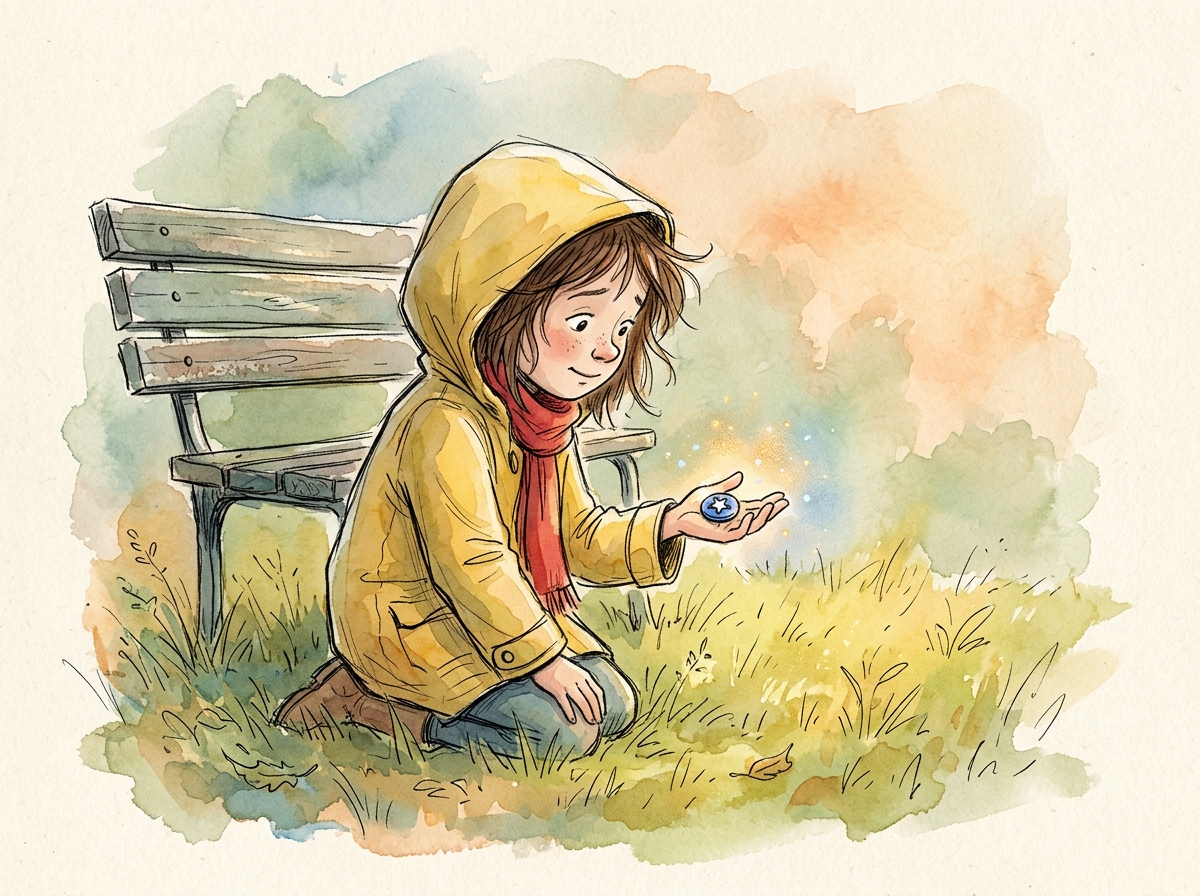
"My grandma's button," Ada whispered.
Her grandmother had given her a small, round, blue button with a tiny silver star in the middle. It had come off her grandmother's favorite coat — the one she used to wear when she walked Ada home from school, before she moved far away. Ada carried it everywhere. And last weekend, it was just… gone.
"It rolled under the bench," the wind said. "Between the slats. Into the grass. I've been sitting on it all week so it wouldn't get lost. But I'm the WIND, Ada. I can't sit still forever. I've been trying to TELL you."
Ada was already running.
She ran back past Mrs. Huang's garden, past the old stone wall, past the bakery, and through the park gate. She dropped to her knees beside the bench by the pond and looked underneath.
There, in the grass, tucked right against the leg of the bench, was a small, round, blue button with a tiny silver star in the middle.
Ada picked it up and held it tight in both hands.
"You kept it safe," she said.
The wind ruffled her hair — gently this time, the way her grandma used to.
"Of course I did," the wind said, and it sounded proud and grumpy and relieved all at once — the way someone sounds when they've been trying to help for a very long time and someone has finally, finally let them.
Ada sat down on the bench. She held the button up, and it caught the afternoon light, and the little silver star winked at her.
"Thank you," she said. "And… I'm sorry. For not listening."
"Hmph," said the wind, but it was a warm hmph. A forgiving hmph.
"You're welcome, Ada."
And then the wind blew softly through the park, shaking the trees just enough to make them sound like they were clapping, and it carried the smell of bread from the bakery and flowers from Mrs. Huang's garden. Ada sat on the bench and felt it all around her — not grumpy anymore, not pushy, just there, the way good friends are, even when you don't make it easy for them.
She put the button back in her pocket.
And she walked home the long way — down Mulberry Lane, with the wind beside her.