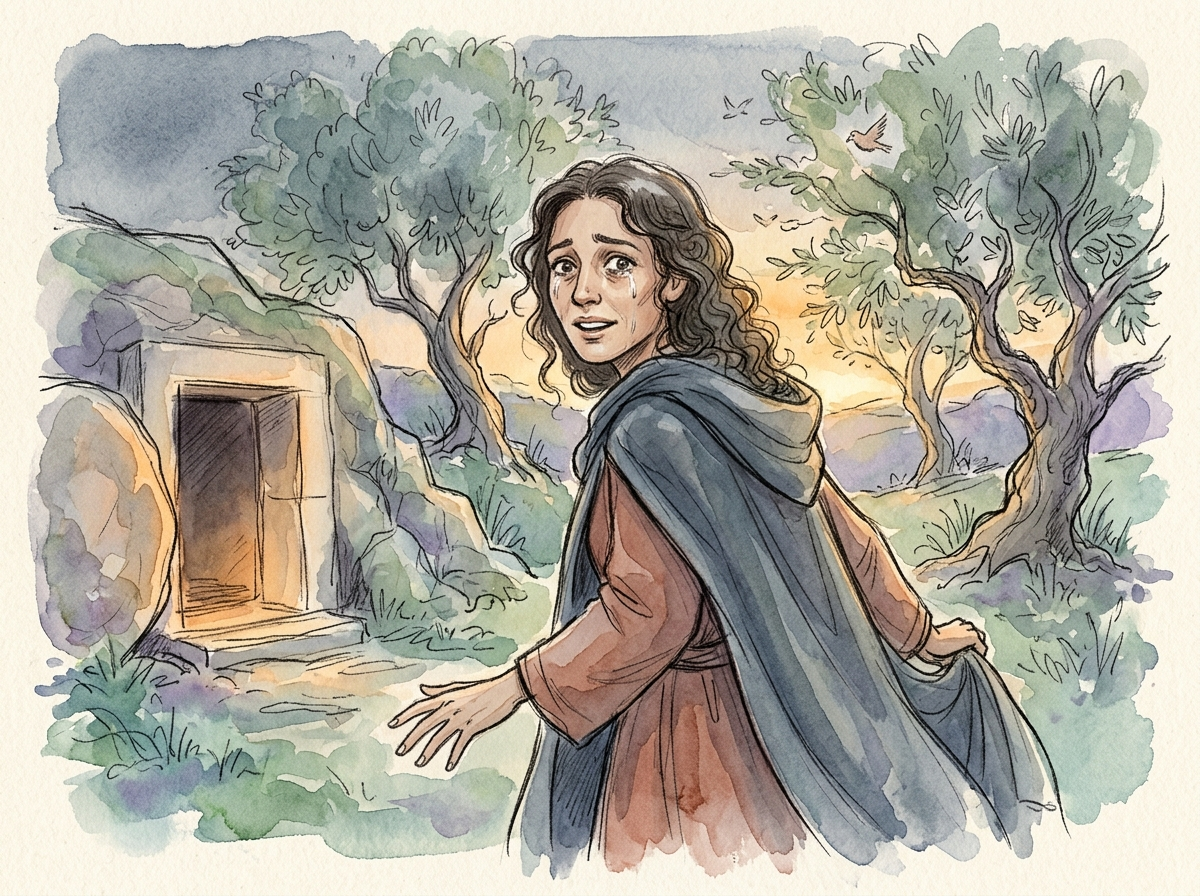
The Garden Before Dawn
Fable
Ages 9–11 · 11 min
Before the sun rises, Mary brings spices to the garden where Jesus was buried, but the massive stone sealing his tomb has been rolled away.
The world was still dark when Mary left the house.
She hadn't slept—not really. She'd lain on her mat with her eyes open, watching the ceiling, listening to the others breathe. Everyone in the house was exhausted. The kind of exhausted that comes not from working hard but from crying hard, from the weight of a grief so heavy it presses you flat against the ground and holds you there.
The world was still dark when Mary left the house.
She hadn't slept—not really. She'd lain on her mat with her eyes open, watching the ceiling, listening to the others breathe. Everyone in the house was exhausted. The kind of exhausted that comes not from working hard but from crying hard, from the weight of a grief so heavy it presses you flat against the ground and holds you there.
Two days ago, they had killed Jesus.
Mary Magdalene pulled her cloak tight around her shoulders and stepped into the street. The stones were cold beneath her sandals. No one else was awake. No lamps burned in any windows. Even the birds hadn't started yet.
She didn't have a plan, exactly. She just knew she needed to go to the tomb. She needed to be near him, even now—even though "him" was just a body wrapped in linen, lying behind a massive stone in a rich man's garden. She carried spices in a small cloth bundle, pressed against her chest. Myrrh and aloe. It was the only thing left she could do for him.
The road wound uphill through olive trees. Mary's feet knew the way even in darkness. She had walked every road Jesus walked for the past two years. She had been there when he healed people who had been sick their whole lives. She had been there when he fed thousands from almost nothing. She had been there when crowds cheered for him, and she had been there when crowds screamed for his death.
She had been there at the cross.
Most of the others had run. She didn't blame them—they were terrified, and she was terrified too. But she couldn't leave. Leaving would have meant he was alone, and she couldn't bear that. So she had stood there with a few others, close enough to hear him breathe, until he didn't breathe anymore.
Now, as she climbed the hill in the dark, she replayed everything. Every meal they'd shared. Every time he'd laughed—and he had laughed, more than people might think. That big, real laugh that made everyone around him start laughing too, even if they didn't know why. She thought about the first time she'd met him, when her life had been so broken she couldn't imagine it ever being whole. He had looked at her, and it was like being seen—truly seen—for the first time. Not judged. Not pitied. Just known.
And now he was gone.
The garden came into view as the sky began to lighten—not with color yet, just with the faintest softening of black into deep, deep blue. Mary could make out the shapes of trees, the low wall around the garden, the dark mouth of the tomb cut into the hillside.
She stopped walking.
The stone was moved.
The enormous, heavy, round stone that had been rolled across the entrance—the one that had taken several men to push into place—was sitting off to the side, as if someone had nudged it like a pebble.
The tomb was open.
Mary's heart, which had been heavy and slow with grief, suddenly slammed against her ribs. She ran. Not toward the tomb—away from it. Back down the hill, her sandals slapping the stones, her cloak flying behind her, the bundle of spices forgotten somewhere on the ground.
She found Peter and John still in the house and burst through the door, gasping.
"They've taken him," she said. "Someone moved the stone. He's gone. They've taken him and I don't know where they put him."
Peter was on his feet before she finished. John was already at the door. The two men ran, and John—younger, faster—reached the tomb first. He stopped at the entrance and bent down to look inside but didn't go in. When Peter arrived, breathing hard, he pushed straight past and ducked inside.
The tomb was empty. But the linen wrappings were still there—folded neatly, carefully, the cloth that had covered his face rolled up and set aside in its own place. Not torn. Not scattered. Not what you'd expect if someone had stolen a body in a hurry.
Peter and John looked at each other. They didn't understand what they were seeing. After a while, not knowing what else to do, they went home.
But Mary had followed them back. And Mary stayed.
She stood outside the tomb in the gray almost-light and cried. Not quietly. She cried the way you cry when you have lost the person who mattered most, and now you can't even sit beside the place where they were laid, because someone has taken even that from you. She cried with her whole body, her shoulders shaking, her hands pressed over her face.
Finally, she bent down and looked into the tomb.
Two figures sat inside, dressed in white, one where his head had been and one where his feet had been. "Woman, why are you crying?" they asked.
She answered without even wondering who they were or why they were there, because her grief was bigger than any surprise. "They have taken my Lord away," she said, "and I don't know where they've put him."
She turned around.
A man was standing in the garden. The light was still thin and hazy. She could see his shape near the trees, and she thought he must be the gardener. Someone who worked here. Maybe he would know what happened.
"Woman, why are you crying?" he asked. "Who are you looking for?"
"Sir," she said, and her voice cracked, "if you've carried him away, please tell me where you've put him. I'll take him. I'll carry him myself."
She meant it. She would have carried him across the whole city if she had to. She didn't care how far it was or how heavy he would be. She just wanted to bring him somewhere safe—somewhere she could sit with him and say goodbye properly. She was so tired. So impossibly, achingly tired of losing things.
The man in the garden said one word.
"Mary."
Just her name. That was all. But she knew that voice. She knew the way it sounded when it said her name—the way it always had, from the very first time, with warmth and knowing and an impossible gentleness, as if her name was something precious.
Her breath stopped.
The gray garden went sharp and vivid around her. She could feel the cool air on her wet face. She could smell the earth, the dew on the leaves, the green scent of growing things. The sky above the hills had turned the color of a pale shell, and the first birds—she hadn't even noticed—the first birds were singing.
"Rabboni!" she cried.
Teacher.
She reached for him. Of course she reached for him—you reach for the person you thought was gone forever and is suddenly, impossibly, here. Standing in a garden. Speaking your name. Alive.
He was alive.
Not alive the way people meant when they said they could still feel someone in their heart, or alive in memory, or alive in spirit. He was alive alive—standing, breathing, talking, real. The same Jesus who had laughed at meals and walked dusty roads and looked at her like she was known.
"Go tell the others," he said to her. "Go and tell them."
And Mary ran again—but this time, everything was different. The same feet on the same stones, the same cloak flying, the same burning lungs and pounding heart. But two days ago the world had ended, and now it was being remade, and she was the first one to know. She was the first person he had spoken to. Not Peter, not John—they had come and gone. He had waited for her. He had waited for the one who stayed in the garden, crying in the dark, unwilling to leave.
She burst through the door for the second time that morning. Everyone was still there—Peter and John, and the others, sitting in their grief, hollow-eyed and broken.
"I have seen him," Mary said. "He's alive. I've seen him."
They stared at her. Some of them didn't believe it. She could see it in their faces—the doubt, the pity, the worry that grief had broken her mind.
It didn't matter. She knew what she knew. She had heard her own name spoken by the voice that had called her out of darkness years ago, and it was the same voice, and he was not dead.
Outside, the sun finally broke over the hills. Light poured through the doorway and across the floor, warm and golden, reaching into every corner of the room.
The longest night was over.
And it was Mary Magdalene—the one who had come to the garden before dawn, carrying nothing but her grief and her stubborn, unshakable love—who brought the first word of morning.