The Empty Table
Fable
Ages 9–11 · 12 min
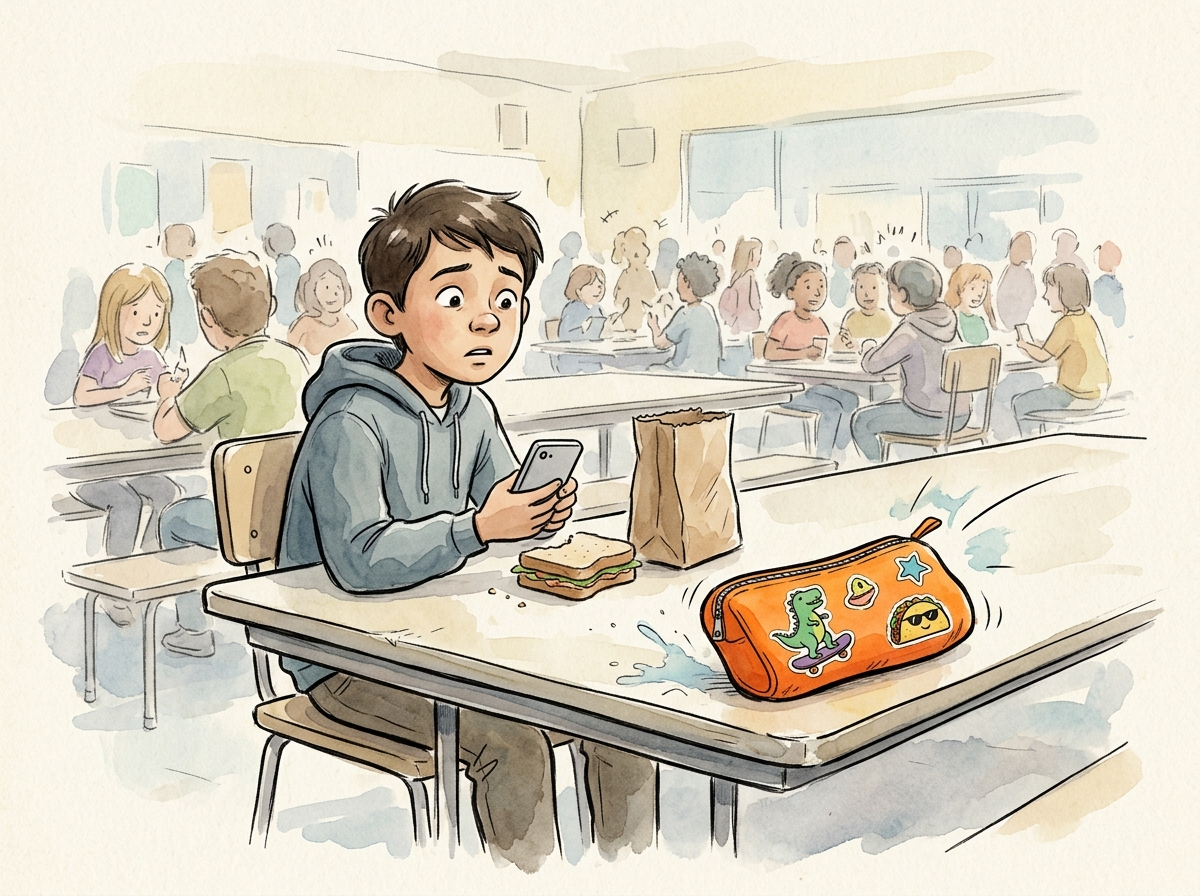
After moving to a new town, Diego eats his lunch alone at an empty table in the school cafeteria, scrolling through messages from his old friends.
Starting Over
Diego counted the ceiling tiles above his bed for the third morning in a row. Forty-seven. Same as yesterday. Same as the day before. At least the ceiling tiles weren't going anywhere.
Starting Over
Diego counted the ceiling tiles above his bed for the third morning in a row. Forty-seven. Same as yesterday. Same as the day before. At least the ceiling tiles weren't going anywhere.
"Diego! Breakfast! You're going to be late!" Mom's voice floated up the stairs, bright and cheerful in that way she'd been doing ever since the move — like if she sounded happy enough, the whole family would just catch it like a cold.
He pulled on a hoodie he didn't care about, grabbed his backpack, and trudged downstairs. The kitchen still smelled wrong. Their old apartment had smelled like Dad's coffee and the neighbor's curry and the oak tree outside the window that somehow made everything smell green. This kitchen smelled like fresh paint and cardboard boxes.
"Turkey sandwich or PB&J?" Mom asked, already spreading peanut butter.
"Either."
She looked at him with that soft, careful expression. The one that meant she wanted to ask how he was really doing. He grabbed an apple from the counter before she could.
"PB&J's fine. Thanks, Mom."
Westbrook Middle School was shaped like a giant H, which Diego thought was fitting because every hallway felt like an obstacle course of people who already knew exactly where they were going. They moved in clusters — laughing groups that split and reformed around him like water flowing past a rock in a stream.
He knew the basics by now. Locker 247, combination 14-32-8. Mrs. Huang for homeroom. Mr. Pascoe for math, who talked with his hands so much he'd already knocked his coffee over twice. Science with Ms. Adler, who seemed cool. English with Mr. Kim, who was definitely cool.
But knowing the basics wasn't the same as knowing the place.
The morning classes crawled by. Diego answered one question in science — correctly — and a girl with red glasses glanced back at him for half a second. That was the most human interaction he'd had all day, unless you counted the kid who'd said "my bad" after stepping on his foot in the hallway.
And then came lunch.
Diego walked into the cafeteria holding his brown paper bag like a shield. The noise hit him first — hundreds of voices crashing together into a wave of sound. Every table was a little island, and every island was full.
He recognized the geography of it immediately. Loud table near the windows: athletes. Cluster of kids hovering around someone's phone near the vending machines: probably gamers. A table in the far corner where kids had books and notebooks spread everywhere: the studious ones. Two tables pushed together in the middle where people seemed to be doing more laughing than eating: the popular orbit.
Diego scanned for an empty spot the way you'd scan for a life raft.
There. A table near the emergency exit with nobody at it except a crumpled napkin someone had left behind. He sat down, opened his bag, and unwrapped his sandwich.
Day three of eating alone.
He tried to look like it was a choice. Like he preferred it. He took slow, deliberate bites and stared at his phone, scrolling through messages from Marco and Jaylen back home — back in his real home — a meme about a cat wearing a sombrero, Marco asking if he'd seen the new Zelda trailer, Jaylen complaining about their math teacher. Diego typed back a bunch of laughing emojis he didn't really feel.
Halfway through his sandwich, something landed on his table with a clatter.
A pencil case. Bright orange, covered in stickers — a dinosaur riding a skateboard, a taco with sunglasses, a cat that looked weirdly philosophical.
"Sorry! Sorry, sorry —"
A kid scrambled over, slightly out of breath, dark curly hair flopping in every direction. He grabbed the pencil case, then paused, looking at Diego like he'd just noticed he existed.
"Oh. Hey. You're the new kid, right?"
Diego braced himself. He'd been "the new kid" approximately forty-seven times in three days — the same number as his ceiling tiles, which felt cosmically unfair.
"Yeah."
"Cool. I'm Nico." The kid didn't leave. Instead, he dropped into the seat across from Diego like he'd been invited. "My pencil case has a death wish. It jumps off tables. I think it's trying to escape."
Diego blinked. "Maybe it doesn't like school."
"Can't blame it. Today in social studies, Mr. Branson made us do a timeline of the Roman Empire entirely from memory. From memory. My timeline had like three things on it. Romans exist. Romans do stuff. Romans stop existing."
Diego almost smiled. Almost.
Nico pulled out his own lunch — a squished burrito wrapped in foil and a bag of chips that looked like they'd lost a fight with a textbook. "You eat here every day?"
The question was light, casual. But it pressed right against the bruise Diego had been carrying for three days. He shrugged.
"I just started Wednesday."
"Right, right. Mid-year transfer. That's brutal." Nico said it matter-of-factly, not with pity, which made it easier to hear. "Where'd you come from?"
"Riverside."
"Oh, nice. I've got cousins out there. You miss it?"
Diego looked down at his sandwich. The peanut butter had gotten thick and sticky. "Yeah," he said. "A lot."
Nico nodded like that was a completely reasonable thing to say. Then he shoved half his burrito in his mouth and talked through it: "Okay, shso, do you play shoccer?"
"What?"
Nico swallowed. "Soccer. Do you play soccer?"
"A little. I mean — yeah. I played on a team back home."
"We need people. Our lunch soccer game is desperate. Matteo moved to forward and he's terrible at it, but nobody wants to tell him because he's sensitive. Like, really sensitive. He cried when we dissected worms in bio."
"I played midfielder," Diego offered.
Nico's face lit up like Diego had just said he could fly. "Are you serious? Dude. Come play with us Monday."
"I don't know anyone."
"You know me."
Diego considered this. He'd known Nico for approximately two and a half minutes. But Nico was already pulling out his phone, saying, "Here, what's your number? I'll add you to the group chat. Fair warning: it's ninety percent memes and ten percent actual soccer talk."
Diego gave him his number. His thumbs felt clumsy typing, like they'd forgotten how to do something that used to be easy.
The bell rang. Nico crumpled his foil into a ball, tossed it at the trash can from six feet away, and missed completely.
"That," Nico said, pointing at the foil on the floor, "is why I don't play basketball." He picked it up, dropped it in properly, and grinned. "See you Monday, Diego."
That weekend, Diego lay on his bed and stared at the ceiling tiles again. Still forty-seven. But his phone buzzed, and it was the group chat — someone named Priya had sent a video of a golden retriever trying to play soccer, and someone named Matteo (the sensitive one, presumably) had responded with seventeen heart emojis.
Diego watched it twice. The dog was genuinely terrible at soccer. He sent a laughing emoji — and this time, he actually meant it.
Monday came faster than any day that week. Diego dug his cleats out of the moving box by the garage — he'd asked Mom where they were, and she'd told him without asking why, though her eyes had gone bright and hopeful in a way that made him look away.
At lunch, he ate fast. PB&J in approximately four minutes. Then he walked out to the field behind the school where a group of kids were already kicking a ball around.
Nico spotted him immediately. "DIEGO! Get over here! Matteo's already in goal crying because someone kicked it too hard."
"I'm not crying!" a stocky kid protested from the goal. "My eyes are watering! It's allergies!"
"It's January, Matteo."
"I have winter allergies!"
Diego jogged over. His chest felt tight — the kind of tight that came from wanting something to go right so badly you almost couldn't breathe.
Nico tossed him a penny jersey. "You're on our team. Show us what Riverside taught you."
The game started messy, the way lunch soccer always does — too many people, not enough structure, someone arguing about whether the ball went out of bounds when there weren't even real boundaries. But Diego's feet remembered what to do. He received a pass, controlled it, looked up. Saw space on the left side. Threaded the ball through to a girl with red glasses — the same girl from science — who took a shot that sailed just over the backpack they were using as a goalpost.
"Close!" she yelled, then turned to him. "Good pass. I'm Priya."
"Diego."
"I know. You got that question right about tectonic plates. I was impressed."
Something warm flickered in his chest. Small, but real.
The game went on. Diego scored once — a lucky bounce off someone's shin that Nico loudly insisted was "pure skill." Matteo let in four goals and blamed the wind, the sun, and his winter allergies. A kid named Oscar did a slide tackle on the concrete and immediately regretted it. Priya turned out to have a left foot like a cannon.
When the bell rang, Diego was sweating and breathing hard and his cheeks hurt.
It took him a second to realize it was because he was smiling.
Walking back inside, Nico fell into step beside him.
"Same time tomorrow?"
Diego looked down the hallway — the same H-shaped hallway that had felt like a maze last week. Kids streamed past them. A few nodded at Nico, and then at Diego, because he was next to Nico, and that seemed to be enough for now.
It wasn't Riverside. It wasn't Marco and Jaylen and the curry smell and the green oak tree. It wasn't home. Not yet.
"Yeah," Diego said. "Same time tomorrow."
He walked into fifth period and sat down, and for the first time in this new place, he didn't count a single tile.