The Elephant Who Forgot
Fable
Ages 6–8 · 11 min
Deep in the savanna, Elara the elephant keeps track of every lost acorn and forgotten birthday until she wakes up with a strange, empty hole where one of her own memories used to be.
Elara was an elephant who remembered everything.
She remembered the exact spot where the sweetest mangoes fell every September. She remembered the sound her grandmother's footsteps made on dry leaves — a soft crunch-crunch-crunch that was different from every other elephant's walk. She remembered the day she was born, or at least she said she did, and nobody could prove otherwise because, well, she was an elephant, and elephants never forget.
Elara was an elephant who remembered everything.
She remembered the exact spot where the sweetest mangoes fell every September. She remembered the sound her grandmother's footsteps made on dry leaves — a soft crunch-crunch-crunch that was different from every other elephant's walk. She remembered the day she was born, or at least she said she did, and nobody could prove otherwise because, well, she was an elephant, and elephants never forget.
The other animals came to Elara whenever they needed to remember something.
"Elara, where did I bury my acorns?" the squirrel would ask.
"Third oak tree past the river, two tail-lengths to the left, right under the mossy rock."
"Elara, when is my birthday?" the hippo would ask.
"Next Tuesday. You'll be eleven. You like mud cake."
"Elara, what's my name?" the very old tortoise would ask.
"Gerald."
"Ah, yes! Gerald. That's a good one."
Elara remembered it all. Every raindrop pattern, every birdsong, every bedtime story her mother ever told her. Her memory was enormous — even bigger than her ears, and her ears were very big.
But one morning, Elara woke up and something felt wrong.
She stood at the edge of the watering hole, staring at her reflection. The water was still and glassy. Her big gray face looked back at her. Everything seemed normal — trunk, tusks, two wise brown eyes. But deep inside her chest, in the place where she kept all her rememberings, there was a hole. A small, empty, Elara-shaped hole.
She had forgotten something.
"Oh no," she whispered. "Oh no, oh no, oh no."
An elephant who forgets something is like a fish who forgets how to swim, or a bird who forgets which way is up. It's not supposed to happen. It had never happened. Not to Elara.
She paced back and forth, her big feet making soft thud-thud-thud sounds in the dirt. What was it? What had she forgotten? Was it something big? Was it something small? Was it something in-between, like a medium-sized thing that only seemed small but was actually very important?
She didn't know. And not knowing was the worst part.
"I'll find it," she said, lifting her trunk with determination. "I just have to look."
First, she went to the mango grove.
She sniffed every tree. She counted every branch. Seventeen trees, two hundred and four branches, one hornbill nest on the left side of the tallest trunk. Everything accounted for. Nothing forgotten here.
Next, she visited the river.
She listened to the water. She remembered every fish — the spotted one, the fast one, the one that always swam in circles for no reason. She remembered the exact shape of every stone on the riverbed. Nothing was missing.
She walked to the big acacia tree where the baboons lived. She checked on the hill where the zebras grazed. She visited the termite mounds and the warthog dens and the place where the rainbow always touched the ground after a storm.
Everything was right. Everything was where it should be.
But the hole in her chest was still there, and it was getting bigger.
By afternoon, Elara was tired and worried. She sat down — THUMP — under a baobab tree so wide that even she looked small next to it. She rested her head against its trunk and closed her eyes.
"You look terrible," said a voice.
Elara opened one eye. It was Kip, the small brown weaver bird who lived in the baobab tree. He was hanging upside down from a branch, looking at her with his head tilted.
"I forgot something," Elara said quietly. It was hard to say out loud. Her voice wobbled a little.
Kip almost fell off his branch. "YOU forgot something? You? Elara who remembers what the clouds looked like four Julys ago?"
"Fluffy with a flat bottom, slight gray on the western side," Elara murmured. "Yes. Me."
Kip flew down and landed on her knee. "Well, what did you forget?"
"That's the problem, Kip. If I knew what I forgot, I wouldn't have forgotten it."
Kip thought about this for a moment. "Fair point," he said. "Have you tried retracing your steps?"
"I've been everywhere. The mango grove, the river, the hills, the dens. I checked everything."
"Hmm," said Kip. "What about yesterday? What happened yesterday?"
Elara closed her eyes. "I woke up at dawn. I ate breakfast — four bundles of grass and a papaya. I walked to the watering hole. I helped Gerald remember his name. I watched the sunset. The sky was orange, then pink, then deep purple with exactly fourteen stars visible before I fell asleep."
"That sounds like a perfectly normal day," Kip said.
"It was," Elara sighed. And then, very quietly, she added, "Maybe that's the problem."
Kip didn't understand. Neither did Elara, not yet.
The afternoon stretched on. The shadows grew long. Other animals started to notice that Elara wasn't her usual self. The squirrel brought her an acorn. The hippo splashed water in her direction to make her smile. Gerald the tortoise walked all the way across the field, which took him two and a half hours, just to sit beside her.
"You look like someone who lost something," Gerald said.
"I forgot something," Elara told him. "And I've looked everywhere."
Gerald nodded very slowly, the way tortoises do. "Have you looked everywhere, though? You've been checking on the places. Have you checked on the creatures?"
Elara blinked. "What do you mean?"
But Gerald had fallen asleep, because he was very old and the walk had tired him out.
Elara sat with his words. Checked on the creatures. She looked around. The squirrel was nearby. The hippo was in the watering hole. Gerald was right here, snoring softly.
And then she noticed something she hadn't noticed all day.
Kip was quiet.
The little weaver bird was still sitting on her knee, but he wasn't chattering. He wasn't bouncing. He was just sitting there, very still, looking at the sunset.
"Kip?" Elara said gently. "Are you all right?"
Kip didn't answer right away. Then he said, in a very small voice, "Today's the day I finished my nest. My first real nest. I've been building it for three weeks. I wove every piece of grass myself."
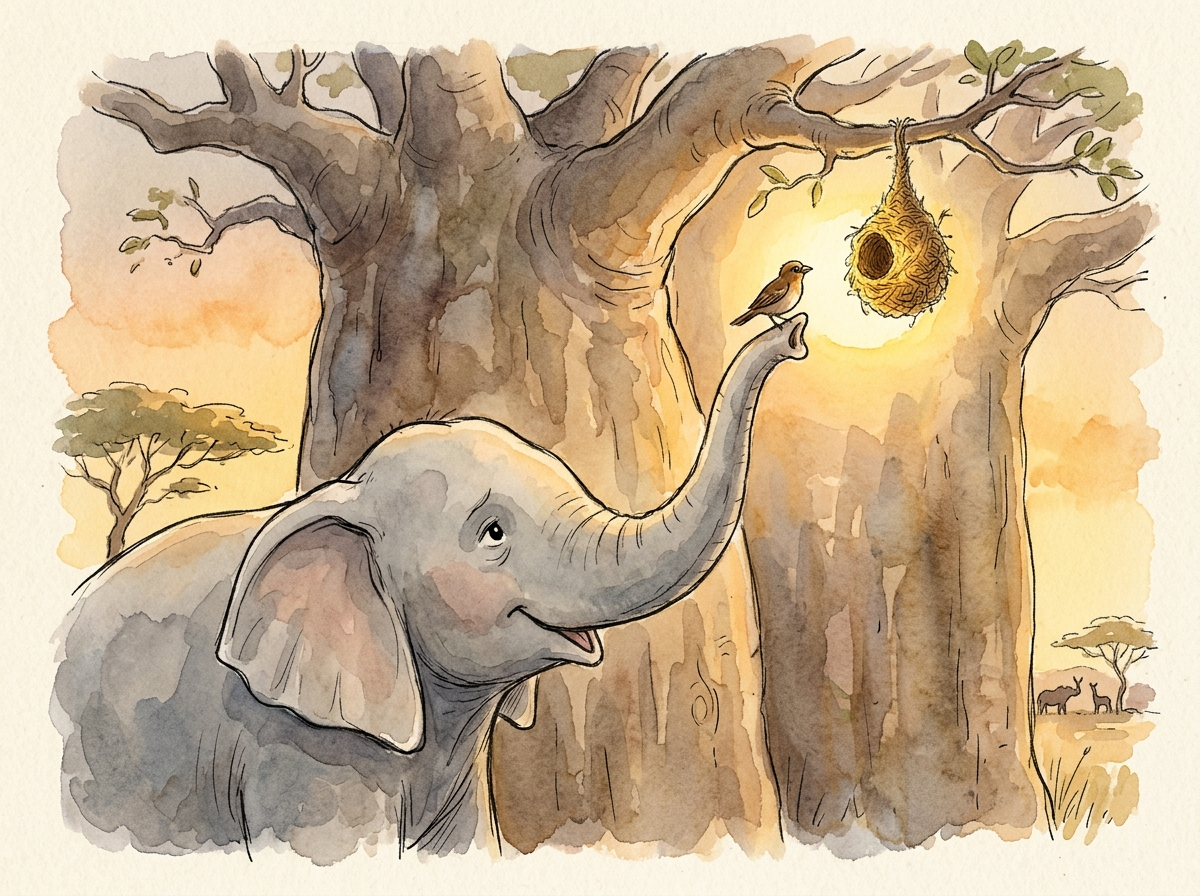
Elara looked up at the baobab tree. There, hanging from a branch, was the most beautiful little nest she had ever seen. Golden grass, perfectly woven, swaying gently in the breeze. It was round and snug and wonderful.
"Kip," Elara breathed. "It's magnificent."
"You didn't notice it this morning," Kip said, and he wasn't angry. He was just sad, in a quiet, bird-sized way. "I thought you'd remember. You always remember everything. I told you last week it would be done today."
And just like that — like a raindrop hitting the surface of a still pond — Elara remembered.
Kip had told her. Last Thursday, while sitting on her ear, he'd said, "Five more days, Elara. Five more days and my nest will be finished. Will you come see it?"
And she had said, "Of course."
And then she had forgotten.
The hole in her chest filled up — not with the memory itself, but with something much heavier. She had remembered every mango, every stone, every cloud in the sky. But she had forgotten her friend's important day.
"I'm sorry, Kip," Elara said softly.
Kip hopped onto her trunk. "It's okay."
"It's not," Elara said. "You worked so hard. I should have been here first thing this morning, telling you how proud I am. Because I am proud of you. That nest is the finest nest in the whole savanna."
Kip fluffed up his feathers, which is what weaver birds do when they're trying not to cry happy tears. "You really think so?"
"I know so. And I will never, ever forget it."
She lifted him up, up, up on her trunk, all the way to the branch where his nest hung. The last light of the sun caught the golden grass, and it glowed like a tiny lantern in the tree.
"It really is beautiful," Elara said.
And for the rest of her life, whenever anyone asked Elara what she remembered most, she would not say mangoes or rainstorms or the shape of clouds in July.
She would say, "A nest. A small, golden nest. And the friend who built it."