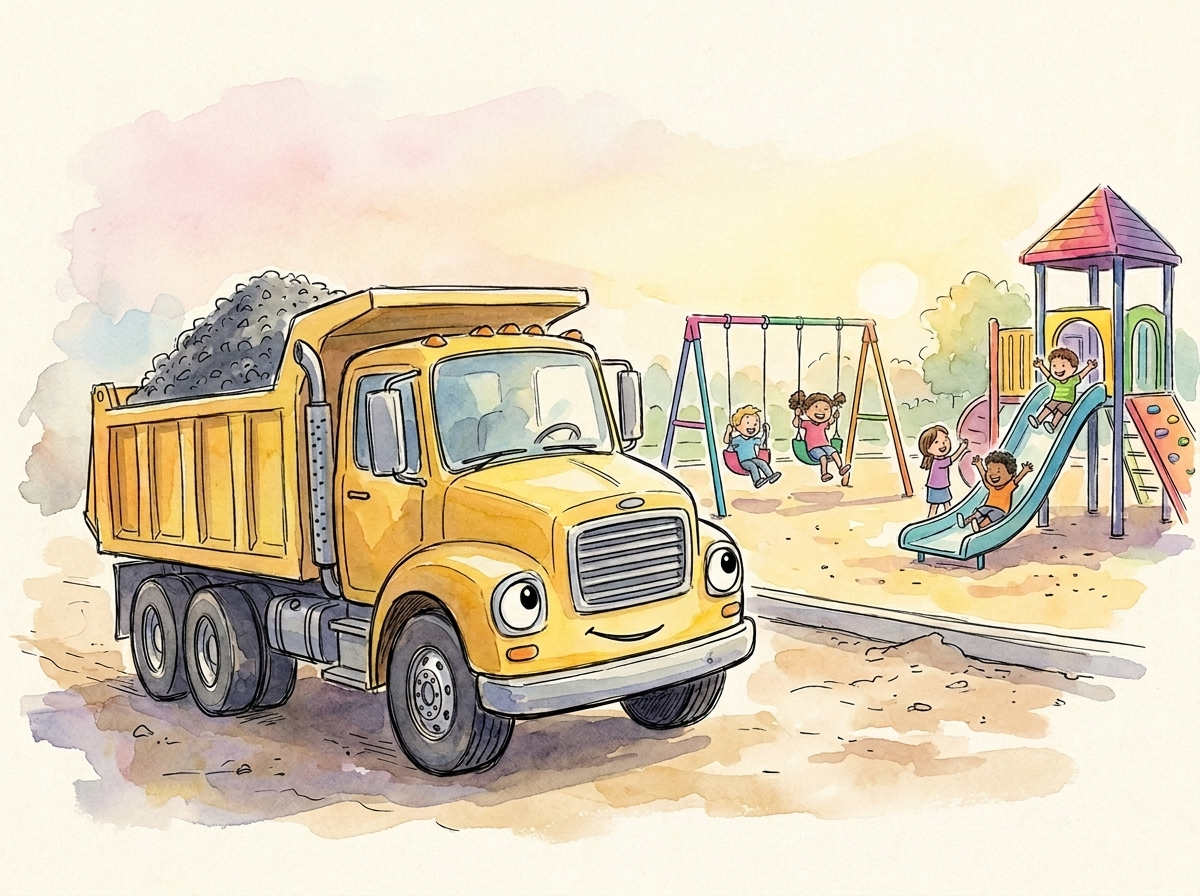
Clyde was a dump truck — big and yellow and proud.
Every morning he rumbled down the dusty road to the quarry, where the excavator scooped heavy loads of rock and sand and gravel right into his bed.
THUNK. THUNK. THUNK.
Clyde loved that sound.
He loved the way each rock landed with a rattle. He loved how his bed got heavier and heavier until his tires squished flat against the ground. He loved being full.
"Looking good, Clyde!" the excavator would say.
And Clyde would rumble with pride.
Then came the part Clyde did not love.
The foreman would blow his whistle and point down the hill toward the building site. "Time to dump, Clyde!"
But Clyde didn't want to dump.
He had worked SO hard to collect all that rock. Every single piece! Why would he just… tip it out?
So Clyde didn't.
He drove right past the building site. He kept his bed down flat. He held on tight to every last pebble.
"Clyde!" called the foreman. "We need that gravel!"
But Clyde just kept driving.
He drove all the way through town with his bed full and heavy. Past the bakery. Past the school. Past the pond where the ducks floated in a line.
"Nice rocks!" quacked a duck.
"Thank you," said Clyde. "I collected them myself."
He parked beside the pond and sat there, full and proud, watching the sun sparkle on the water and sparkle on his gravel.
This was perfect.
But then — the road by the bakery needed fixing. There were potholes everywhere, big as bathtubs! Cars bounced. Bicycles wobbled. A lady's grocery bag flew right off her basket and — SPLAT — eggs on the road.
Nobody could fix the road without gravel.
And nobody had any gravel.
Because Clyde had all of it.
The foreman walked all the way through town. He sat down on the curb next to Clyde, right by the pond.
He didn't blow his whistle. He didn't yell.
He just sat.
"Clyde," he said quietly. "Do you know what happens to your rocks after you dump them?"
Clyde's engine idled low. "They're just… gone."
"No, no," said the foreman. "Come look."
They went together back through town — bumping slowly over the potholes — all the way to the building site.
And Clyde saw something he had never really looked at before.
The gravel he had dumped last week? It wasn't gone. It was under the new road. Smoothed out flat and packed down tight so that cars could drive and bikes could roll and people could walk without tripping.
His rocks were holding everything up.
"You see that library?" said the foreman. "Your gravel is under it. And the playground? Your sand is in the concrete. That stuff you carried — it didn't disappear, Clyde. It turned into something."
Clyde sat very still.
He looked at the road. He looked at the library. He looked at the playground, where kids were sliding and swinging and laughing.
His rocks were under all of it.
Clyde drove back through town one more time. He stopped right at the bakery road, where the potholes gaped and the eggs were still splattered.
He took a big, deep breath.
His bed tilted — slowly, slowly — higher and higher —
And WHOOOOSH!
All that beautiful gravel came sliding out in a great gray wave, filling the holes, covering the cracks, tumbling and rattling and settling into place.
THUNK. THUNK. THUNK.
Clyde loved that sound too.
His bed was empty now. Light and open and ready.
A lady on a bicycle rolled over the fresh gravel. Smooth. No wobble.
"Thanks, Clyde!" she called.
Clyde rumbled back toward the quarry, his empty bed bouncing in the sunshine. The excavator was waiting.
"Ready for more?" it asked.
Clyde opened his bed wide.
"Fill me up."