The Drawing She Kept
Fable
Ages 9–11 · 12 min
For a girl named Faye who throws away everything she creates, a single crayon drawing from kindergarten is the only piece she has ever wanted to save for the town art show.
Faye threw things away.
Not regular things — not socks or apple cores or the Sunday comics after she'd read them twice. Faye threw away the things she made.
Faye threw things away.
Not regular things — not socks or apple cores or the Sunday comics after she'd read them twice. Faye threw away the things she made.
She'd been doing it since she was six years old, and now she was ten, and the habit was as much a part of her as her left-handedness or the way she sneezed exactly three times in a row, never two, never four.
It worked like this: Faye would make something — a drawing, a clay figure, a story scrawled in purple marker — and for a few glowing minutes, she'd feel a warm hum in her chest, like she'd caught a firefly in her ribs. Then she'd look at it again. Really look. And the hum would go cold, and she'd think, That's not it. That's not what I meant. And into the trash it went.
Her bedroom wastebasket was always full.
Her mom had tried to save things over the years — sneaking drawings out of the recycling bin, tucking clay animals into her own dresser drawer. But Faye always found out, and she'd get that pinched look between her eyebrows.
"Mom, please. It's not good."
"It's wonderful, Faye."
"It's not what I was trying to make."
Her mom would sigh the kind of sigh that meant she had a hundred more things to say but was choosing to hold them all in her mouth like hard candy.
The summer Faye was ten, three things happened.
First, her grandmother came to stay with them for two weeks while her apartment got new floors. Grandma Lise was seventy-four years old, had opinions about everything, and carried a tote bag that said "I'M PROBABLY RIGHT" in block letters.
Second, the community center on Maple Street announced a children's art show. Every kid in town could submit one piece. Just one. It would hang in the big front window for all of August, and the mayor would come and eat cake and say something boring, and everyone would clap.
Third — and this was the thing that mattered most — Faye found the drawing.
It happened on a Tuesday. Grandma Lise had taken over Faye's room for the visit — "You've got the best mattress, sweetheart, and my back is older than some countries" — so Faye was sleeping in the little guest room at the end of the hall. The guest room had a closet that stuck, and inside that closet were boxes that hadn't been opened since the family moved in four years ago.
Faye was bored. Faye opened the boxes.
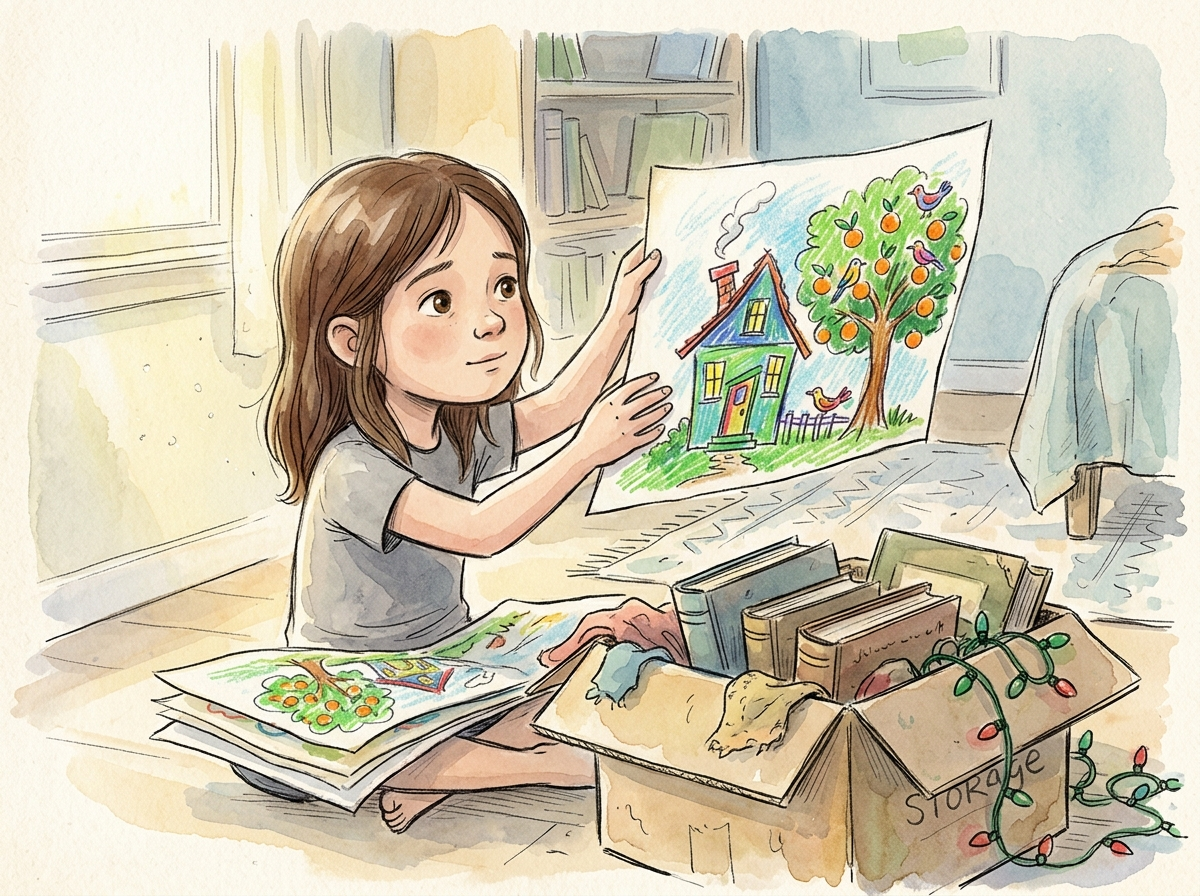
Most of it was junk — old tax papers, a broken blender, a bag of tangled Christmas lights that would never untangle in a million years. But in the third box, under a stack of her mom's college textbooks, she found a flat manila envelope, and inside the envelope was a drawing.
A drawing she had made.
Faye knew it immediately — the way you know your own handwriting, even from years ago, even when it was shaky and six years old and the letters leaned all different directions. This was hers. She'd drawn it with crayons on thick white paper, the kind they gave you at the good art table in kindergarten.
It was a picture of a house. But not their house — not any real house. It was tall and narrow and leaning slightly to the left, with seven windows of different sizes and a door that was round like a hobbit's. There was a tree next to it, except the tree was bright orange and had birds sitting on every branch — fat, round birds, each one a different color, each one with a slightly different expression. One looked grumpy. One looked like it was telling a joke. One was asleep.
The sky behind the house wasn't blue. It was a swirl of green and purple and gold, like the Northern Lights had come down low enough to touch the chimney.
Faye stared at it for a long time.
She felt the hum. The warm one. The firefly one.
She waited for it to go cold. She waited for the voice in her head to say, That's not it. That's not what you meant. She waited, and she kept waiting, sitting cross-legged on the guest room floor with the drawing in her lap.
The voice didn't come.
The drawing was — she didn't have a word for it. It wasn't perfect. The house was crooked. The birds were lumpy. One of them might have been upside down; it was hard to tell. But it was exactly, completely, top-to-bottom right. It was the thing she'd meant to make. Somehow, at six, sitting at the good art table with a fistful of crayons, she had reached into the tangled hum inside her chest and pulled out something that matched.
She couldn't explain it. She didn't try.
Grandma Lise found her still sitting there twenty minutes later.
"What've you got?"
Faye held it up.
Grandma Lise put on her reading glasses, then took them off again, then put them back on. She tilted her head. She made a small "hm" sound.
"You made this."
"When I was six. I don't even remember making it."
"It's something," Grandma Lise said. "It's really something." She sat down on the edge of the guest bed, which creaked like it had feelings about it. "You going to throw it away?"
Faye looked at the drawing again. The grumpy bird. The round door. The sky that couldn't decide what color it wanted to be.
"No."
Grandma Lise nodded like this was the answer she expected. "You know about the art show at the community center?"
"I'm not putting it in the art show."
"I didn't say you should."
"You were about to."
"I was about to say nothing. I was going to sit here in dignified silence." Grandma Lise folded her arms. "But since you brought it up—"
"You brought it up!"
"—it would look awfully nice in that big front window."
Faye said no. She said no at breakfast the next morning and no at lunch and no during the car ride to the grocery store. She said no so many times that the word started to sound weird in her mouth, the way any word does if you repeat it enough. No. No. Noooo. Nnnnno.
The drawing sat on the guest room nightstand, leaning against the lamp. Every time Faye walked past it, she felt the hum.
Here was the problem. Faye had thrown away hundreds of things she'd made. Drawings, paintings, a whole series of comic strips about a detective cat named Sergeant Whiskers. She'd thrown them away because they weren't right, because the finished thing never matched the bright, buzzing picture in her head. And she'd started to believe — quietly, in the way you believe things you've never said out loud — that maybe nothing she made would ever be right. That the hum would always go cold. That the gap between what she imagined and what she created was just her, was just how she was built.
But here was this drawing. This lumpy, crooked, completely right drawing. And it had been sitting in a box for four years.
On Thursday evening, Faye brought the drawing to the kitchen table where Grandma Lise was doing a crossword puzzle and her mom was chopping onions and pretending not to cry.
"If I put it in the show," Faye said, "people will see it."
"That is generally how shows work," said Grandma Lise.
"What if they don't think it's good?"
Grandma Lise put down her pencil. "Do you think it's good?"
Faye looked at the drawing. She thought about the gap — the big, dark gap between what she imagined and what she made. She thought about how this one drawing, this one time, the gap had closed, and the thing in her hands and the thing in her chest were the same.
"I think it's right," she said.
"Then that's the only opinion in this kitchen that matters." Grandma Lise picked her pencil back up. "Six-letter word for 'brave.' Starts with D."
"Daring," said Faye's mom, wiping her eyes.
The art show was on the first Saturday of August. Faye walked to the community center with her mom and Grandma Lise, the drawing in a plastic sleeve so it wouldn't get bent. The big front window was full of artwork — watercolors and charcoal sketches and one sculpture of a dog made entirely out of bottle caps.
Faye's drawing went up on the left side of the window, between a painting of a sunset and a collage made from magazine clippings. It looked small up there. It looked like exactly what it was: a crayon drawing made by a six-year-old kid who didn't know the rules yet.
The mayor came. He ate cake. He said something boring. Everyone clapped.
And then something happened that Faye didn't expect.
A girl about her age stopped in front of the window. She had red rain boots even though it wasn't raining and a ponytail that was coming undone. She stared at Faye's drawing for a long time — the crooked house, the lumpy birds, the impossible sky — and then she smiled. Not a polite smile. A real one. The kind that starts in your eyes.
She turned and saw Faye standing nearby.
"Is that yours?"
Faye nodded.
"I love the grumpy bird," the girl said. "He looks like my uncle."
Faye laughed — a real laugh, the kind that sneaks up from your stomach before you can stop it.
The girl in the red boots walked away, and Faye stood there on the sidewalk looking at her drawing through the glass. It was small and crooked and not perfect. But it was right. It had always been right. And she had kept it.
On the walk home, Faye was quiet. Her mom glanced at her sideways, holding in all those words like hard candy again.
"Mom?"
"Yeah, honey?"
"Can I have my sketchbook back? The big one?"
Her mom smiled. "It's in the hall closet. Top shelf."
That night, Faye sat on the guest room floor with the big sketchbook open in her lap and a set of colored pencils spread around her like a compass rose. She drew a tree — orange, of course — with seventeen birds on its branches. They were lumpy. One might have been upside down.
She looked at it.
The hum came. Warm. Bright.
Then it flickered, just a little. The voice whispered, That's not quite—
Faye kept drawing.