The Disaster Dinner
Fable
Ages 6–8 · 9 min
To help his tired family, Cade promises to cook dinner all by himself, only to discover the kitchen holds nothing but a can of tuna and a sleeve of crackers.
Cade had a plan.
Not just any plan — a magnificent plan. The kind of plan that deserved a drumroll and maybe even a spotlight.
Cade had a plan.
Not just any plan — a magnificent plan. The kind of plan that deserved a drumroll and maybe even a spotlight.
Tonight, Cade was going to cook dinner for the whole family. All by himself. Well, mostly by himself. He was seven, after all, and seven was practically a grown-up.
Mom had been working late every night that week. Dad's back was hurting again. And Cade's little sister, Bea, was only four, which meant she was basically useless in the kitchen — unless you needed someone to lick a spoon.
"I'm going to make spaghetti," Cade announced to Bea, who was sitting on the kitchen floor, drawing a picture of a horse that looked like a potato.
"With the red sauce?" Bea asked.
"With the red sauce," Cade confirmed.
He had watched Mom make it a hundred times. A thousand times. Maybe a million. You boil the water, you cook the noodles, you heat up the sauce from the jar, and BOOM — dinner. Easy as breathing.
Cade dragged a chair to the counter and climbed up to reach the cabinet. He knew exactly where the spaghetti box lived — top shelf, behind the oatmeal.
He reached his hand in.
He felt oatmeal. He felt rice. He felt a very old bag of something that crinkled in a suspicious way.
But no spaghetti.
"That's okay," Cade said, hopping down. "We'll make mac and cheese instead."
He opened the next cabinet. Then the next one. Then the one under the sink, which only had soap and a sponge shaped like a frog.
No mac and cheese. No pasta of any kind. Not even the weird curly kind that nobody liked.
"Hmm," said Cade.
"Hmm," said Bea, because she copied everything.
"New plan," Cade said. "Sandwiches."
Sandwiches were even easier than spaghetti. Bread, peanut butter, done. He opened the bread box with a flourish.
Inside was one heel. One single, lonely, stiff end-piece of bread. The kind of piece that even the birds at the park would probably refuse.
Cade stared at it.
The bread stared back.
"Okay," Cade said slowly. "Okay, okay, okay. Eggs! We always have eggs."
He opened the refrigerator with confidence. The egg carton was right there on the second shelf, and Cade grabbed it with both hands and set it on the counter.
He opened the lid.
Empty. Completely empty. Twelve little egg-shaped dents and not a single egg in any of them.
"Why is this even IN here?" Cade said to no one.
Bea looked up from her potato-horse. "Are we gonna eat?"
"YES," Cade said, a little too loud. "We are absolutely going to eat. I just need to... think."
He opened the fridge again, wider this time, like maybe food was hiding in the back. There was a jar of pickles. A container of leftover something with a fuzzy gray spot on top. Half a lemon. And a bottle of ketchup that made a sad, airy wheeze when he squeezed it.
Cade closed the fridge.
He stood in the middle of the kitchen and looked around. The clock on the wall said 5:47. Mom wouldn't be home until 6:30. Dad was resting on the couch with a heating pad, and Cade had promised — really, truly promised — that he would take care of dinner tonight.
His throat got tight.
This was supposed to be the night he showed everyone he could do something big. Something helpful. Something that would make Mom smile when she walked through the door, tired and hungry, and see the table all set and dinner ready.
Instead, there was nothing. A heel of bread, a jar of pickles, and a lemon.
Bea tugged on his sleeve. "Cade? Can we have crackers?"
Crackers.
CRACKERS.
Cade dove into the pantry. Way in the back, behind a bag of flour and a box of raisins, he found a sleeve of saltine crackers. Not a full sleeve — more like two-thirds — but it was something.
And raisins. Those were a food.
And wait — was that a can of tuna? It WAS a can of tuna!
And there, hiding behind the flour like it was playing a game, was a small jar of peanut butter with about two inches left in the bottom.
Cade lined everything up on the counter: crackers, tuna, peanut butter, raisins, pickles, half a lemon, and one sad bread heel.
Bea climbed up on her chair and looked at the spread. "That's not dinner," she said.
Cade's shoulders drooped. She was right. It wasn't spaghetti. It wasn't mac and cheese. It wasn't even sandwiches. It was just... a bunch of random stuff on a counter.
He felt his eyes sting, and he rubbed them fast with the back of his hand.
Then Bea said, "But it could be a picnic."
Cade looked at her.
"A what?"
"A PICNIC," Bea said again, bouncing on her chair. "Like at the park! With little foods! We could put the peanut butter on the crackers! And the tuna on the crackers! And we could make it fancy!"
Cade sniffed. "It's not fancy. It's just scraps."
"We could put it on the nice plates," Bea said. "The ones with the flowers."
Cade looked at the cabinet where the fancy plates lived. The ones Mom used when Grandma came over. He'd never been allowed to touch them before.
"We're not supposed to—"
"PLEASE?" Bea clasped her hands together. "Please, please, please with a pickle on top?"
And despite everything — despite the empty egg carton and the missing spaghetti and the wheezy ketchup bottle — Cade laughed.
"Fine," he said. "But we have to be very careful."
They got to work.
Cade opened the tuna and spread it on crackers, making neat little circles. Bea put peanut butter on other crackers and pressed raisins into the top — "raisin faces," she called them, giving each one a smile. Cade sliced the pickles into thin coins and fanned them out on the plate like he'd seen at a restaurant once. Bea tore the bread heel into four pieces and arranged them in the middle, like it was something special instead of something forgotten.
Cade squeezed the lemon into two cups of water and stirred in a little sugar he found in the pantry. "Lemonade," he said, and Bea gasped like he'd performed actual magic.
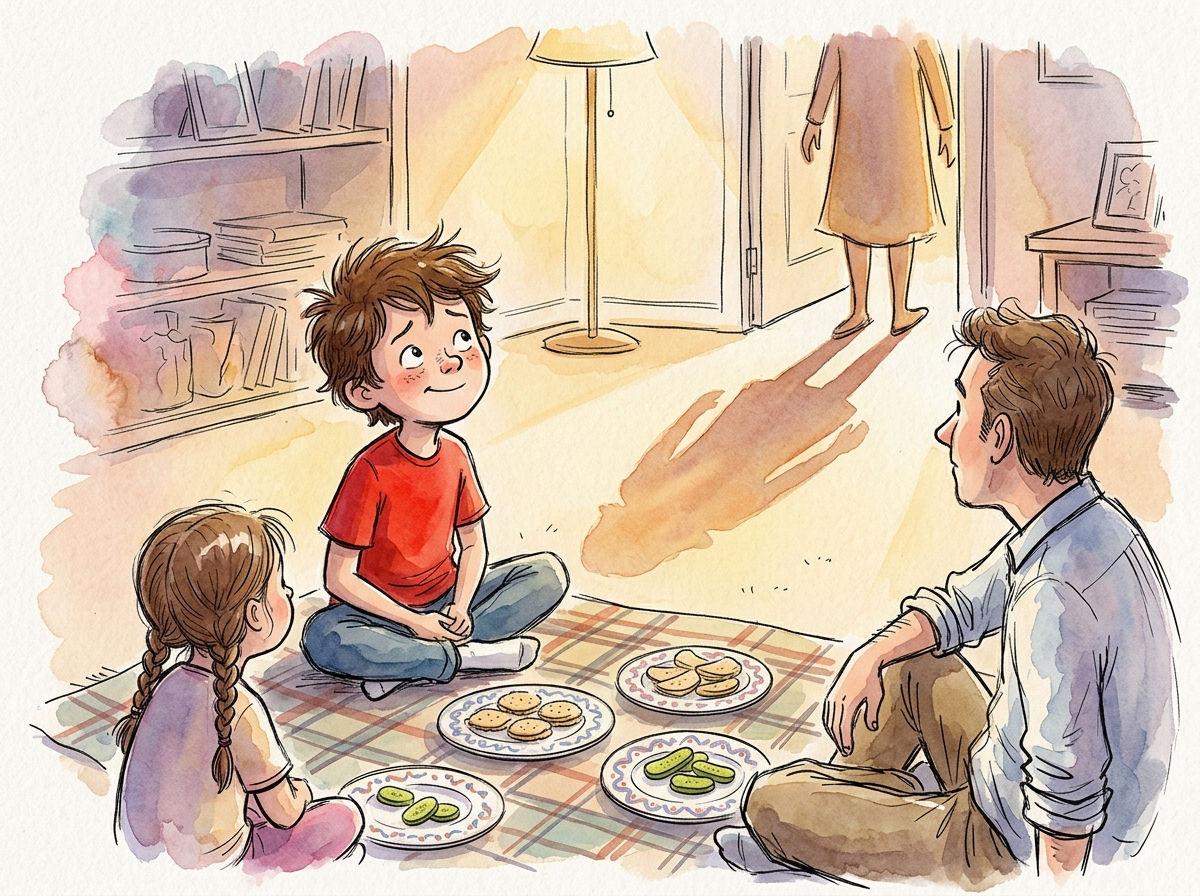
They spread a blanket on the living room floor, right next to Dad's couch. They set down the flowered plates. They folded napkins into triangles — well, Cade folded triangles, and Bea folded hers into a lump, but she was very proud of it.
Dad opened his eyes and looked down from the couch. "What's all this?"
"It's a picnic dinner," Cade said. His voice came out quieter than he meant it to. "I was going to make spaghetti, but... we didn't have anything. So. This is what we have."
Dad looked at the plates. The tuna crackers and raisin faces and pickle fans and torn-up bread and two cups of sugary lemonade. He looked at it for a long time.
"Cade," Dad said. "This is the greatest picnic I've ever seen."
"You don't have to say that."
"I'm not just saying it. Come on, help me down."
Cade and Bea each took one of Dad's hands, and slowly, carefully, he lowered himself onto the blanket with a groan and a sigh and then a smile.
They were halfway through the raisin-face crackers when the front door opened.
Mom walked in, hair falling out of her ponytail, bag sliding off her shoulder, looking like she could sleep for a hundred years.
She stopped.
She looked at the blanket. The flowered plates. The pickle fans. Her three favorite people sitting on the floor, cross-legged, mid-bite.
"Is that... a picnic?" she whispered.
"Indoor picnic," Bea corrected. "I invented it."
"I invented it," Cade said.
"I helped," Bea said.
Mom dropped her bag right there in the doorway. She stepped out of her shoes. And she sat down on the blanket, tucking her legs underneath her.
Cade handed her a lemonade.
She took a sip. She took a tuna cracker. She took a long, deep breath.
"This," Mom said, "is the best dinner I've had all week."
And the thing was — looking around at all of them, together on the blanket, passing pickles and laughing about raisin faces — Cade believed her.