The Dinosaur in the Backyard
Fable
Ages 6–8 · 9 min
In the soft dirt of her backyard, Tilda's shovel strikes a large, curved bone, but her dad is sure it is just an old pipe.
Tilda was digging a hole.
She wasn't digging for any particular reason. It was Saturday, the sun was warm, and the dirt in the backyard was soft from last night's rain. Sometimes you just need to dig a hole. Tilda was very good at this.
Tilda was digging a hole.
She wasn't digging for any particular reason. It was Saturday, the sun was warm, and the dirt in the backyard was soft from last night's rain. Sometimes you just need to dig a hole. Tilda was very good at this.
Her little yellow shovel went chunk, chunk, chunk into the earth. She had already made a pile of dirt that was almost as tall as her boots. Worms wriggled away from the light. A roly-poly curled into a tiny gray ball. Tilda said, "Sorry, roly-poly," and moved it gently to the grass.
Then her shovel hit something hard.
Clunk.
Not a rock clunk. Not a root clunk. A different kind of clunk — hollow and strange, like knocking on a drum.
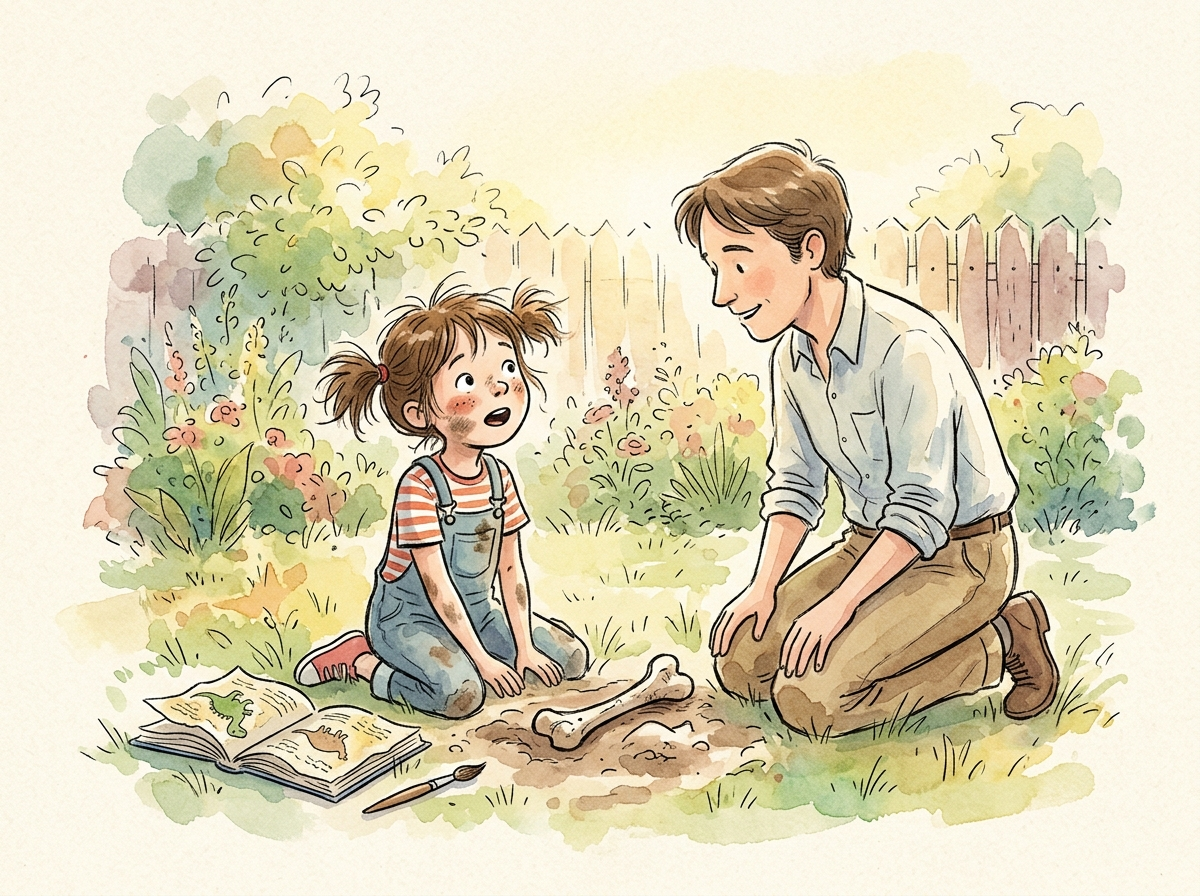
Tilda got down on her knees. She brushed the dirt away with her fingers, slowly, the way she'd seen scientists do on TV. And there, poking out of the brown earth, was something pale and curved, almost like a big stone smile.
"Huh," said Tilda.
She brushed more dirt away. The thing was long — longer than her arm. It curved up and then down again, like a crescent moon buried on its side. It had tiny bumps and ridges along the surface. It was not a rock. Rocks didn't have bumps and ridges like that.
Tilda sat back on her heels and stared.
"That looks like a bone," she whispered.
Her heart began to beat faster. She ran inside, screen door banging behind her, and grabbed the big dinosaur book from under her bed — the one with the crinkled pages because she'd read it approximately one thousand times.
She flipped to the section on fossils. She looked at the pictures. She looked at the thing in the ground. She looked at the pictures again.
"Oh my gosh," said Tilda. "Oh my gosh."
She ran to find her dad, who was in the kitchen making a sandwich.
"Dad! Dad, there's a fossil in the backyard! A real one! I think it's a dinosaur rib bone!"
Her dad smiled the way grown-ups smile when they think something is cute but not serious. "A dinosaur bone, huh? In our backyard?"
"Yes! Come look!"
He followed her outside, still holding his sandwich. He looked down at the hole. He tilted his head. He chewed thoughtfully.
"Til, that's probably just a tree root. Or maybe an old pipe."
"It's not a pipe, Dad. Pipes don't have ridges. And tree roots don't curve like that. Look."
Her dad crouched down. He squinted. "Hmmm," he said. "Well, it does look kind of interesting. But dinosaur bones? Here? In our yard? That's... I mean, that's pretty unlikely, sweetheart."
"But not impossible," said Tilda.
"Not impossible," her dad agreed. "But—"
"I'm going to keep digging."
And she did.
All afternoon, Tilda dug. Carefully now — no more chunking with the shovel. She used a big spoon from the kitchen and an old paintbrush she found in the garage. She worked around the curved bone-thing slowly, clearing the dirt away bit by bit, the way the book said real paleontologists did.
Her neighbor Marcus leaned over the fence. "Whatcha doing, Tilda?"
"Found a fossil."
Marcus wrinkled his nose. "That's probably just a rock."
"It's not a rock."
"My mom says there's no dinosaurs around here."
"Your mom wasn't around sixty-five million years ago," said Tilda. "So she doesn't really know."
Marcus opened his mouth. Then he closed it. Then he climbed over the fence to get a better look.
"Whoa," he said. "That's... actually kind of cool. Can I help?"
"Get a spoon," said Tilda.
By late afternoon, they had uncovered more of it. The curved piece connected to another piece — something flatter and wider, with a rough, pitted surface. The shapes fit together in a way that made Tilda's stomach flip with excitement. She kept checking the book, comparing, turning pages back and forth so many times that another page got crinkled.
Her dad came back outside. This time he wasn't smiling the cute-but-not-serious smile. He was frowning the huh-that's-actually-weird frown.
"Tilda, don't touch it anymore, okay? I'm going to make a phone call."
"Who are you calling?"
"The university. They have a... I think they have a geology department or something."
Tilda and Marcus looked at each other. Marcus's eyes were huge.
They waited. Tilda sat next to her hole, guarding it. She ate a granola bar. She re-read the fossil chapter. She brushed a little more dirt away from the edges — even though her dad said not to touch it — because she couldn't help it.
The next morning was Sunday, and it felt like it took four hundred years to arrive. A woman pulled up in a dusty white car. She had short gray hair, muddy boots, and a bag full of tools that clinked when she walked. Her name was Dr. Reena Gupta, and she was a paleontologist.
A real paleontologist. In Tilda's actual backyard.
"So," said Dr. Gupta, kneeling beside the hole. "Show me what you've found."
Tilda showed her. She pointed out the curve, the ridges, the flat piece connected to it. She had her dinosaur book open to page forty-seven, where there was a drawing of a hadrosaur skeleton.
"I think it might be a rib," Tilda said. "See how it curves the same way? And this flat part could be part of the hip. Hadrosaurs lived in this area during the late Cretaceous period. I read that in chapter six."
Dr. Gupta looked at Tilda. Then she looked at the bone. She pulled out a small pick and a brush from her bag and worked at the edges for a long, quiet minute.
Then she sat back. She had a funny expression on her face — like someone trying very hard not to get too excited.
"Well," she said. "It's definitely not a pipe."
"I told you!" said Tilda, spinning toward her dad.
"It's also not a tree root," Dr. Gupta continued. She pulled out a magnifying glass and leaned close. "The mineralization pattern, the texture... this is fossilized bone. No question."
Tilda forgot how to breathe.
"Now," said Dr. Gupta, "I can't tell you exactly what it is yet. We'd need to excavate more of the site and run some tests. It could be from any number of ancient animals. But the size and the curvature..." She looked at Tilda's book, still open to page forty-seven. "Your guess isn't bad. It's not bad at all."
Tilda sat down in the dirt. Right in it. She didn't care. Her hands were shaking, and she was smiling so wide her cheeks hurt.
"Can I help excavate?" Tilda asked.
Dr. Gupta looked at the careful, neat edges Tilda had dug around the fossil. She looked at the paintbrush, the spoon, the crinkled dinosaur book. She looked at the girl sitting in the dirt with wonder all over her face.
"I think," said Dr. Gupta, "I'd be lucky to have you on my team."
Over the next several weeks, Tilda's backyard turned into a real dig site. There were ropes and gridlines and little flags. Dr. Gupta came with two students, and they brought real tools — but Tilda noticed they also used brushes and spoons, just bigger ones. Marcus helped on weekends. Tilda's dad brought everyone lemonade and stopped saying the word "unlikely."
Piece by piece, more bones emerged from the dark earth. Each one felt like unwrapping the most incredible gift — a gift that had been waiting underground, patient and quiet, for millions and millions of years.
And it had been waiting right there, the whole time, just beneath the grass where Tilda played — until one Saturday, one yellow shovel, and one girl who kept digging when everyone else said to stop.