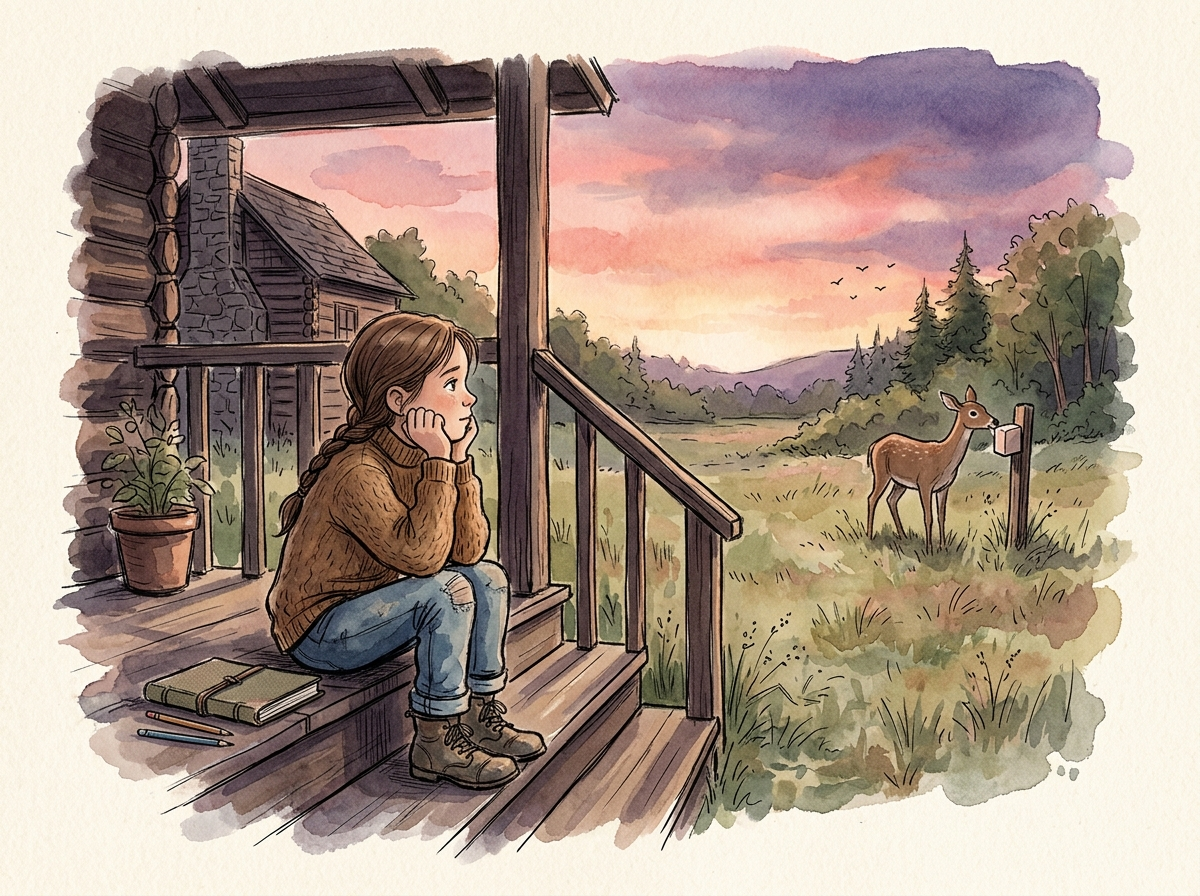
The Deer at the Salt Lick
Fable
Ages 6–8 · 9 min
At her grandpa's cabin for the summer, Sage fills a sketchbook with drawings of the wild deer at the salt lick, knowing she must leave them behind when fall comes.
Sage found the salt lick on the first day of summer.
It was a big pinkish-white block, like a brick made of crystal, sitting at the edge of the meadow behind Grandpa's cabin. Grandpa had set it out on a flat rock where the grass turned to wildflowers, and when Sage asked what it was for, he just said, "Sit on the porch. Be patient. You'll see."
Sage found the salt lick on the first day of summer.
It was a big pinkish-white block, like a brick made of crystal, sitting at the edge of the meadow behind Grandpa's cabin. Grandpa had set it out on a flat rock where the grass turned to wildflowers, and when Sage asked what it was for, he just said, "Sit on the porch. Be patient. You'll see."
So she did.
She sat on the porch with a glass of lemonade and her sketchbook, and she waited. The afternoon bugs hummed. The trees swayed. Nothing happened for a long, long time.
Then — a flicker at the tree line.
A deer stepped out. Then another. Then a tiny one, all spots and wobble, tucked close to its mother's side.
They walked to the salt lick like they were arriving at a party. The big one licked first, slow and calm, and the little one copied her, and then the third deer — a young buck with fuzzy nubs on his head — nudged in sideways like he'd been waiting all day for his turn.
"Grandpa," Sage whispered through the screen door. "There's three."
"Mm-hm," said Grandpa from inside, where he was doing a crossword puzzle. "There'll be more."
Grandpa was right. There were more.
By the second week of June, Sage had counted seven different deer visiting the salt lick. She knew they were different because she watched so carefully that she started to notice things — this one had a notch in her left ear, that one walked with a little dip in his step, this little fawn had a patch of spots shaped almost exactly like a mitten.
And because she noticed them, she named them.
The mother with the notched ear was Clover, because she always stood in the clover patch first, like she was checking to make sure everything was safe before walking over.
The young buck with the fuzzy nubs was Nubs. Sage felt a little bad about that one, but it suited him.
The spotted fawn with the mitten-shaped patch was Mittens, and Mittens was Sage's absolute favorite, because Mittens did everything wrong. She tripped on roots. She startled at butterflies. Once, she licked the salt block so enthusiastically that she bonked her own nose and jumped backward three feet.
"Mittens!" Sage whisper-laughed from the porch, drawing fast in her sketchbook. "You goof!"
Then there was Compass, who always came from the north. Velvet, whose coat was the softest brown Sage had ever seen. Driftwood, an old buck with a grey muzzle who moved slow and steady, like he had nowhere to be and all the time to get there.
And Rosie — a shy doe who only came at dusk, right when the sky turned pink, and who always, always came alone.
Sage filled her sketchbook with drawings of all of them. She wrote their names in big letters with arrows pointing to the details — notched ear, mitten spots, grey muzzle. She memorized their habits. Clover came in the morning. Nubs came after lunch. Rosie came at sunset, never a minute before.
"You know they're not pets, right?" Grandpa said one evening, settling into his porch chair with his coffee.
"I know," said Sage.
"They're wild things."
"I know."
"Okay." Grandpa sipped his coffee. "Just making sure."
July was the best month of Sage's entire life.
She woke up every morning and ran to the porch in her pajamas, and almost always, someone was there. Clover and Mittens at dawn. Nubs by midmorning, his antlers getting a tiny bit bigger every week. Driftwood in the afternoon, standing so still he looked like a painting.
Sage started leaving little notes in her sketchbook, like a scientist.
July 7th — Mittens tried to eat a dandelion puff and sneezed four times.
July 12th — Compass brought a friend! New deer, no name yet. Thinking about it.
July 19th — Rosie let me see her for eleven whole minutes tonight. New record.
She talked to them too, very softly, from the porch. She never walked closer. Grandpa had told her the rule — you can watch, but you don't go to them — and Sage followed it, even though sometimes she wanted to so badly her fingers itched.
"Good morning, Clover," she'd whisper. "Hi, Mittens. Don't bonk your nose."
And the deer would flick their ears — just barely — like maybe, possibly, they knew.
August slowed down the way August always does, warm and golden and syrupy. The fawns grew. Mittens lost some of her spots. Nubs's antlers branched into real antlers, and Sage had to update her drawings.
"They're changing," she told Grandpa.
"Everything does," he said.
Then September came fast. School was starting. Sage packed her bag the night before she had to leave and sat on the porch one last time. The air had a new crispness to it, like the sky was taking a breath.
Rosie came at dusk, right on time. She stood at the salt lick in the pink light, and Sage watched her, and something inside Sage's chest felt very full and very quiet all at once.
"Bye, Rosie," she whispered.
Rosie's ears turned toward her — two soft triangles — and then she walked back into the trees.
October came.
Sage was home now, in her house, in her regular life, with school and her friends and soccer practice on Thursdays. She kept her sketchbook on her nightstand, and sometimes before bed she'd flip through it and look at Mittens bonking her nose and Driftwood standing like a painting and Rosie in the pink light.
One Saturday, Grandpa called.
"How's my girl?"
"Good! We're doing fractions. They're terrible."
Grandpa laughed. Then he got quiet for a second.
"Sage, I want to tell you something. I went out to check the salt lick today. It's almost gone — they've licked it down to a nub."
"Like Nubs!" said Sage.
"Like Nubs," Grandpa chuckled. "But listen. I didn't see Driftwood. Haven't seen him in a few weeks now."
Sage held the phone tighter.
"Where did he go?"
"I don't know, sweetheart. He was old. Sometimes old deer move on to other places. Sometimes they find a quiet spot in the woods and they just... rest."
Sage didn't say anything for a moment. She thought about Driftwood, slow and steady, like he had nowhere to be.
"Do you think he's okay?" she asked.
Grandpa was quiet for a breath. "I think he had a good summer," he said. "I think he found the salt lick, and the meadow, and the good grass. I think he had everything a deer could want."
Sage's eyes stung a little. She blinked hard.
"What about the others?"
"Clover's still here. Nubs is getting big — you wouldn't believe his antlers now. And Mittens..." Grandpa paused, and Sage could hear him smiling. "Mittens got her whole head stuck in a bush yesterday."
Sage laughed. It came out a little watery, but it was real.
"What about Rosie?"
"Every evening. Right at sunset. You could set a clock by that deer."
Sage nodded, even though Grandpa couldn't see.
"Grandpa? Can you put out a new salt lick? A really big one?"
"Already did."
That night, Sage opened her sketchbook to a fresh page. She sat for a while, thinking. Then she drew Driftwood — his grey muzzle, his steady eyes, the way he stood in the afternoon light like the whole world was gentle.
Underneath, she wrote: Driftwood. He was here.
Then she turned to the next page and started a new drawing — the meadow in October, the leaves turning, the salt lick on its flat rock, waiting.
She left space in the picture. Lots of space.
For whoever came next.