The Crow's Winter
Fable
Ages 6–8 · 8 min
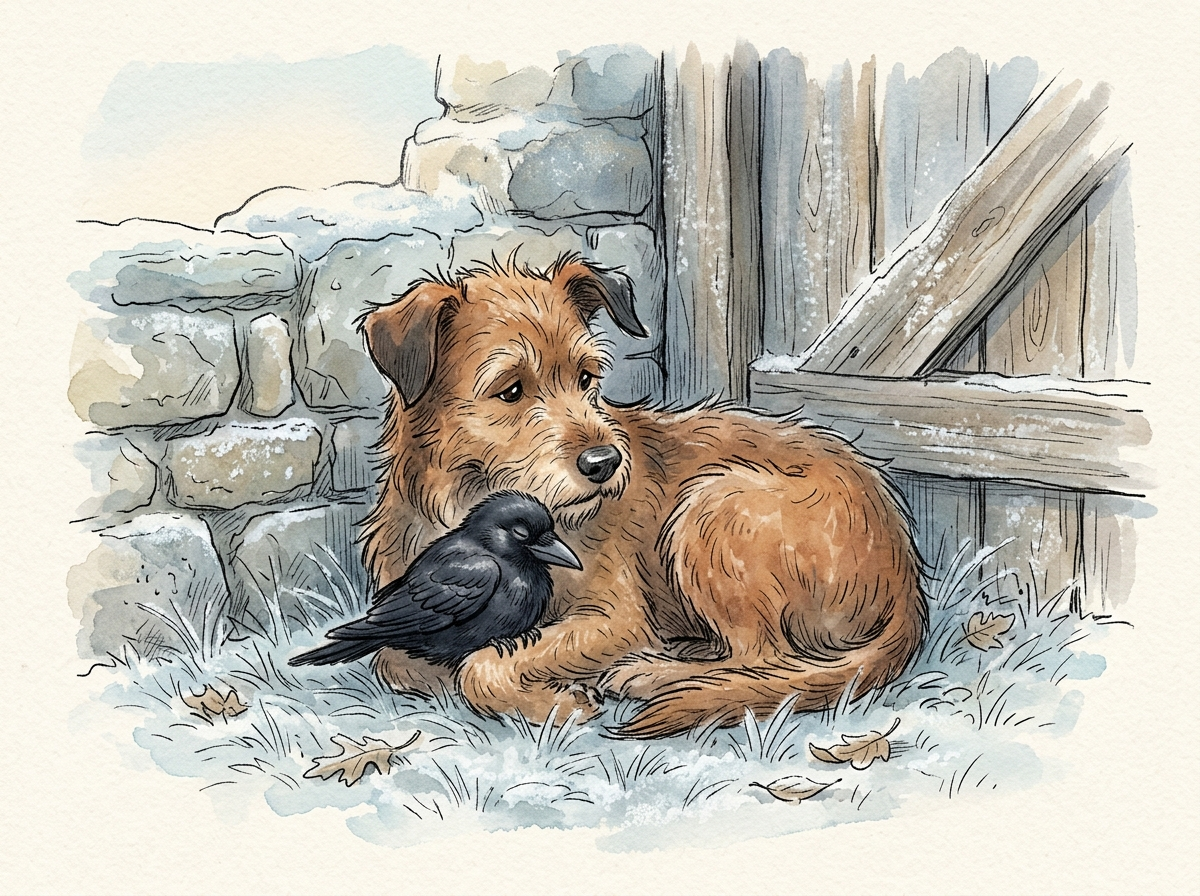
During a bitter frost at Milberry Farm, a crow named Ink sits alone on a cold stone wall while a dog named Hatch watches from his blanket.
The frost came hard on the first morning of January, and it turned the whole world into glass.
Every blade of grass wore a tiny coat of ice. Every puddle had become a mirror. And the old stone wall at the edge of Milberry Farm was so cold that if you touched it, your fingers would stick.
The frost came hard on the first morning of January, and it turned the whole world into glass.
Every blade of grass wore a tiny coat of ice. Every puddle had become a mirror. And the old stone wall at the edge of Milberry Farm was so cold that if you touched it, your fingers would stick.
On top of that wall sat a crow named Ink.
She was called Ink because she was the blackest black you ever saw — blacker than a shadow in a closet, blacker than the sky before stars come out. Her feathers didn't just look dark. They looked like someone had dipped her in a bottle of the finest, deepest ink and set her out to dry.
Ink sat on the wall and puffed herself up into a ball.
She was cold.
She was very cold.
She was the kind of cold where you stop thinking about anything except being cold. The kind of cold where your thoughts freeze right along with your toes.
Down below the wall, in the brown and crackly yard, a dog named Hatch lay on a folded blanket outside the farmhouse door. Hatch was a medium-sized dog with wiry fur the color of burnt toast and two ears that could never agree on which direction to point. One went up. One flopped sideways. They'd been like that his whole life.
Hatch had been watching Ink for three days.
Not in a mean way. Not in a chasing way. In a wondering way.
He wondered why she always sat alone. The other crows — and there were many around Milberry Farm — flew together in great noisy gangs, arguing over scraps and telling each other off from the treetops. But Ink sat by herself on the cold stone wall, every single morning, and she never joined them.
On this particular morning, the frost was worse than ever. Hatch could see it on Ink's feathers — a fine white dust, like sugar on a dark cake. She kept tucking her beak under her wing, then pulling it out, then tucking it back again. She couldn't get comfortable.
Hatch stood up. He shook himself so hard his tags jingled like little bells. Then he picked up something from his blanket — half a biscuit the farm girl had given him at breakfast — and carried it in his mouth across the frozen yard.
He set it at the bottom of the wall.
Then he backed up. Way up. All the way to the fence post, which was a good distance. He sat down and looked away, pretending to be very interested in a patch of ice on the water trough.
Ink watched him with one bright eye.
She didn't move.
Hatch waited.
The wind blew. The frost sparkled. A long minute passed.
Then Ink dropped down from the wall in one quick motion, snatched the biscuit in her beak, and flew back up. She ate it in three sharp pecks, tilting her head back each time to swallow.
Hatch's tail moved — just a little — against the frozen ground.
The next morning, he did it again. This time it was a bit of sausage from the farm girl's plate. He placed it at the bottom of the wall and backed away to his usual spot by the fence post.
Ink came down faster this time. She ate the sausage and then — instead of flying back to the very top of the wall — she landed on the lower part. The part that was only a few feet off the ground.
She was still far away. But she was closer.
On the third morning, the cold was so sharp it hurt to breathe. Hatch trotted out with a crust of bread, but when he got to the wall, he stopped.
Ink wasn't on the wall.
She was on the ground. Huddled in the corner where the wall met the old barn. Her feathers were puffed so big she looked like a black pom-pom, and her eyes were half-closed.
Hatch set the bread down carefully, close to her. Closer than he'd ever been.
Ink opened one eye. She looked at the bread. She looked at Hatch.
She didn't fly away.
Hatch lay down — slowly, slowly, the way you lower yourself into cold water — right there on the frozen dirt. Not next to her. But near her. Close enough that if you stretched a yardstick between them, it would just barely reach.
They stayed like that.
The wind came and bit at them both. Ink's feathers ruffled. Hatch's ears — the up one and the sideways one — flattened against his head. Neither of them moved.
After a while, something happened.
Ink hopped — one hop, two hops — closer to Hatch.
Hatch didn't look at her. He kept his chin on his paws and his eyes on the middle distance, as if he hadn't noticed a single thing.
Ink hopped once more.
Now she was right beside his front leg. Right in the curve of warmth where his chest blocked the wind.
She settled down. She tucked her beak into her feathers. And Hatch — very, very gently — curled his body just a little bit more around the space where she sat, the way you'd cup your hands around a candle flame.
They were warm.
Well — warmer. Warm enough.
The farm girl found them like that when she came out to fill the water trough. She stopped in the doorway with the bucket in her hand and didn't move for a long moment, because she knew — the way children always know — that she was seeing something important.
She went back inside and came out with an old wool scarf, red with gold threads running through it. She folded it up and set it on the ground near the wall, a few steps from where Hatch and Ink sat. Then she went about her chores and left them alone.
That afternoon, the sun came out — thin and pale, but real. Ink flew up to the rooftop and called out — caw caw caw — and her voice rang across the frozen farm like a bell. Hatch barked once, just once, as if to say, "Yes, I hear you."
The next morning, January fifth, the cold was back and the frost was thick as ever.
But this time, when Hatch trotted out to the wall, Ink was already waiting for him. She was sitting on the red scarf, which she had dragged — tugging and pulling with her strong black beak — right into the sheltered corner where the wall met the barn.
She looked at Hatch.
Hatch looked at her.
He walked over and lay down on one half of the scarf. She sat on the other half.
And that was that.
From then on, every cold morning that January, the farm girl would look out the window and see them. The black crow and the burnt-toast dog, sitting together on a red scarf in the corner by the barn. Not making a fuss about it. Not explaining anything. Just two creatures who had decided, in the hardest, coldest part of winter, that they were better off together than alone.
Some mornings, the other crows would call to Ink from the treetops, and she would fly up to join them for a while — wheeling and diving and making a tremendous racket. But she always came back.
And Hatch was always there.
Sometimes the farm girl would bring them both breakfast — a biscuit for Hatch and a handful of grain for Ink — and she'd set it right on the red scarf between them. They'd eat side by side, the crow pecking and the dog crunching, and it looked for all the world like two old friends having tea.
By the time February came and the frost began to thin and the first brave snowdrops pushed up through the hard ground, Ink and Hatch had worn that red scarf down to a soft, flat nest of wool.
It smelled like dog and crow and cold mornings and bread crusts.
It smelled like winter.
It smelled like belonging.