The Clockwork Garden
Fable
Ages 6–8 · 10 min
A girl named Wren finds a hidden door into the frozen Clockwork Garden, where the little gardener Pippa stands still with a brass key in her back that will not turn.
In a cozy village tucked between two green hills, there was a garden unlike any other. It was called the Clockwork Garden, and everything inside it ran on gears.
The flowers opened and closed with tiny brass cogs. The fountain spun with a silver wheel. The butterflies had copper wings that clicked and whirred as they floated from bloom to bloom. And right in the very center of it all stood Pippa — a little clockwork gardener no taller than a watering can.
In a cozy village tucked between two green hills, there was a garden unlike any other. It was called the Clockwork Garden, and everything inside it ran on gears.
The flowers opened and closed with tiny brass cogs. The fountain spun with a silver wheel. The butterflies had copper wings that clicked and whirred as they floated from bloom to bloom. And right in the very center of it all stood Pippa — a little clockwork gardener no taller than a watering can.
Pippa had round glass eyes the color of blueberries, a hat made from a thimble, and a big brass key sticking out of her back. When she was wound up, she could do anything. She could coax the metal roses to open. She could tune the singing crickets. She could turn the great Golden Gear buried under the garden — the one that made the seasons change.
But here's the thing.
Nobody had wound Pippa in a very, very long time.
She stood perfectly still in the middle of the garden, one hand reaching toward a frozen rosebud, snow piled on her thimble hat. Her gears hadn't turned in so long that frost had crept inside them.
And because Pippa was still, the garden was still too.
The flowers stayed shut. The fountain stayed frozen. The butterflies hung on branches like tiny ornaments. Winter had come to the Clockwork Garden — and it had forgotten to leave.
The village children pressed their faces against the iron gate every morning, hoping. But every morning, the garden was the same: white and silent and still.
"Doesn't anyone have a key?" asked a boy named Henry.
"Pippa doesn't need a key," said his grandmother. "She needs someone to turn the key she already has. But the garden's been locked up so long, nobody remembers how to get in."
Now, there was one girl who thought about the Clockwork Garden more than anyone else. Her name was Wren. She was seven years old, she had mud on her boots every single day, and she kept a collection of broken things in her pockets — a watch with no hands, a music box with no song, a compass that only pointed sideways.
"I bet I could fix it," Wren said one evening at dinner.
"Fix what, love?" asked her dad.
"The garden. Pippa. All of it."
Her dad smiled a gentle smile. "That garden's been frozen since before I was born, Wren."
"So? That just means it's been waiting a really long time."
The next morning, Wren went to the iron gate. She pushed it. It didn't budge. She pulled it. Nothing. She kicked it — which only hurt her toe.
She sat down in the snow and thought.
Then she noticed something. Down at the very bottom of the gate, behind a clump of icy weeds, there was a tiny door. It was no bigger than a loaf of bread. It had a gear-shaped handle, and when Wren turned it — click — the little door swung open.
Wren squeezed through on her belly, snow crunching against her coat, and tumbled into the Clockwork Garden.
It was beautiful, even frozen. Crystal icicles hung from gear-shaped branches. The metal flowers glittered under thick frost. And everywhere, everywhere, there were gears — big ones, small ones, some no larger than a freckle.
And there in the center stood Pippa.
Wren walked up to her carefully, boots crunching on the snow. She looked at Pippa's blueberry-glass eyes. She looked at the brass key sticking out of her back.
"Hi, Pippa," she whispered. "I'm going to try to help. Okay?"
She reached out and tried to turn the key.
It wouldn't move.
She tried with both hands. She tried with her mittens off. She braced her boots against the ground and pulled with all her might.
The key was completely, absolutely, stubbornly stuck.
Wren sat down with a huff. Her breath made a little cloud in the cold air.
She pulled the broken watch out of her pocket and turned it over in her hands, thinking. She always thought better when she was holding something broken. Then she pulled out the music box. Then the compass.
She looked at them. She looked at Pippa. She looked at the frost jammed into the cracks of Pippa's gears.
"Oh," Wren said softly. "You're not locked. You're frozen."
She needed warmth. Not a lot — just enough.
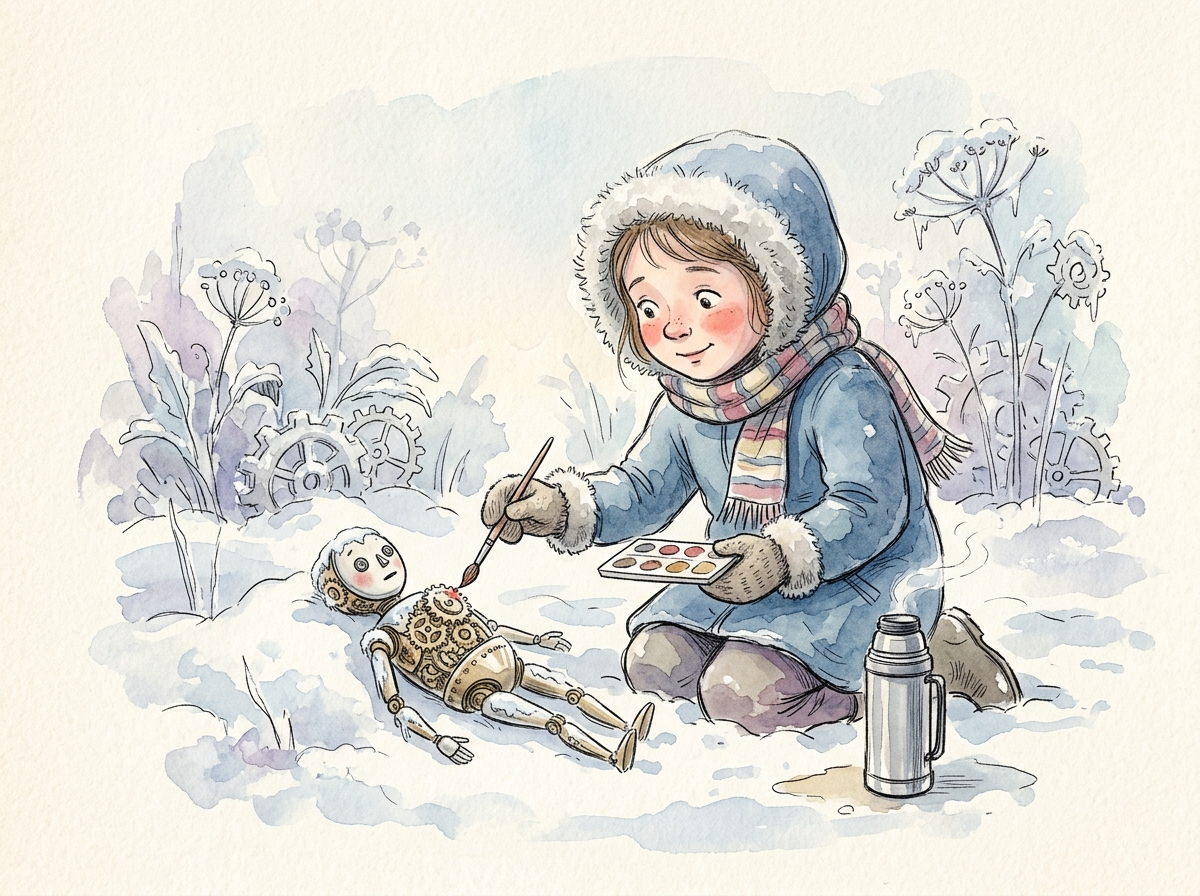
Wren raced home and came back with a thermos of hot tea and her dad's smallest paintbrush. She dipped the brush in the warm tea and — very carefully, very gently, very patiently — she painted the warmth into every tiny gear on Pippa's back. Around the key. Between the cogs. Into every little frozen crack.
Drip. Drip. Drip.
The ice began to melt. Little drops of water ran down Pippa's back like tears.
Wren tried the key again.
Crrrrick.
It moved. Just barely. Just a hair.
Her heart leaped. She painted more tea into the gears. She blew warm breath onto the key.
She tried again.
Crick-crick-crick-crick-crick.
The key turned. Once. Twice. Three times. And on the fourth turn —
TICK.
Pippa blinked.
Her glass eyes clicked to the left. Then to the right. Then straight at Wren.
"Oh!" said Pippa, in a voice like a tiny bell. "Oh my. How long was I sleeping?"
"A really long time," Wren said, grinning so wide her cheeks ached.
Pippa looked around at the frozen garden. She looked at the shut-tight flowers and the still fountain and the butterflies hanging like ornaments. Her little clockwork face made an expression that, if you looked closely, was very sad.
"I can't fix all of this alone," Pippa said quietly. "I'm only wound a little bit. I don't have enough turns in me to reach the Golden Gear."
Wren knelt down so she was eye to eye with Pippa. "Show me what to do. I'll be your hands."
Pippa stared at her for a long moment. Then she smiled — and her smile made a sound like a music box opening.
"Start with the smallest gear," Pippa said. "The one by the daisy. Turn it to the right."
Wren found it — a gear no bigger than a button, hidden under the snow. She turned it.
Click.
The daisy next to it trembled. Then, with a creak, its petals opened — stiff and slow, but open. A tiny shower of frost fell away.
"Now the next one," said Pippa. "By the tulip."
Click. The tulip opened.
Click. A butterfly's wings twitched.
Click-click-click. Three crickets started singing — rusty at first, then clearer.
Wren moved through the garden, turning gear after gear, following Pippa's directions. Her fingers got cold. Her knees got wet. Her back got tired from bending down. But every click made something new wake up, and she couldn't stop.
The fountain began to drip, then trickle, then spin.
The copper butterflies lifted off their branches, one by one, wobbling into the air.
Color came back to the garden like a painting being un-erased.
And then Wren reached the very last gear — the big one, buried at the center under a blanket of snow and ice. The Golden Gear. It was as wide as a wagon wheel.
"This one changes the season," Pippa said. "But it's too big for just your hands."
Wren looked at the Golden Gear. She looked at the iron gate. She ran to the little door, poked her head through, and shouted to the village children who were watching with wide eyes:
"Come help!"
Henry came first. Then Maisie. Then twins named Oscar and Olive. They squeezed through the tiny door one by one, tumbling into the garden with snow on their noses, gasping at the waking flowers and whirring butterflies.
Together, all five children grabbed the Golden Gear. They pushed. They strained. They dug their boots into the muddy ground.
And slowly — slowly — the great gear turned.
GONNNNNNG.
A sound rang out across the garden like the deepest, warmest bell you ever heard. The snow began to melt. The air grew soft. Green crept up every metal stem.
Spring.
The Clockwork Garden burst into life — gears spinning, flowers blooming, butterflies swirling in great copper spirals, the fountain throwing diamond drops into the sunlight.
Pippa stood in the middle of it all, her gears ticking steadily now, her blueberry eyes bright.
"Wren?" she said.
"Yeah?"
"Will you come back tomorrow?"
Wren reached into her pocket, past the broken watch and the silent music box and the sideways compass, and she smiled.
"I'll come back every day."
And she did.