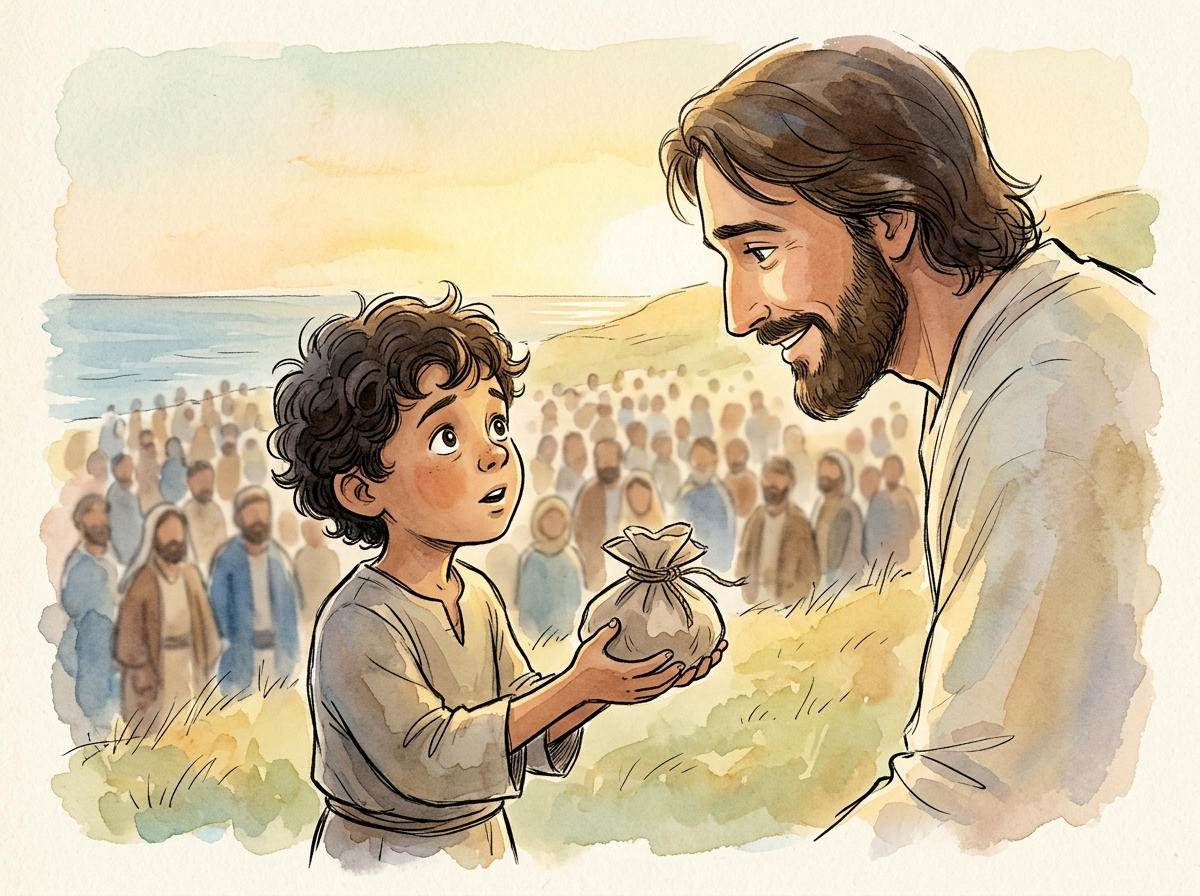
The Boy's Lunch
Fable
Ages 6–8 · 9 min
With only five loaves and two fish packed for his lunch, Asher sits in a crowd of thousands of hungry people who have come to hear the teacher Jesus.
Asher woke up before the sun did.
He lay on his mat, staring at the ceiling, listening to the birds outside just beginning to figure out their songs. Today was the day. Today, he was going to see the Teacher.
Asher woke up before the sun did.
He lay on his mat, staring at the ceiling, listening to the birds outside just beginning to figure out their songs. Today was the day. Today, he was going to see the Teacher.
Everyone in the village had been talking about Him — the man who made sick people well, who told stories that made grown-ups cry, who spoke in a voice that somehow sounded like it was meant just for you, even in a crowd. His name was Jesus, and He was teaching today by the sea.
"Asher!" his mother called softly from the other room. "You're already awake, aren't you?"
"How did you know?" he whispered back.
"Because you've been talking about this for three days straight."
He grinned in the dark.
By the time the sky turned pink, Asher was dressed and standing in the kitchen, bouncing on his toes. His mother knelt beside him and held up a cloth bundle, tied at the top with a piece of twine.
"Five barley loaves," she said, "and two small fish. Enough for your lunch — and maybe a little extra, in case you make a friend."
Asher tucked the bundle under his arm. It was warm and smelled like his mother's kitchen — like home pressed into bread.
"Thank you, Mama."
She kissed his forehead. "Stay with Uncle Tobias. Listen well. And don't lose your lunch."
"I won't!"
He lost Uncle Tobias almost immediately.
The crowd was enormous — bigger than anything Asher had ever seen. It was like his whole village, and the next village, and the village after that, and maybe ten more villages had all decided to go to the same place on the same morning. People stretched across the hillside like a blanket of heads and shoulders, sitting in clusters on the green grass near the water.
Asher squeezed through legs and elbows, clutching his bundle tight against his chest. He found a spot on a little rise where he could see over the crowd, and he sat down cross-legged with his lunch in his lap.
And then he saw Him.
Jesus was standing near the shore, and even from far away, there was something about Him that made Asher go still. He wasn't the tallest person there. He wasn't shouting. But when He spoke, the whole hillside leaned in, like flowers turning toward the sun.
He told stories about seeds and soil, about birds that never worried about where their next meal would come from, about how much God loved every single person — yes, even that person, and that one, and the woman in the back who thought nobody noticed her.
Asher forgot about his lunch. He forgot about Uncle Tobias. He forgot about everything except the sound of that voice rolling over the hillside like warm water.
Hours passed. The sun climbed high, then started sliding down, and Asher's stomach began to rumble. He looked at his bundle. He thought about his mother tying the twine that morning, the flour still on her fingers.
He was just about to unwrap it when he noticed something happening near Jesus. The men who were always with Him — His disciples — were walking through the crowd with worried looks on their faces. One of them, a big broad man with sun-dark skin, was shaking his head and waving his arms.
"There's no food!" Asher heard someone nearby whisper. "They want to feed everyone, but there's no food for miles."
Asher looked around. The hillside was packed. Children, grandparents, families with babies. Some of them looked tired. Some of the little ones were starting to fuss. Five thousand men, someone said — and that wasn't even counting the women and children.
His stomach rumbled again. He looked down at his bundle.
Five loaves. Two fish. Enough for your lunch — and maybe a little extra.
One of the disciples was walking nearby now — a younger man with kind eyes and a harried expression. He was scanning the crowd, asking questions, checking with people. His name, Asher would later learn, was Andrew.
Andrew's eyes landed on Asher.
Or rather, on Asher's bundle.
"What have you got there, son?"
Asher's heart thumped. He looked down at his lunch, then back up at Andrew. He thought about five thousand people. He thought about his five loaves and two fish. The math did not add up. He knew that. He was only seven, but he could count.
But something in his chest — something warm and stubborn and brave — told him to stand up anyway.
"Five barley loaves," he said, holding out the bundle. "And two fish."
Andrew stared at the little package. He opened his mouth, then closed it. Then he let out a breath that was almost a laugh — not a mean laugh, but the kind of laugh that happens when you don't know what else to do.
"Well," Andrew said quietly, "come with me."
Asher followed Andrew through the impossible crowd, weaving between families and blankets and sandals, until they were standing right in front of Jesus.
Asher had never been this close to anyone important before. His hands trembled. The bundle suddenly felt very, very small.
Jesus looked at him.
And smiled.
It was the kind of smile that made Asher feel like he was the only person on the whole hillside — like his five loaves and two fish were exactly what had been needed all along.
"Thank you," Jesus said.
Asher handed over the bundle. His mother's bread. His lunch. Everything.
Jesus took the food and held it up. He looked toward the sky, and He gave thanks. His voice was quiet, but somehow Asher heard every word, and so did everyone else.
Then He began to break the bread.
And this is the part that Asher would tell his mother about later, his words tumbling over each other, his eyes wide as moons.
The bread didn't run out.
Jesus broke it, and the disciples carried it into the crowd, and He broke more, and they carried more, and the bread kept coming. The fish too — flaky and warm and salted, enough for handful after handful after handful. The disciples' baskets were full, and they emptied them, and they were full again.
Asher stood there, watching his little lunch travel across the hillside like a wave. He saw a mother tear off a piece and give it to her baby. He saw an old man chew slowly with tears running down his cheeks. He saw children grabbing bread with both hands, laughing with their mouths full.
Five thousand men. Plus the women. Plus the children. Every single one of them ate until they were full.
Full.
Not just a little bit. Not just enough to stop the rumbling. Full, the way you feel after the best meal your mother ever made.
When it was over, the disciples went around collecting what was left. Asher counted the baskets.
Twelve.
Twelve whole baskets of leftover bread and fish — from a lunch that started as five loaves and two.
Asher sat back down on his little rise. The sun was turning orange now, sinking toward the sea, painting everything gold. His stomach was full. Everyone's stomach was full. The hillside hummed with the sound of happy, satisfied people.
Andrew walked past and ruffled Asher's hair. "Not bad for a boy's lunch," he said, grinning.
Asher grinned back.
On the walk home, Uncle Tobias finally found him. "Where have you BEEN?" he cried. "Your mother is going to have my head!"
"I gave away my lunch," Asher said.
"You WHAT?"
"It's okay," Asher said, smiling to himself. "It was enough."
That night, back home, his mother sat beside his mat as he told her everything. When he finished, she was quiet for a long moment.
"So," she said slowly, "my bread fed five thousand people?"
"More than five thousand, Mama."
She shook her head in wonder, then pulled him close and kissed the top of his head.
"Asher," she whispered, "I packed that lunch hoping it would be enough for you and maybe one friend."
He snuggled deeper into his blanket, already half-asleep, the memory of broken bread and a hillside full of people warm in his chest.
"It was enough for everyone," he murmured.
And it was.