The Bee's Day
Fable
Ages 6–8 · 10 min
On her first flight out of the hive, a young bee named Marigold must find her way across the enormous meadow to gather nectar.
The sun hadn't even finished rising when Marigold woke up.
She stretched all six of her legs, one at a time — left front, right front, left middle, right middle, left back, right back — and yawned a tiny bee yawn that nobody heard, because bees yawn very, very quietly.
The sun hadn't even finished rising when Marigold woke up.
She stretched all six of her legs, one at a time — left front, right front, left middle, right middle, left back, right back — and yawned a tiny bee yawn that nobody heard, because bees yawn very, very quietly.
"Today," Marigold whispered to herself, "I fly."
It was her first day as a forager. Up until now, she'd worked inside the hive — cleaning cells, feeding larvae, fanning the honeycomb with her wings to keep it cool. Important jobs, every one. But today, for the very first time, she would go out.
The older foragers were already buzzing near the entrance. Marigold squeezed in beside a bee named Clover, who had been foraging for twelve whole days and therefore knew everything.
"Stick to the clover field," Clover said, not unkindly. "It's close, it's easy, and you won't get lost."
Marigold nodded. She wouldn't get lost. She had memorized the angle of the sun. She had studied the waggle dances of returning foragers. She had felt the wind speed on her antennae. She was ready.
She stepped to the edge of the hive entrance and looked out.
The world was enormous.
The meadow stretched in every direction, an ocean of green dotted with splashes of color — purple, yellow, white, pink. The sky above was so wide and so blue that Marigold felt, for just one moment, very small.
Then she flew.
The clover field was exactly where Clover said it would be. Marigold landed on her first flower — a fat, round head of white clover — and got to work.
She uncurled her long tongue, reached deep into the tiny blossoms, and sipped. Nectar! It was sweet and thin, like the tiniest drink of honey-water. She stored it carefully in her honey stomach, which was different from her regular stomach. Bees have two stomachs, which is one of the most useful things about being a bee.
One flower done. Marigold checked the sun's position, felt the breeze, and flew to the next.
And the next.
And the next.
Each flower was a little puzzle. How much nectar is here? Is it worth the energy to land? How far to the next bloom? Which direction is home? Marigold's brain was small — smaller than a grain of rice — but it was built for exactly this work, and it hummed along beautifully.
By mid-morning, she had visited forty-seven flowers and her honey stomach was half full.
That was when she found the lavender.
It was past the clover field, past a stone wall, in a garden Marigold had never seen before. The smell hit her antennae first — rich and sweet and complicated, like a song with a hundred notes.
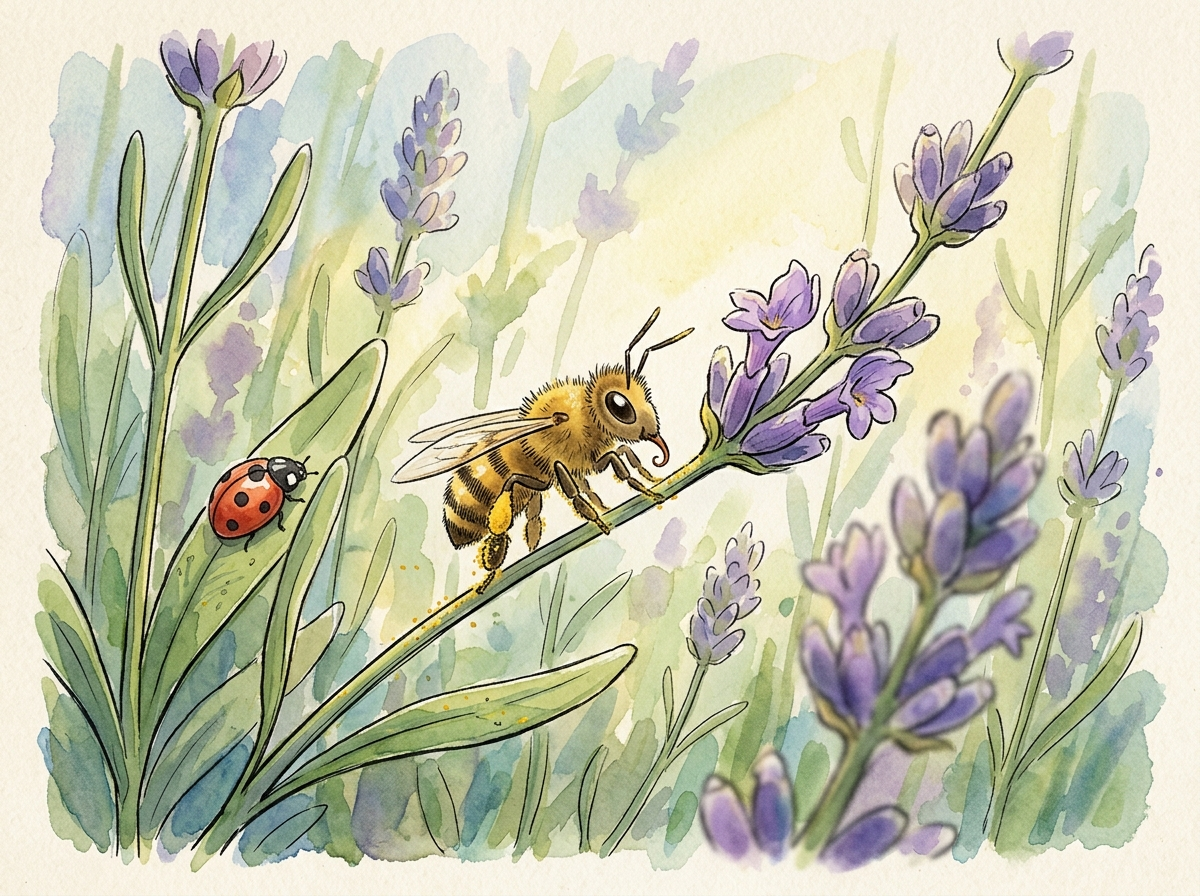
She landed on a tall purple spike and sipped.
Oh.
Oh, this was good nectar. Thick and fragrant and plentiful. Each tiny lavender blossom was bursting with it.
But Marigold hesitated. The garden was far from the hive. Farther than a new forager should go. Every wing-beat out here was energy spent, and energy spent meant she needed more nectar just to break even.
Distance to hive: far. Wind: slight headwind on return. Nectar quality: excellent. Nectar quantity: very high. Energy cost of return trip: high, but manageable.
She made her decision: worth it.
Marigold worked the lavender row with fierce concentration. Flower after flower after flower. She moved with a rhythm now — land, grip, uncurl, sip, store, release, fly, land again. Her legs were dusted golden with pollen. Her honey stomach grew heavy and full.
She was so focused that she didn't notice the shadow.
A bird.
It swept over her so close that the wind from its wings tumbled Marigold sideways. She spun, caught herself, and dove straight down into the lavender, pressing her body flat against a stem.
Her heart — her tiny, tube-shaped bee heart — hammered fast.
The bird circled once, twice, then glided away toward the trees.
Marigold stayed still for a long time. The lavender swayed gently around her. A ladybug crawled past on a nearby leaf and didn't even glance at her.
I could go home now, Marigold thought. Her honey stomach was almost full. She had enough. She had done well for a first day. No one would say a word if she flew straight back.
But there were three more lavender stalks right in front of her, heavy with blooms, and the sun was still high.
Marigold uncurled her tongue and got back to work.
The flight home was hard.
She was loaded down with nectar, and the headwind was stronger now, just as she'd expected. Her wings beat two hundred and thirty times per second — the same as always — but each beat felt heavier. The meadow scrolled beneath her, green and gold and slow.
She navigated by the sun, by the landmarks she'd memorized, by a feeling deep in her body that pointed toward home like an invisible thread. Left at the crooked oak. Over the stream. Past the stone wall. Through the clover field, where other foragers bobbed lazily from bloom to bloom.
She could see the hive.
It was a wooden box at the edge of the meadow, ordinary-looking from the outside. But Marigold could hear it — the deep, warm hum of ten thousand bees working together. She could smell it — wax and honey and home.
She landed on the entrance board, and her legs trembled just a little.
Inside, the hive was alive with purpose. Bees crawled over honeycomb in every direction. Builder bees sculpted perfect hexagons from wax. Nurse bees fed pearly white larvae. Fan bees beat their wings in rows, pushing air through the corridors to keep everything at exactly the right temperature — ninety-five degrees, no more, no less.
A house bee met Marigold at the entrance, and Marigold opened her mouth. She passed the nectar from her honey stomach to the house bee's honey stomach. The house bee would chew it and work it and eventually seal it into a golden cell of honey.
One stomach-load of nectar, delivered.
It would take Marigold her entire life — every flight, every flower, every trip — to make just one-twelfth of a teaspoon of honey.
One-twelfth of a teaspoon.
But Marigold didn't think about that. She thought about the lavender. She thought about how she needed to tell the others.
She found an open patch of comb where other foragers were gathered, and she began to dance.
It was a waggle dance — the figure-eight pattern that bees have been dancing for millions of years. The direction of her waggle told them where. The length of the waggle told them how far. The speed of her turns told them how good.
And Marigold danced fast.
Past the clover. Past the stone wall. Lavender garden. Rich nectar. Worth the trip.
Other bees watched. Their antennae quivered. One by one, they turned and headed for the entrance.
Marigold rested for four minutes. Then she went back out.
She made seven trips that day. Seven flights to the lavender and back. Each time, the headwind. Each time, the calculations. Each time, her legs trembling just a little more when she landed.
On her seventh return, the sun was sinking orange over the meadow. The lavender garden was closing its blooms for the night. Marigold passed her last load of nectar to a waiting house bee and crawled deep into the hive, where the comb was warm and dark and humming.
She found a spot near the center, surrounded by other foragers who had just finished their own long days. She tucked her wings. She curled her legs beneath her.
She had visited three hundred and eighty-two flowers.
She had flown five miles.
She had made her contribution to one-twelfth of a teaspoon of honey — one day's worth of a whole life's work, stored in a single golden cell among thousands.
And tomorrow, the lavender would be blooming again.
Marigold closed her eyes.
The hive hummed.
And somewhere in the dark wax comb, the honey thickened, slow and sweet.