Rosa and the Baby Bird
Fable
Ages 6–8 · 11 min
A girl named Rosa who has a rule for everything finds a tiny baby bird on the sidewalk, far below its nest in the oak tree.
Rosa had rules about everything.
She had rules about breakfast: cereal first, then toast, never the other way around. She had rules about her backpack: water bottle on the left, snack on the right, pencils in the front pocket standing straight up like tiny soldiers. She had rules about walking to school: step on the sidewalk cracks with your left foot only, and always — always — count the red cars.
Rosa had rules about everything.
She had rules about breakfast: cereal first, then toast, never the other way around. She had rules about her backpack: water bottle on the left, snack on the right, pencils in the front pocket standing straight up like tiny soldiers. She had rules about walking to school: step on the sidewalk cracks with your left foot only, and always — always — count the red cars.
Her little brother Marco said she was bossy. Her mom said she was "organized." Her dad said she was "a person who likes things just so." Rosa didn't care what anyone called it. Rules made sense. Rules kept things from getting messy and confusing and wrong.
On a Tuesday afternoon in April, Rosa was walking home from school, counting red cars — seven so far, which was a pretty good day — when she heard a sound.
It was tiny. Smaller than tiny. It was the kind of sound you'd miss if you were talking or humming or thinking too loud. But Rosa wasn't doing any of those things. She was counting, which required silence.
Cheep.
Rosa stopped.
Cheep. Cheep.
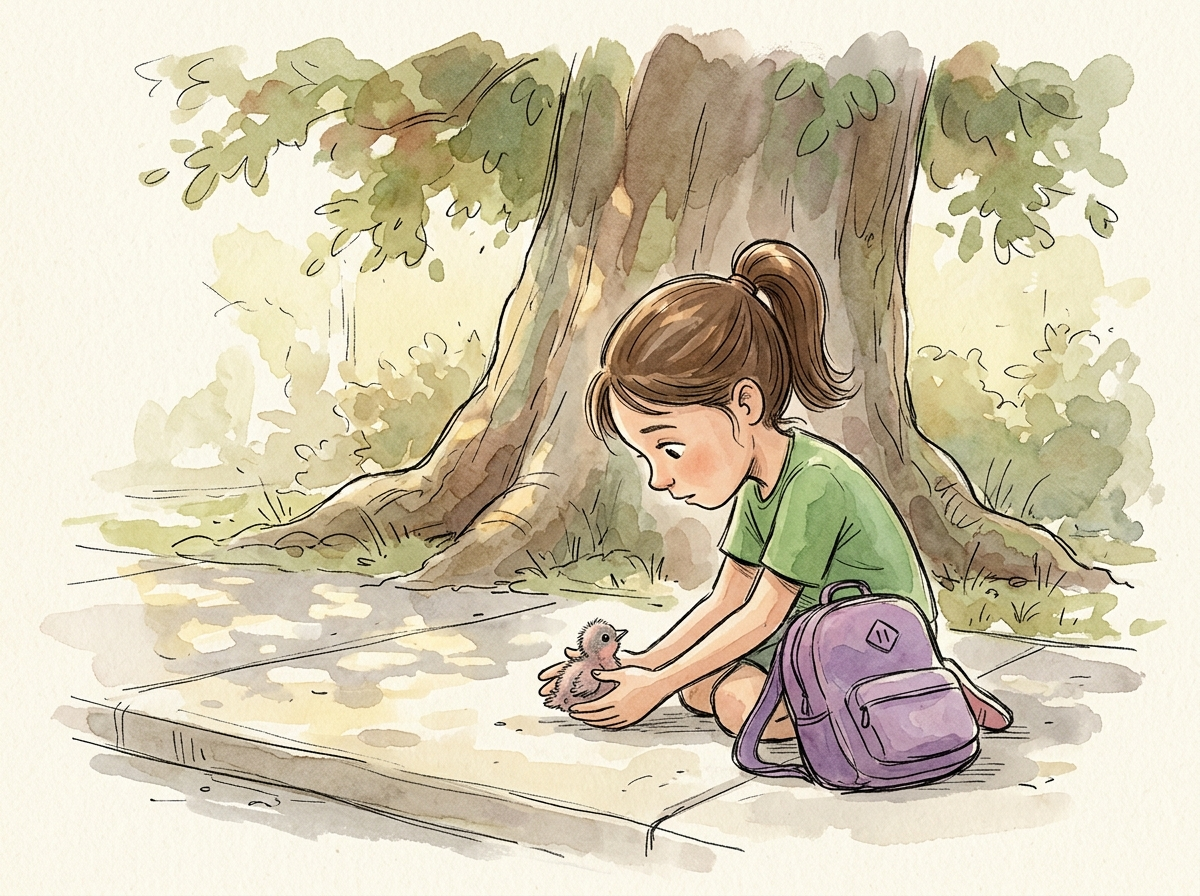
She looked down. There, on the sidewalk, right next to the big oak tree between Mr. Patterson's house and the Garcias' fence, was a bird.
But it wasn't a regular bird. It was a baby bird. It was pinkish-gray with fuzz instead of feathers, and its eyes were big and dark and not quite all-the-way open, like it was still deciding whether or not the world was worth looking at. Its beak opened and closed, opened and closed.
Cheep.
Rosa's stomach did a flip.
She crouched down very slowly, the way you'd move if the ground were made of bubbles. The baby bird was so small it could have fit inside her cupped hands. One of its wings stuck out a little to the side.
Rosa looked up. Way up in the oak tree, she could see a nest — a messy clump of sticks and stuff wedged into a fork between two branches. It was very high.
"Okay," Rosa whispered. She set down her backpack. Water bottle on the left. Snack on the right. Pencils in the front pocket. She stood back up and looked at the bird again.
"I don't have a rule for this," she said.
And that felt strange. Like showing up to school and finding out it was actually Saturday.
Rosa thought about picking the bird up. But wait — hadn't she heard something once? Something about how if you touch a baby bird, the mother won't take it back because of the human smell? Or was that not true? She couldn't remember. And Rosa did not do things she couldn't remember the rules for.
"Stay right there," she told the baby bird, as if it were going anywhere. "I'm going to figure this out."
She ran home.
Rosa burst through the front door, kicked off her shoes — left shoe first, then right, that was a rule — and went straight to the computer in the living room.
"Mom, I need to look something up!"
Her mom poked her head in from the kitchen. "Homework?"
"Bird work."
Her mom raised an eyebrow but nodded.
Rosa typed very carefully: what to do if you find a baby bird on the ground.
This was serious research. Rosa read one website. Then she read another. Then she read a third one, because two sources were good but three was better. That was a new rule she made up right there on the spot.
Here is what she learned:
First — you can touch a baby bird. The mother won't reject it because of human smell. Birds can barely even smell! That thing everyone says? Not true.
Second — if the bird has fuzzy down and no real feathers, it's a nestling, and it probably fell out of the nest. It needs to go back.
Third — if you can't reach the nest, you can make a little substitute nest out of a small container with holes in the bottom, fill it with dry grass or leaves, and attach it to the tree near the real nest. The parents will usually find it.
Fourth — keep cats away.
Rosa wrote all of this down on a notepad. She made a list. She numbered the steps. She drew a small diagram.
"Mom," she said, "I need a berry basket. One of those plastic ones with holes."
"Check the recycling bin."
Rosa found one. She grabbed a handful of dry leaves from the bag in the garage that her dad hadn't taken to the yard waste yet. She got a piece of twine from the junk drawer. She put everything in a paper bag, tucked the bag under her arm, and headed for the door.
"Where are you going?" asked Marco, who was building something out of couch cushions.
"I have a patient," Rosa said.
The baby bird was still there. Its beak was still going — open, close, open, close — but slower now. Rosa's heart beat hard.
She knelt down. Very gently, more gently than she had ever done anything in her entire seven years, she scooped the bird into her hands. It weighed almost nothing. It weighed less than a secret. She could feel its heartbeat, fast as a tiny drum, tapping against her palms.
"Hi," she whispered. "I looked you up."
She set the bird carefully inside the berry basket, nestled into the dry leaves. Then came the hard part.
Rosa looked up at the oak tree. The real nest was way too high. She couldn't reach it, not even if she stood on her backpack, which she would never do anyway because that was against backpack rules. But about halfway up, there was a thick low branch she could reach if she climbed on Mr. Patterson's fence.
Rosa looked at the fence. She looked at the branch. She had never climbed a fence before. There was no rule for fence-climbing in any of her lists.
She chewed her lip.
Cheep, said the bird.
Rosa climbed the fence.
It was wobbly and her knee banged against a post and her shoe almost slipped, but she held on, and she reached the branch, and she tied the berry basket to it with the twine — one knot, two knots, three knots, because three was better. The little substitute nest hung right against the trunk, sheltered by leaves, close enough to the real nest that any mother bird flying home would spot it.
Rosa climbed back down. Her hands were shaky. Her knees had dirt on them. A piece of bark was stuck in her hair.
She sat down on the sidewalk and watched.
She waited five minutes. Then ten. Then fifteen. Marco came outside and asked what she was doing and she said "shh," and he actually shh-ed, which might have been the most amazing part of the whole day. He sat down next to her.
Then — a flutter.
A brown bird with a sharp little beak landed on the branch right next to the berry basket. It tilted its head. It looked at the basket. It looked at the leaves. It hopped closer. Then it leaned in, and Rosa heard a burst of cheeping from inside the basket — loud, fast, excited cheeping, like the baby bird had been saving up all its sound for this exact moment.
The mother bird hopped onto the rim of the basket. She had something in her beak. Something small and squirmy.
She fed the baby.
Rosa grabbed Marco's arm. Marco grabbed Rosa's arm. Neither of them said a word.
The mother bird flew away and came back a minute later with more food. And then again. And again.
Rosa checked on the berry basket every day after school for two weeks. She made a chart. She noted the times the mother visited — mostly mornings and late afternoons. She recorded the weather. She watched the baby bird grow fuzz into feathers, gray into brown. And one afternoon, she arrived to find the basket empty.
She looked around, and there — sitting on Mr. Patterson's fence — was a small brown bird, fluffing its wings in the sun.
It looked at her.
She looked at it.
It flew away.
Rosa stood there for a while. Then she picked up her backpack — water bottle on the left, snack on the right — and walked home. On the way, she stepped on a sidewalk crack with her right foot.
She didn't even fix it.