Quitting Piano
Fable
Ages 6–8 · 9 min
With a list of reasons to quit piano folded in his pocket, Rhys is met with a single request from his dad to play his favorite song one last time.
Rhys had made up his mind.
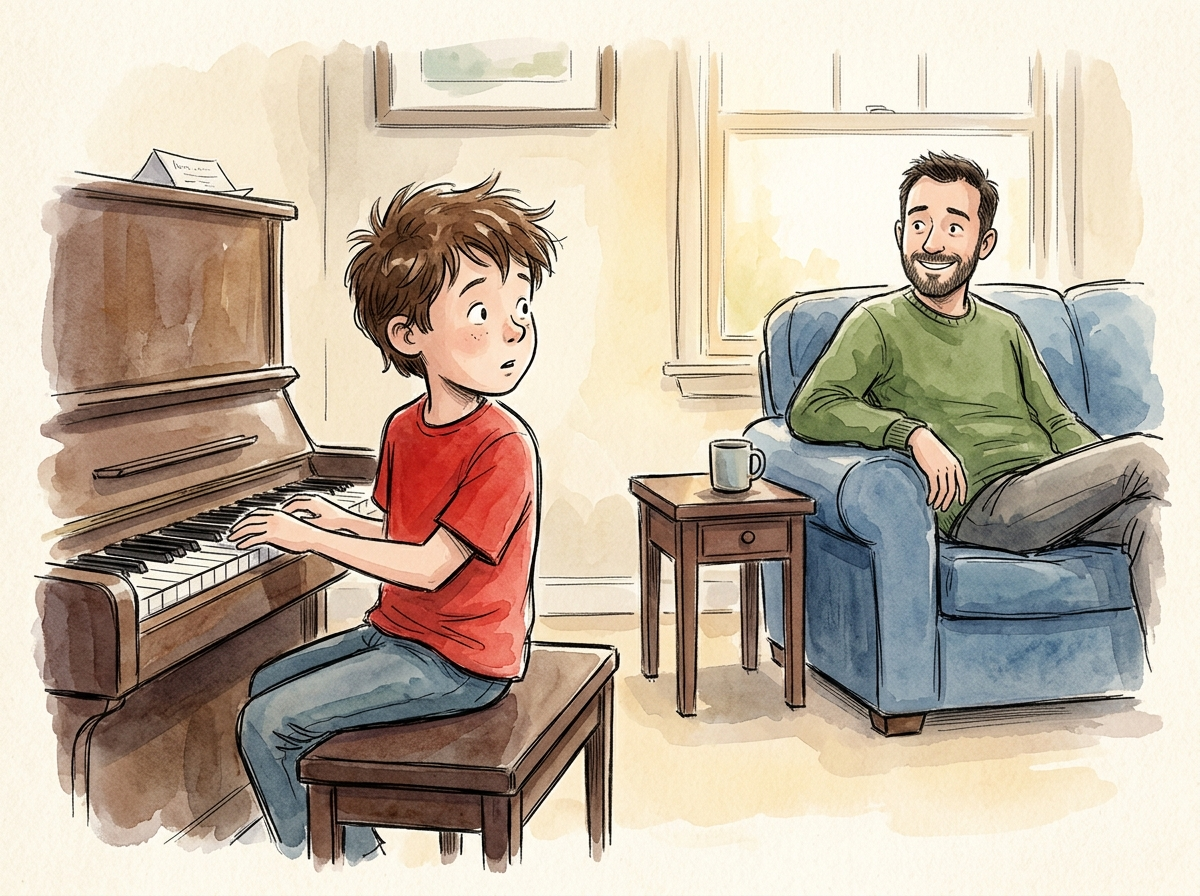
He sat on the piano bench with his arms crossed, staring at the black and white keys like they were his enemies. The piano stared back, saying nothing, which was the only good thing a piano had ever done.
Rhys had made up his mind.
He sat on the piano bench with his arms crossed, staring at the black and white keys like they were his enemies. The piano stared back, saying nothing, which was the only good thing a piano had ever done.
"Dad," Rhys said, the moment he heard footsteps in the hallway. "I need to talk to you."
His dad appeared in the doorway, holding a mug of coffee and wearing his Saturday socks — the ones with little tacos on them. "Sounds serious," he said.
"It is serious." Rhys took a big breath. "I want to quit piano."
He braced himself. He'd been practicing this moment in his head for three days. He was ready for But you've been playing for two whole years! He was ready for You'll regret it when you're older. He was ready for Let's not make any hasty decisions.
His dad took a sip of coffee. Then he walked over and sat down on the arm of the big green couch across from the piano.
"Okay," his dad said.
Rhys blinked. "Okay?"
"Okay."
"Okay like... okay I can quit?"
"Okay like I heard you." His dad set his coffee on the side table. "Can I ask you something first?"
Rhys narrowed his eyes. Here it comes, he thought. The trap. The sneaky parent trick. "...What?"
"Play me your favorite song. Just one more time."
Rhys stared at him. "That's it?"
"That's it. One song, your favorite, and then we'll talk."
Rhys almost argued, because arguing had been part of the plan and he had some really excellent arguments saved up. He'd written them on a piece of paper that was folded in his pocket. Number one: Henry Garcia quit saxophone and he's fine. Number two: I could use the practice time for soccer. Number three — the big one: Life is short.
He'd been very proud of number three.
But his dad wasn't fighting him. He was just sitting on the couch in his taco socks, waiting.
"Fine," Rhys said. He unfolded his arms. "One song."
He turned to the piano and put his fingers on the keys. His favorite song. He didn't even have to think about which one. It was the one Mrs. Davila had given him four months ago, the one called "River Crossing." It started slow and quiet, like stepping stones in shallow water, and then it got faster and bigger, like the river was growing, and at the very end it got soft again, like you'd made it to the other side and were looking back.
He played the first note.
It was a wrong note.
"Ugh." He pulled his hands back, shook them out, and tried again.
This time, the opening came out right. Slow, careful notes, one after another, like little drops of rain on a window. He knew this part so well that his fingers just went where they were supposed to go, and his brain could wander.
He remembered the first time Mrs. Davila had put this song in front of him. He'd looked at all those notes on the page and said, "No way." And she had laughed — Mrs. Davila had a big, loud laugh that didn't match her tiny body at all — and she'd said, "Way. But not all at once. Just the first line today."
Just the first line. That was always how she said it.
Rhys reached the part where the song started to wake up. The left hand came in now, steady and deep, like a heartbeat underneath the melody. This was the part that had taken him the longest to learn. Two hands doing two different things — it had felt impossible, like trying to pat your head and rub your belly at the exact same time.
He'd complained to his dad about it one night at dinner. "My hands won't cooperate," he'd said, and his dad had laughed into his spaghetti.
But then one Tuesday, sitting at the piano after school, it just... clicked. His left hand and his right hand figured each other out, like two people finally learning to dance together. He'd played it through once, twice, three times, and then run into the kitchen shouting, "DAD, COME LISTEN, COME LISTEN RIGHT NOW."
His dad had come. His dad always came.
Now Rhys was in the middle of the song, the part where the river grew wide and wild. The notes came faster, louder, tumbling over each other. He leaned into it. His foot found the pedal — the one that made the sound bloom and blur — and he pressed it at just the right moments, the way Mrs. Davila had shown him.
He thought about the recital last spring. How his stomach had been a knot of snakes. How the auditorium had felt enormous, and the piano on the stage had looked like it was sitting in the middle of an ocean. He'd walked out under the bright lights, and his hands were shaking, and he'd thought, I can't do this, I can't do this, I can't —
But then he'd started playing.
And the room had gone away. The lights, the people, the snakes in his stomach — all of it. It was just him and the song, like they were inside a bubble together. When he'd played the last note and looked up, the room was clapping. His dad was in the third row, clapping the loudest, grinning so wide it looked like his face might come apart.
Rhys was near the end now. The river was calming. The notes slowed, softened, spread out like ripples. This was the part that always made him feel something he didn't have a word for. Not happy, not sad. Something in between. Something like standing at your window right after it stops raining, when everything outside is quiet and shiny and new.
He played the second-to-last measure. Then the last.
The final note hung in the air like a soap bubble, round and shimmering, before it faded into nothing.
Rhys sat very still.
The house was quiet. Outside, a dog barked. A car went by.
He looked down at his hands, still resting on the keys. Those hands that couldn't do two things at once, until they could. He felt the smoothness of the white keys under his fingertips. The little dip between the black ones.
He turned around on the bench.
His dad was sitting on the couch, his coffee completely forgotten. He wasn't saying anything. He didn't need to. He was just looking at Rhys with that same grin from the recital, the too-big one, except softer now, like the end of the song.
Rhys opened his mouth.
Then he closed it.
He reached into his pocket and pulled out the folded piece of paper with his three excellent arguments. He looked at it for a moment. Then he set it on top of the piano, unread.
"Dad?" he said.
"Yeah?"
"Mrs. Davila said there's a new song she wants me to learn. It's got three pages."
His dad picked up his coffee and took a long sip. "Three whole pages, huh?"
"Yeah. She said it's the hardest one yet." Rhys turned back to the piano. He played the first note of "River Crossing" again — the right note this time — and let it ring. "I'm going to need more practice time."
"I bet you will," his dad said.
And Rhys began to play.