Palm Sunday
Fable
Ages 6–8 · 10 min
In a church where everyone else holds a perfectly folded palm cross, Caleb's own leaf becomes more torn and wrinkled with every failed attempt to make one for himself.
Caleb sat in the wooden pew between his mom and his grandmother, swinging his feet back and forth because they didn't quite reach the floor. The church was packed today — every seat taken, every aisle full of people in their Sunday best. And everyone, everyone, was holding a palm leaf.
Caleb held his too. It was long and green and smooth, and it smelled like something fresh and alive, like the air after a rainstorm. He ran his fingers along the edges, feeling the way it wanted to bend and spring back.
Caleb sat in the wooden pew between his mom and his grandmother, swinging his feet back and forth because they didn't quite reach the floor. The church was packed today — every seat taken, every aisle full of people in their Sunday best. And everyone, everyone, was holding a palm leaf.
Caleb held his too. It was long and green and smooth, and it smelled like something fresh and alive, like the air after a rainstorm. He ran his fingers along the edges, feeling the way it wanted to bend and spring back.
Pastor Williams was up front talking about Jesus riding into Jerusalem on a donkey, and how the people waved palm branches and laid them on the road. Caleb liked that part. He imagined the whole dusty road turning green with leaves, like a carpet rolling out for a king — except the king was on a donkey, which Caleb thought was pretty funny and pretty cool at the same time.
But Caleb wasn't really listening to the sermon right now. He was watching hands.
Two rows ahead and to the left, Mrs. Henderson was doing something magical. She was folding her palm leaf, bending it this way and that, tucking one end through a loop, and — just like that — she held up a perfect little cross. A cross made out of a palm leaf.
Caleb's eyes went wide.
He looked around. Mr. Davis, across the aisle, already had one too. It sat on his knee, neat and tidy, like it had grown that way. Caleb's cousin Amara, sitting with her family near the front, was holding hers up and showing it to her little brother, who grabbed at it with sticky fingers.
Everybody knew how to make one. Everybody except Caleb.
He looked down at his palm leaf. It was still just… a leaf.
Okay, he thought. I can figure this out.
He bent the leaf in half. Then he bent it again. It flopped open. He tried folding the top part down like he'd seen Mrs. Henderson do. But when he tucked the end through, it just made a lumpy green knot that looked like a squished frog.
He glanced up. His mom had her eyes closed, nodding along to the sermon. His grandmother was fanning herself gently with her program, her own perfect palm cross already resting in her Bible.
Caleb unfolded his leaf and tried again.
This time he watched Mr. Franklin, who was sitting right in front of him. Mr. Franklin's big, rough hands moved slowly. Fold here. Loop there. Pull through. Caleb tried to copy each move. Fold here — okay, got it. Loop there — wait, which way did it loop? Left? Right? Caleb went left.
The leaf tore a little.
Caleb's stomach sank. He pressed the torn part together, hoping it would heal itself like a scraped knee. It did not.
He let out a long, quiet breath through his nose — the kind of breath that means you are trying very hard not to be frustrated in a place where you are supposed to be quiet.
He peeked at his grandmother. She was watching the pastor again, but there was a tiny smile on her face, like she knew something. Grandmothers always looked like they knew something.
Caleb smoothed out his leaf on his leg. It was a little wrinkled now, and there was that tear near the top. But it was still green. Still alive-smelling. Still a leaf.
He watched one more person — old Mr. Wallace, who sat in the very last pew by the door because he said his knees couldn't make it any farther. Mr. Wallace's hands were shaky — they always shook a little — but he made his cross slowly, carefully, like he had all the time in the world. First, he made the long part by folding the leaf straight. Then he bent a piece sideways to make the arms. Then he did a little tuck-and-pull to lock it in place.
The long part first, Caleb thought. Then the arms. Then the tuck.
He took a deep breath.
He folded his leaf lengthwise, pressing the crease flat with his thumbnail the way his grandmother pressed pie crust. Good. That was the long part. Then he carefully, carefully bent a section sideways, holding it with his thumb. His tongue poked out of the corner of his mouth, which it always did when he was concentrating.
Then came the tuck.
He slid the end of the leaf through the fold, holding his breath like he was threading the world's most important needle.
It slipped.
He tried again.
It slipped again.
Caleb bit his lip. His leaf was getting more wrinkled by the second. It had the tear. It had creases going in every direction. It looked like a leaf that had been through a windstorm and then sat on by a dog.
He almost gave up. He almost just set the leaf on the pew and stared at his shoes for the rest of the service.
But then he thought about those people on that dusty road in Jerusalem, thousands of years ago. They probably didn't have perfect palm leaves either. They probably just grabbed whatever branch was closest and waved it with everything they had, because what mattered was that they were there, waving.
Caleb picked up his crumpled leaf.
One more try.
Long part — fold. Arms — bend sideways. And the tuck…
He pushed the end through, gently, gently, the way you close a door when the baby's sleeping. And this time —
It held.
Caleb stared at it.
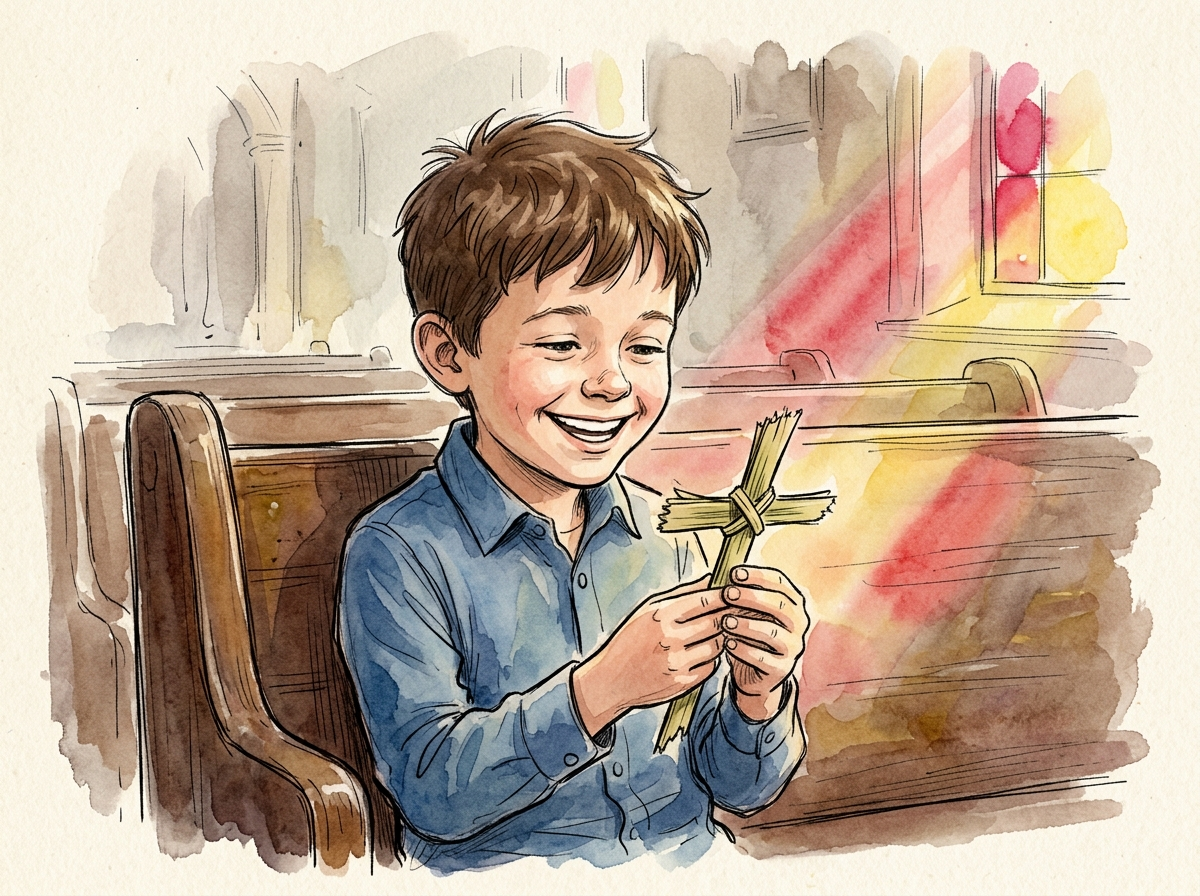
It was… well, it was a cross. Sort of. The arms were uneven — one stuck out longer than the other, like the cross was waving hello. The torn part near the top made it look a little ragged. And the whole thing leaned slightly to the left, like it was tired.
It was not a perfect palm cross. It was not like Mrs. Henderson's or Mr. Davis's or his grandmother's.
But it was his.
And it held together. That was the important thing. It held.
A grin spread across Caleb's face — a big, wide, couldn't-stop-it-if-he-tried grin.
He held it up, just a little, just enough to see it in the light coming through the stained-glass window. The colored light — ruby red and golden yellow — fell across his hand, and the little cross glowed like it was something precious.
His grandmother glanced over. She looked at the cross. She looked at Caleb. And then she did something she almost never did during service.
She winked.
Caleb felt warm all over, from the inside out, the way you feel when you've done something that took everything you had.
When the service ended and everyone stood up, Caleb's mom looked down and noticed the palm cross in his hand.
"Caleb! When did you learn to make one of those?"
"Just now," he said.
"Who taught you?"
Caleb thought about Mrs. Henderson and Mr. Franklin and old Mr. Wallace with his shaky hands. He thought about watching and trying and failing and trying again.
"Everybody," he said. "Everybody taught me."
His mom smiled and put her hand on his shoulder as they walked down the aisle toward the sunshine outside.
Caleb tucked his little lopsided palm cross into his shirt pocket, right over his heart, where it rode all the way home.
That night, he set it on his nightstand next to his lamp. And every time he looked at it — even days later, when the green had faded to gold and the edges had curled like old paper — he remembered the feeling.
Not the feeling of getting it right.
The feeling of not giving up until he did.