Learning to Lose
Fable
Ages 6–8 · 10 min
To win the Golden Marble Trophy, a boy who is used to winning everything must race his complex track against the new kid's single piece of metal gutter.
Brody was the kind of kid who won at everything.
He won at checkers. He won at tag. He won at the spelling bee, the science fair, and the contest to see who could hold their breath the longest underwater at the community pool. He even won the raffle at the school carnival — twice — which made Deena Hartwell so mad she threw her snow cone on the ground and had to go sit in her mom's car.
Brody was the kind of kid who won at everything.
He won at checkers. He won at tag. He won at the spelling bee, the science fair, and the contest to see who could hold their breath the longest underwater at the community pool. He even won the raffle at the school carnival — twice — which made Deena Hartwell so mad she threw her snow cone on the ground and had to go sit in her mom's car.
Winning felt like sunshine. It felt like jumping off the high dive. It felt like the first bite of a warm cinnamon roll on a Saturday morning.
And Brody figured that was just how life worked. You played the game. You tried your best. And then you won.
Simple.
Then came the Marble Derby.
Every spring, the second graders at Riverside Elementary held the Marble Derby in the big grassy field behind the school. Everyone built their own marble track out of cardboard tubes, tape, wooden blocks — whatever they could find. You set your track on the hill, released your marble at the top, and whoever's marble reached the bottom first won the Golden Marble Trophy, which was really just a marble painted gold and glued to an old baseball trophy, but still. It was magnificent.
Brody had been planning his track for weeks. He'd tested nine different marbles on his bedroom floor, rolling each one forty times and writing down the results in a notebook. He picked the fastest marble — a heavy blue-and-white swirl he named Lightning. He built his track with three long cardboard tubes angled just right, a smooth wooden ramp at the bottom, and a little wax coating on the inside so Lightning could really fly.
"This," Brody whispered to Lightning the night before the Derby, "is going to be our greatest victory."
Lightning said nothing, because it was a marble.
The morning of the Derby, the whole second grade buzzed with excitement. Twenty-two tracks lined the hillside, all shapes and sizes. Maya Reeves built hers out of pool noodles. Terrell Jackson used a series of funnels taped together that looked like a wild roller coaster. Nia Chakrabarti's track had actual working doors that opened when the marble pushed through them, which wasn't fast but was extremely cool.
And at the far end stood a boy named Oliver Fong.
Oliver was new. He'd only been at Riverside for three weeks. He was quiet and kept his hands in his pockets a lot and always had a book sticking out of his backpack. Brody had never really talked to him.
Oliver's track was strange. It was short — much shorter than everyone else's — and made from a single piece of bent metal that looked like it came from an old rain gutter. There were no fancy tubes. No decorations. Just a smooth, shiny strip of metal, propped at a steep angle on two stacked bricks.
Brody looked at it and almost laughed. That's his track?
The Derby started. Marbles flew down the hill in heats of four. Brody's marble, Lightning, zipped through every round. Down the tubes, across the ramp, whoooosh — first place, first place, first place. The crowd of second graders cheered. Brody pumped his fist each time.
Oliver's marble was winning too. That little metal gutter worked like a rocket launcher. His plain gray marble — no name, no swirl, no personality — shot down that track so fast it was hard to even see it.
One by one, the other tracks were eliminated until it came down to the final race.
Brody versus Oliver.
Brody crouched beside his track. He placed Lightning at the very top, right in the center groove, exactly the way he'd practiced. His heart hammered. The whole second grade was watching. Even Mrs. Petersen, their teacher, leaned forward with her coffee cup frozen halfway to her mouth.
"Ready..." called Mr. DeLuca, the gym teacher, holding up his whistle. "Set..."
FWEEEEET!
Brody released Lightning. The blue-and-white marble shot into the first tube, rocketed through the second, spiraled through the third, and launched off the wooden ramp toward the finish line.
But Oliver's marble was already there.
It had streaked down that plain metal gutter like a raindrop on a window, hit the grass, and rolled across the finish line a full two seconds before Lightning even left the last tube.
Oliver won.
The second graders erupted. Oliver blinked, surprised, like he hadn't quite expected it either.
And Brody just stood there.
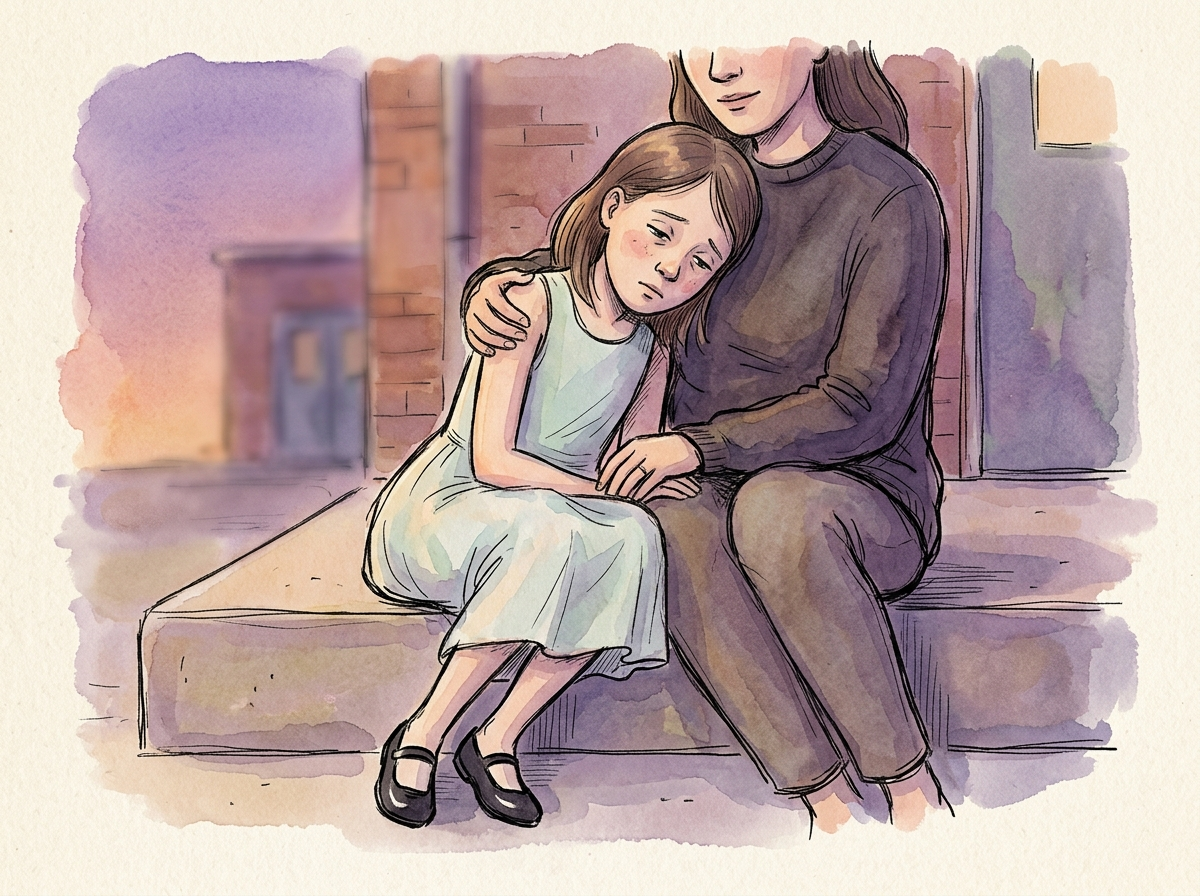
He didn't throw anything. He didn't cry. He didn't even move, really. He just stood there with this tight, hot feeling in his chest, like someone had zipped his jacket too high and it was pressing against his throat.
I lost.
The thought bounced around his brain like a marble with nowhere to go.
I lost. I lost. I actually lost.
He watched Mr. DeLuca hand Oliver the Golden Marble Trophy. Oliver held it with both hands and smiled a small, shy smile. Some kids patted him on the back. Maya Reeves said, "That gutter thing was genius."
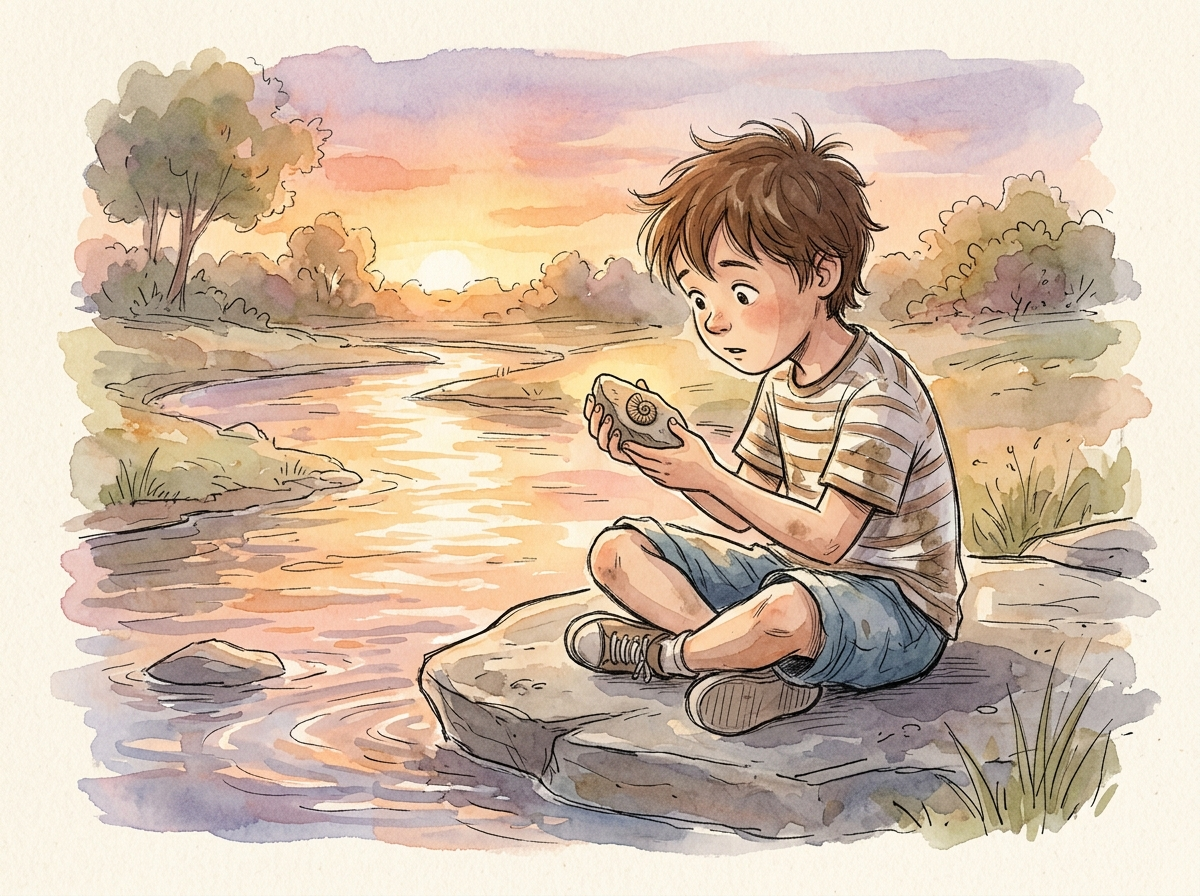
Brody picked up Lightning from the grass. The marble felt cold in his hand.
He wanted to say something mean. Not to Oliver, exactly, but to someone. He wanted to say the track was too simple, or the race wasn't fair, or his tube had a dent in it. He wanted to find a reason — any reason — that explained why this wasn't real.
But he didn't say any of that. He just squeezed Lightning tight and walked to the back of the crowd where nobody could see his face.
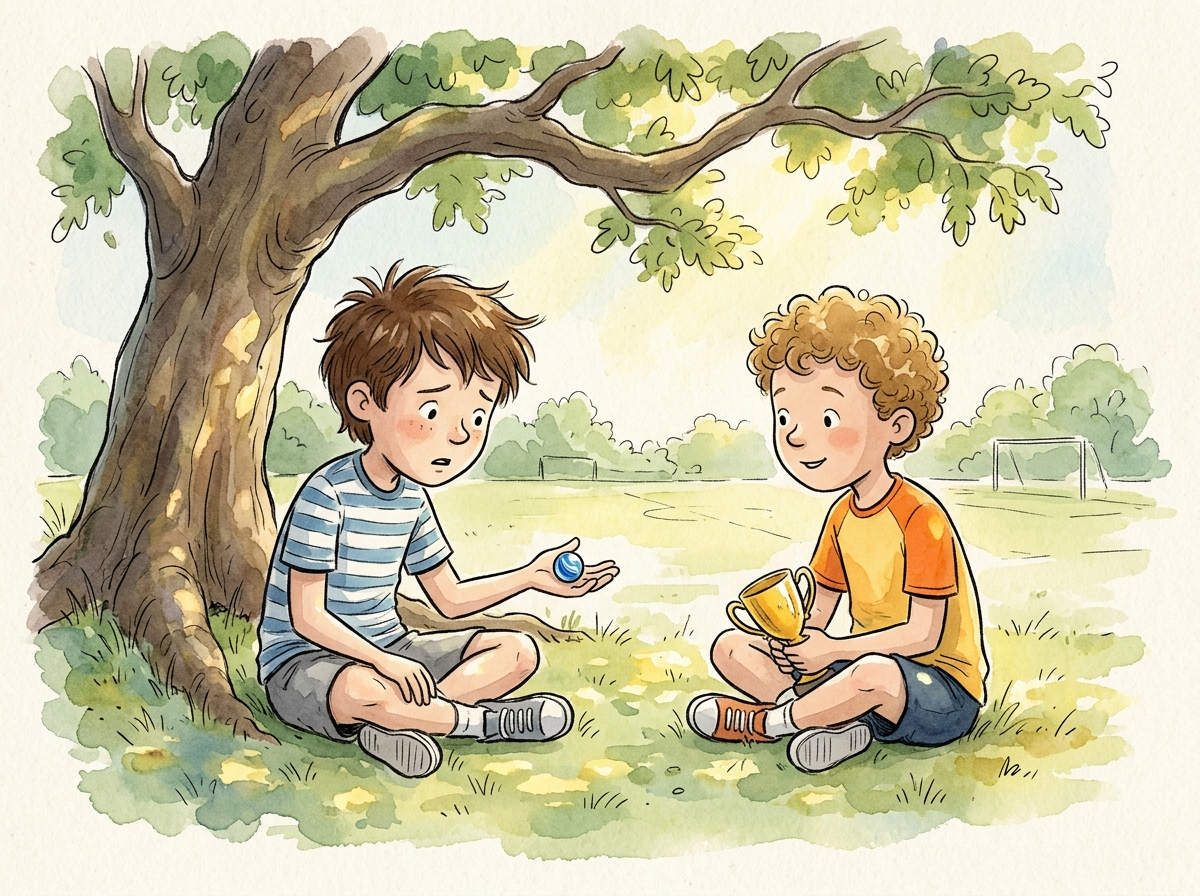
He sat under the big oak tree for a while. The tight feeling in his chest wouldn't leave.
Then he heard footsteps in the grass.
Oliver sat down next to him — not too close, not too far. He still had the trophy in his hands.
"Your track was really cool," Oliver said quietly. "The triple tube part? I couldn't figure out how you got the marble to transition between them without losing speed."
Brody didn't answer right away. He pulled at a blade of grass.
"I waxed the inside," he finally muttered.
"Seriously?" Oliver's eyes went wide. "That's so smart."
Brody looked at him. Oliver wasn't bragging. He wasn't gloating. He was just... a kid who liked marbles, sitting under a tree.
"Where'd you get that metal gutter thing?" Brody asked.
"My grandpa's garage. He said the straighter the path, the fewer places for speed to get lost." Oliver shrugged. "I didn't think it would actually work that well."
Brody almost laughed. "It worked really well."
"Yeah." Oliver grinned. "It kind of did."
They sat there for another minute. The tight feeling in Brody's chest was still there, but it was getting smaller — like a balloon slowly letting out air.
"Can I see Lightning?" Oliver asked.
Brody opened his palm. The blue-and-white swirl caught the sunlight.
"Whoa," Oliver breathed. "That is the coolest marble I've ever seen."
And for some reason, that made Brody feel something warm again. Not the winning kind of warm. A different kind. The kind that comes from someone really seeing something you care about.
"You wanna trade runs?" Brody said. "Your marble on my track, Lightning on yours?"
Oliver jumped up. "Yes. Absolutely yes."
They spent the rest of recess sending marbles down each other's tracks, making adjustments, arguing about angles, and laughing when Oliver's marble flew off Brody's ramp and landed in Maya Reeves's lunch bag.
Brody didn't win anything that afternoon.
But when the bell rang and they walked back inside, Oliver said, "Hey, do you wanna build a track together for the third-grade Derby next year? I bet if we combined your tubes with my gutter, it'd be unbeatable."
Brody looked at him — this quiet kid with a book in his backpack and a gold-painted marble trophy under his arm — and felt that warm feeling again.
"Yeah," Brody said. "Let's do it."
And he meant it. Not because he wanted to win — though he definitely still did.
But because some things, he was learning, felt even better than winning.