Her Own Song
Fable
Ages 9–11 · 13 min
Every time Odette opens her mouth to sing in the school choir, her voice wobbles off-key, so she just moves her lips and hopes no one will notice.
Odette stood in the second row of the Maple Hill Elementary choir, sandwiched between Marcus and a girl named Bea who always smelled like strawberry lip gloss. The auditorium hummed with the sound of forty-three voices warming up, and Odette's mouth moved along with all of them.
But no sound came out.
Odette stood in the second row of the Maple Hill Elementary choir, sandwiched between Marcus and a girl named Bea who always smelled like strawberry lip gloss. The auditorium hummed with the sound of forty-three voices warming up, and Odette's mouth moved along with all of them.
But no sound came out.
She had learned this trick in the third week of September, when Marcus had turned around during "Amazing Grace" and whispered, "Are you doing that on purpose?"
She wasn't.
That was the worst part. She was trying — really, genuinely, desperately trying — to match the note that everyone else seemed to find as easily as breathing. But every time she opened her mouth, something went sideways. The note would start in one place and slide somewhere else entirely, like a shopping cart with a wobbly wheel.
So now she lip-synced.
It worked perfectly. Her mouth opened and closed at all the right moments. She looked like she was singing. She even swayed a little, the way Mrs. Tanaka asked them to during the gentle parts. Nobody noticed. Nobody said a word.
Until the Tuesday that changed everything.
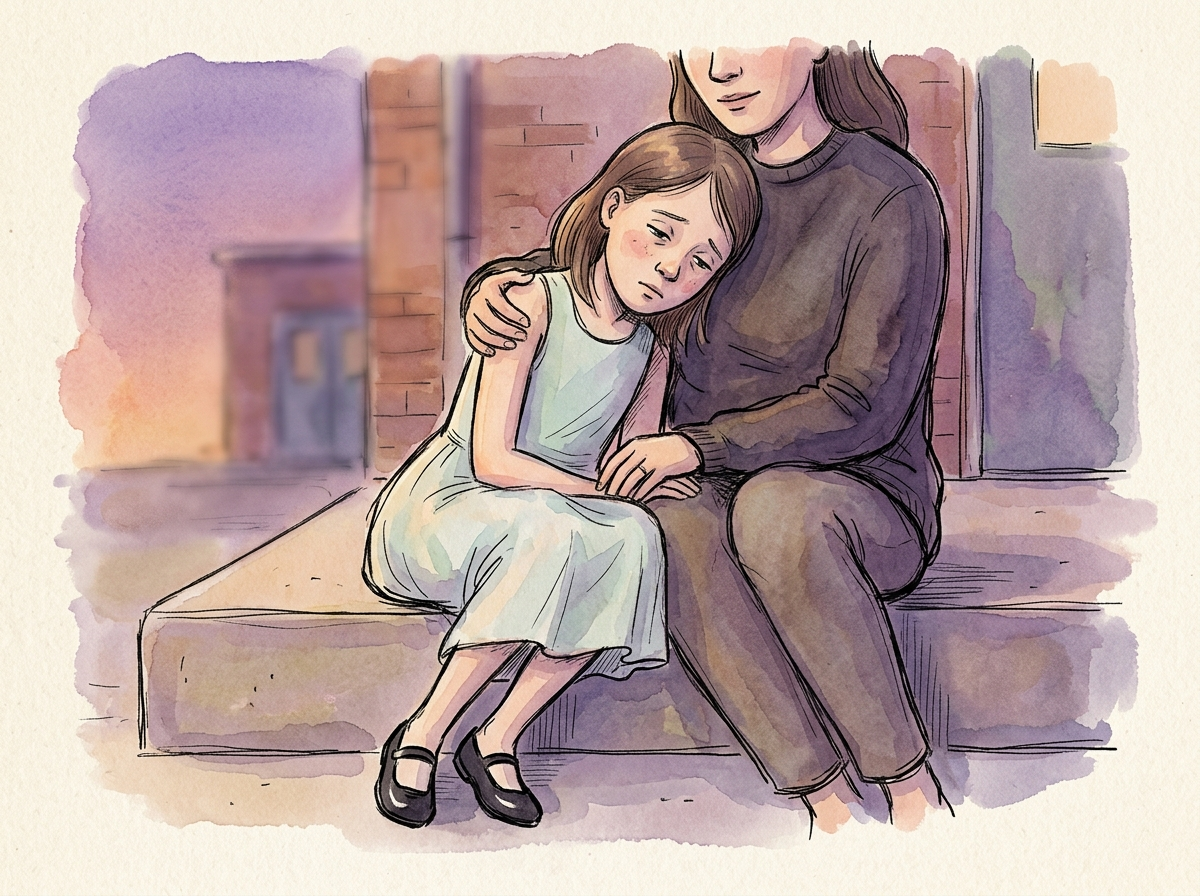
"Odette?" Mrs. Tanaka called after rehearsal, just as Odette was shoving her folder into her backpack. "Could you stay a minute?"
Odette's stomach dropped to somewhere around her knees.
Mrs. Tanaka sat at the piano, her reading glasses pushed up into her silver-streaked hair. She didn't look angry. She looked like someone about to say something careful.
"How long have you been mouthing the words?"
Odette opened her mouth. Closed it. Then said, very quietly, "Since October."
Mrs. Tanaka nodded slowly, like this was about what she'd expected. "Can I ask why?"
"Because I'm bad." Odette said it fast, like ripping off a bandage. "I can't — the notes don't — they go wrong. Every time."
Mrs. Tanaka tilted her head. "Would you sing something for me?"
"I really, really don't want to."
"I know," Mrs. Tanaka said. And then she just waited.
The auditorium was empty now. The last stragglers had banged through the double doors. The silence felt enormous, like standing at the edge of a swimming pool, knowing the water would be cold.
Odette sang the first line of "You Are My Sunshine."
It came out wobbly and thin, and on the word sunshine, her voice cracked upward and then plunged down, missing the melody by what felt like a mile.
She stopped. Her cheeks burned.
Mrs. Tanaka pressed a single key on the piano. A clear, round note floated into the air. "Can you match this?"
Odette tried. The sound that came out was… close? Maybe? She couldn't actually tell, which was part of the problem.
Mrs. Tanaka played another note. Then another. Each time, Odette tried to match it, and each time, she watched Mrs. Tanaka's face for a wince or a flinch. But Mrs. Tanaka just listened with her eyes slightly closed, the way she listened to everything — like sound was something she could see.
"Okay," Mrs. Tanaka said finally. "Here's what I think. You have a voice, Odette. It's in there. But right now, your ears and your voice aren't talking to each other very well. It's like — imagine you're trying to throw a ball into a basket, but you're wearing somebody else's glasses. You can see the basket, sort of, but the aim is off."
"So I'm tone-deaf," Odette said flatly.
"No. Tone-deaf means you can't hear the difference between notes at all. You can hear it — I watched your face just now. You knew when you were off. You just don't know how to steer yet." She smiled. "Would you be willing to work with me? Tuesdays and Thursdays, fifteen minutes before rehearsal?"
Odette thought about saying no. No was safe. No meant she could keep lip-syncing, keep hiding, keep being invisible in the second row.
"Okay," she said instead, surprising herself.
The first two weeks were brutal.
Mrs. Tanaka would play a note, and Odette would try to sing it, and they'd both sit there in the gap between where the note was and where Odette's voice went. Mrs. Tanaka never winced. She'd just say, "Higher… higher… little more… there. Right there. Did you feel that?"
And sometimes Odette did feel it — a tiny click, like a puzzle piece snapping into place, a moment where her voice and the piano were suddenly the same thing. But it would last half a second before sliding away again.
"It's like trying to balance on a tightrope," Odette groaned one Thursday, slumping in her chair.
"That's actually a perfect way to describe it," Mrs. Tanaka said. "Because nobody starts on a tightrope. They start on a line of tape on the floor."
She played two notes, just two, and asked Odette to go back and forth between them. Just those two. Over and over. It felt ridiculous. It felt like being asked to practice walking.
But by the end of that session, Odette could slide between those two notes and land on each one — not perfectly, not every time, but more often than not. She could feel them in her chest, like two different rooms she was stepping between.
"See?" Mrs. Tanaka said. "Your ears and your voice just had a conversation."
The weeks went on. Two notes became three, then five. Mrs. Tanaka brought in a little app on her tablet that showed a line on the screen — the target note — and a bouncing dot that tracked Odette's voice in real time. Odette could actually see herself going sharp or flat, watch the dot drift above or below the line.
"I'm a terrible pilot," she said, watching the dot zigzag.
"You're a learning pilot," Mrs. Tanaka corrected.
Odette started hearing things differently outside of their sessions, too. She'd be in the car with her mom, radio playing, and she'd catch herself tracking a melody, noticing when it moved up, when it moved down, how far it jumped. It was like someone had turned up the resolution on a blurry picture. Music had always been beautiful to her, but now she could see its shape.
In choir, she still lip-synced. She wasn't ready. Not yet.
Then came the day in late January when Mrs. Tanaka handed her the sheet music for the spring concert. The piece was called "Riverside," and it was the most beautiful song Odette had ever seen — a slow, winding melody that rose and fell like hills.
"I want you to learn the alto part," Mrs. Tanaka said.
"The alto part? That's a real part. People will hear me."
"That's generally how singing works, yes."
"Mrs. Tanaka."
"Odette." Mrs. Tanaka leaned forward. "You've been matching pitches accurately for three weeks now. Your range is actually lovely — you've got this warm, low tone that the alto section could really use. But I'm not going to force you. This is your choice."
Odette took the sheet music home. She practiced in her room with the door closed and a pillow pressed over her face, just in case. She used the app, watching the dot, steering it closer and closer to the line. Some days it was awful. Some days she wanted to shred the music into confetti. But some days — some days the dot held steady, and her voice felt like something she was driving instead of something that was happening to her.
She started singing the alto part quietly during rehearsal. Not full voice — just above a whisper, really. But actual sound. Actual notes.
Marcus didn't turn around.
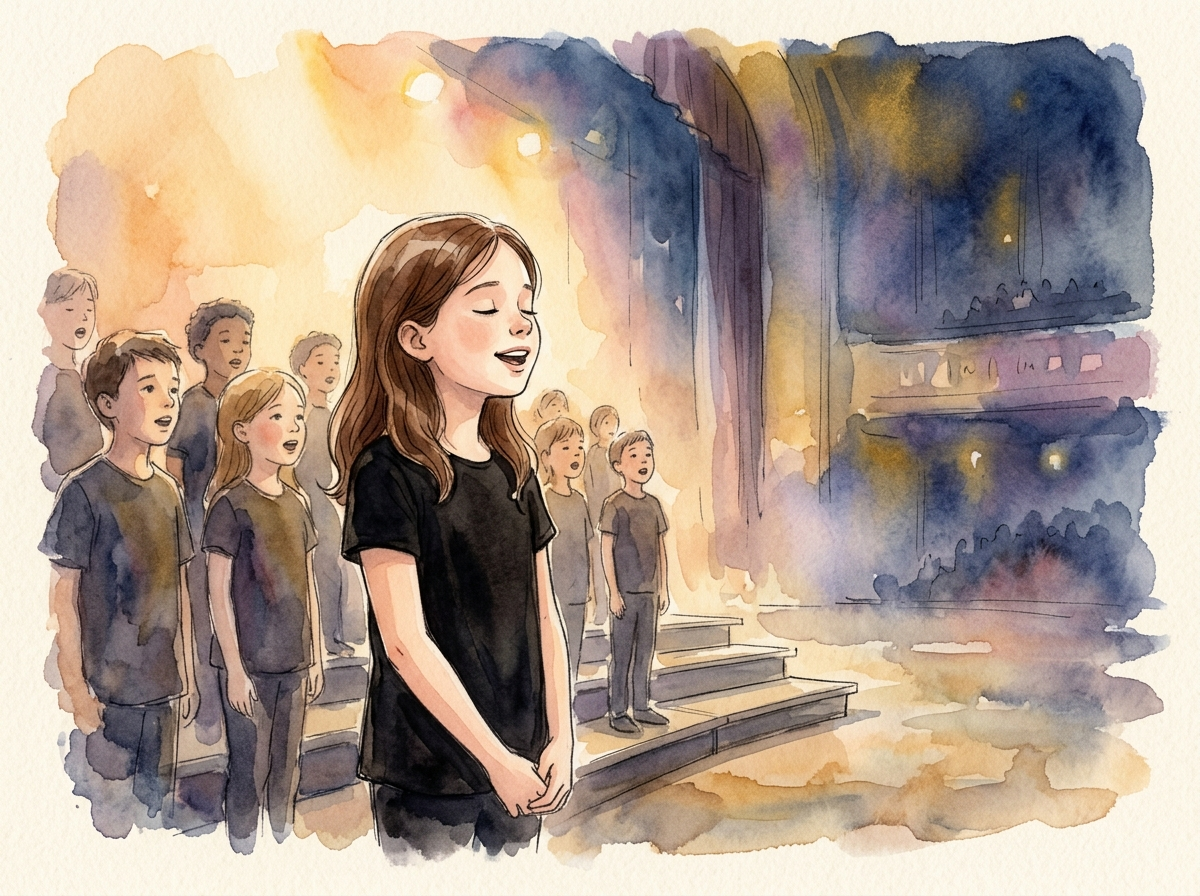
The spring concert was on a Friday night in April. The auditorium was packed. Odette stood in the second row, wearing the standard-issue black shirt, and her heart was hammering so hard she was sure Bea could hear it through her strawberry lip gloss.
The first three songs went fine. Odette sang — really sang — her voice tucked inside the alto section like a hand inside a glove. She wasn't the loudest. She wasn't the best. But she was there, and the notes were going where she aimed them, mostly, and when they slipped, she knew how to pull them back.
Then it was time for "Riverside."
Mrs. Tanaka raised her hands. The piano began. And the choir sang.
Odette felt the music build beneath her, all those voices weaving together, and she found her note — that warm, low note she'd practiced a hundred times — and she held it. The melody rose around her, the sopranos climbing high, and Odette's part moved in the opposite direction, steady and deep, anchoring the song the way the roots of a tree hold it against the wind.
For sixteen measures, she didn't think about pitch or dots on screens or whether she sounded right. She just sang. Her voice moved through the song the way water moves through a riverbed — finding its own path, easy and sure.
It wasn't perfect. On the second verse, she slipped on a note and felt the old panic spike. But she breathed, adjusted, found her way back. The music carried on. It was forgiving like that.
When the song ended, the audience clapped, and Odette clapped too, because her hands were shaking and she needed to do something with them. Her mom was in the third row, smiling so wide that Odette could see it even under the stage lights.
After the concert, Marcus turned to her as they filed off the risers.
"Hey," he said. "You actually sounded really good tonight."
"Thanks," Odette said.
She didn't need him to say it. She'd felt it — that click, that balance, that moment when her voice and the music were finally speaking the same language. She'd been carrying it inside her the whole time.
It had just taken a while to find its way out.